
Application of Micro-Raman in Analysis of Paper Samples
Introduction
As one of the four great inventions in ancient my country, papermaking has played an important role in promoting the process of world civilization. Paper cultural relics are the inheritance carrier of human civilization and promote the spread of knowledge. The protection and restoration of paper cultural relics is the key to the inheritance and research of historical culture. The use of modern instrument analysis technology to study ancient paper cultural relics and modern repair paper has a guiding role in understanding their production technology, preservation status, authenticity identification and formulating protection and restoration plans.
Most paper samples are precious and damaged. How to test and identify samples non-destructively and quickly has always been a major direction in paper sample research. Raman spectroscopy is a molecular spectrum analysis technology based on Raman scattering. It is non-destructive, fast and sensitive. It has been widely used in materials science, chemistry, biology and other fields. In recent years, with the development of paper manufacturing and With the continuous development of the field of cultural relics protection, Raman spectroscopy has gradually exerted its unique application value in paper analysis.
Application principle
Raman spectroscopy experiments generally use lasers as excitation light sources, irradiate the laser onto the sample, collect scattered spectral information, and obtain information such as the molecular structure and chemical composition of the sample through the analysis and processing of the spectral information. Raman spectroscopy, as a molecular fingerprint, has the advantages of non-destructive, micro-area, fast and simple, and is a powerful tool for the identification of material components.
Instrument introduction
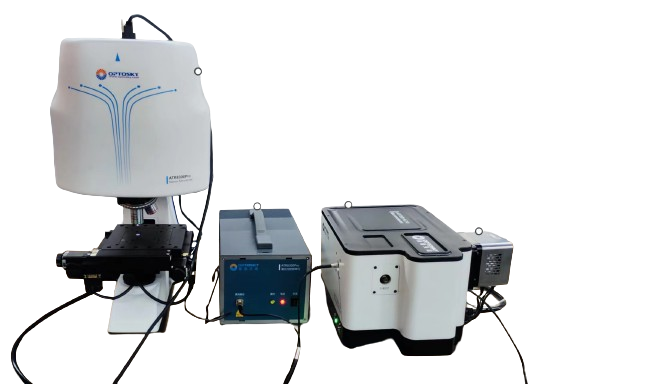
As the leader of domestic Raman products, Optosky's independently developed ATR8300 series combines the advantages of microscopes and Raman spectrometers. The micro-Raman detection platform makes it possible to "what you see is what you measure". The observer can detect the Raman signals of different surface states on the sample, and can simultaneously display the micro-area morphology of the detected position on the computer, which is greatly convenient. Raman micro-area detection.
ATR8300 is equipped with an objective lens specially designed for the Raman system, which makes the laser spot close to the diffraction limit. The focus information is accurately and intuitively displayed on the computer through a 5-megapixel camera, overcoming the slightly higher focal plane of ordinary Raman systems for collecting Raman signals. is smaller than or slightly below the actual optimal focal plane, thereby improving the quality of the Raman spectrum.
ATR8300 has no moving parts for optical path switching. All optical components are solid-state assembly and work very stably. It perfectly solves the loss of light path during camera imaging and realizes the separation of camera imaging and Raman signal collection, thereby obtaining the best signal strength.
Practical application cases
Case 1: Detecting authentic and fake certificates
Microscope picture of sample A:
Whiteboard
Sign
C sample micrograph:
Whiteboard
Sign
Microscopic Raman spectra of samples with different certificates:
Whiteboard Raman spectrum
Signature Raman Spectrum
The ATR8300 microscopic picture can clearly distinguish the difference between AC samples. The white plate part has Raman peaks at 281cm-1 and 1083cm-1. Compared with the white plate and signature part of AB sample, the fluorescence of C sample is more serious. ATR8300 can clearly distinguish between genuine and fake certificates.
Case 2: Detecting different inks on paper samples
Microscopic Raman spectra of paper samples and different ink samples:
red ink
yellow ink
small white paper
Case 3: Detecting banknote ink
Microscopic Raman spectrum of Euro ink:
Euro bridge tunnel part
The application of micro-Raman spectroscopy in paper analysis has the following advantages:
Non-destructive: Raman spectroscopy is a non-invasive analysis method that will not cause damage to samples and is suitable for the detection and protection of precious samples;
High sensitivity: small changes in the sample can be detected, and the sensitivity is much higher than traditional chemical analysis methods;
Rapidity: The experimental operation is simple, and the sample detection and analysis can be completed in a short time;
Reliability: The results obtained have high reproducibility and reliability, which can provide a strong basis for the analysis of paper samples;
Intuitiveness: The observer can detect the Raman signals of different surface states on the sample, and can simultaneously display the micro-area morphology at the detected location on the computer, which greatly facilitates Raman micro-area detection.
Raman spectroscopy technology has important application value and prospects in the analysis of paper samples. It is expected to provide more reliable and efficient technical support for the analysis of paper samples and promote cultural inheritance and development.
Application of Raman Spectroscopy in Gemological Research
ATR8800 rapid test for respiratory diseases with high incidence in winter
Related Article