qr Code Url

Scan qrcode to view mobile website

    OPTOSKY /NEWS /FTIR Blog /FTIR Analysis Of Marine Plastic Litter And Debris /

    FTIR Analysis Of Marine Plastic Litter And Debris
    2024-02-06
    substrate
    It’s no secret that plastic trash and debris are often found on beaches. How to identify these? FTIR is an important tool for identifying contaminants in the environment. It is widely used to determine the type of polymers or identify microplastics.
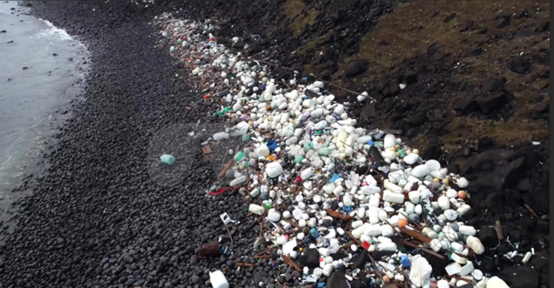
    People sometimes vacation at the seaside or on TV you can see plastic waste polluting the entire coastline and beaches. In some popular tourist destinations, cleanup crews are busy dealing with this plastic waste; in some more remote areas, such as the Arctic, there is no one to deal with this waste.

    So how does plastic waste accumulate on beaches around the world? According to analysis, local garbage and long-distance transportation are considered to be the two main causes of this pollution, but this conclusion lacks support from empirical data. To fill this gap, researchers are getting creative and starting recruiting "citizen scientists" on cruise ships.
    These citizen scientists were tasked with picking up trash that washed ashore in a remote area near the Norwegian island of Spitsbergen. The collected rubbish was then tested for composition and origin by researchers at the Alfred Wegener Institute (AWI).
    To obtain information about the source of a material, these researchers only need to find the relevant label or imprint. But to determine the chemical composition, precise testing is necessary. What tools to use? FTIR spectrometer has become the first measurement tool with its convenient, accurate and fast detection characteristics!
    Application of FTIR in Coastal Plastic Waste Analysis
    In this study, AWI researchers used an Optosky ATP8900Plus spectrometer to determine the type of these polymers through the attenuated total reflectance (ATR) method. In contrast, other methods (e.g., gas chromatography, etc.) also provide reliable detection results. However, the obvious advantage of FTIR spectrometer is that there is no need to prepare samples during the analysis process and the polymer type can be quickly identified. In addition, ATP8900Plus is easy and intuitive to operate.
    Let’s be honest: anyone can use it and test it. Although the science and technology behind this device is quite complex and requires years of experience to fully understand, its detection operation is very simple!
     
    Research result
     
    The study identified 15 different polymer types. The majority of the waste (61%) is polyethylene (PE), followed by (31%) polypropylene (PP). Other types of polymers account for a small share, for example, polyurethane (0.4%).
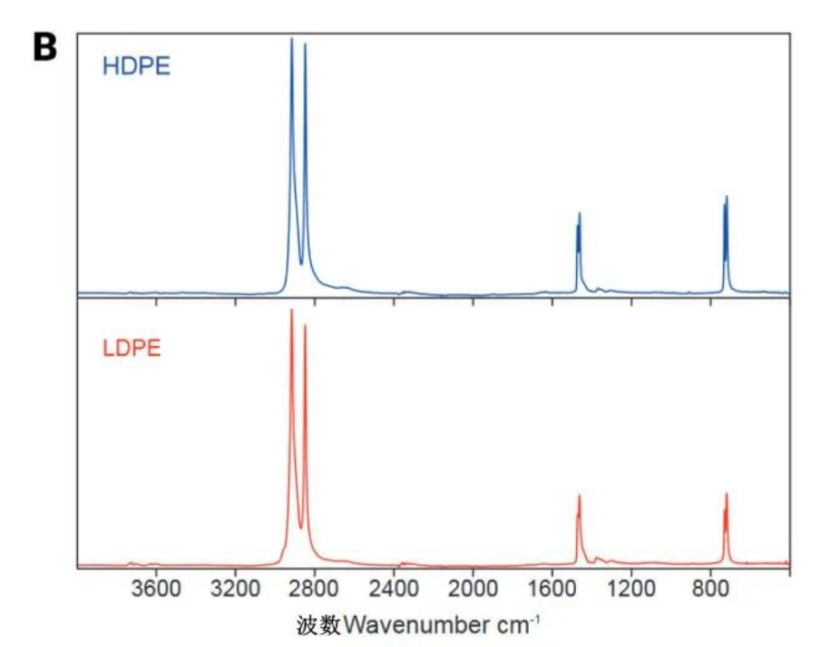
    To derive the most accurate characterization possible, the researchers also determined whether the polyethylene waste was composed of high-density polyethylene (HDPE) or low-density polyethylene (LDPE). HDPE and LDPE have the same chemical structure. Therefore, it is difficult to distinguish between the two, but with the help of Bruker's OPUS software, this problem is easily solved.
    The figure below (A) shows that as the crystallinity of the sample increases, the absorbance intensity at 730cm-1 increases. Crystallinity and density are related, so samples with higher peaks (blue) can be identified as HDPE. The red sample with smaller peak was identified as LDPE.
     
    Comparison of spectra of high-density (blue) and low-density (red) polyethylene

    For samples from the Arctic, researchers measured that among PE waste, HDPE waste accounted for 50% and LDPE waste accounted for 11%. This result is not unexpected as HDPE is more durable than LDPE.

    In the analysis of plastic waste, FTIR spectrometers can help researchers extract rich chemical and physical information from polymer spectra. The device can be used for both the identification and characterization of polymer samples. By using the ATP8900Plus spectrometer, routine qualitative and quantitative analysis of various polymer materials can be easily performed. Untrained users can successfully use the system with just a few minutes of learning through guided workflow software.


    Share:

    FT-IR Microinfrared Spectroscopy To Detect Particles And Impurities In Liquid Drugs

    Principles and Applications of ATR

    Related Article
    image
    This article mainly describes the application of fluorescence spectrometer in the development of organic room temperature phosphorescent materials.
    Fluorescence Spectrometer Develops Organic Room-Temperature Phosphorescent Materials
    2024-11-01
    image
    This article highlights the advantages of near-infrared (NIR) spectroscopy for real-time moisture analysis, focusing on its non-destructive nature and precision. It features a case study on silica granulates in the rubber industry, showcasing how accurate moisture measurements can enhance quality and efficiency. The piece encourages businesses across various sectors to leverage NIR technology for better decision-making and operational improvements.
    NIR Spectroscopy for Measuring Moisture in Granulates
    2024-10-24
    image
    Unlock the potential of Near-Infrared (NIR) spectroscopy for monitoring epoxy resin curing. This non-destructive method provides real-time, precise insights, enhancing product quality in manufacturing and 3D printing. Discover more in our application note!
    Quantitative Evaluation of Epoxy Resin Using NIR
    2024-10-24
    image
    This article primarily describes the application of the QuantaMaster 800 in the research of smart luminescent materials.
    Application Plan | Application of Raman Spectrometer on Fluorescent Materials
    2024-10-21


    Whatsapp :15345924185

    EMAIL: sales@optosky.net

    ADDRESS: No. 7, Tianjing International Intelligent Industrial Park, Tianxin District, Changsha City, Hunan Province, China

    Home
    Products

    About

    Contact

    Download

    SiteMap

    Powered by Optosky

    Optosky©2024

    (135891)
    0
    Service

    WhatsApp
    15345924185
    Wechat
    15345924185
    Phone
    +86-15345924185
    Email
    sales@optosky.net
    Inquiry
    Inquiry
    Top