qr Code Url

Scan qrcode to view mobile website

    OPTOSKY /NEWS /FTIR Blog /Principles and Applications of ATR /

    Principles and Applications of ATR
    2024-01-10
    Principles and Applications of ATR
    The full name of ATR is Attenuated Total Reflectance, which can be used for the analysis and identification of liquids, pastes, powders, films and solids. Attenuated Total Reflectance technology does not require any processing of the sample during the test process and will not cause damage to the sample. It overcomes the shortcomings of traditional transmission method testing, simplifies the sample production and processing process, and greatly expands the application range of infrared spectroscopy. , this technology is currently widely used in various fields.
    Basic principles of ATR
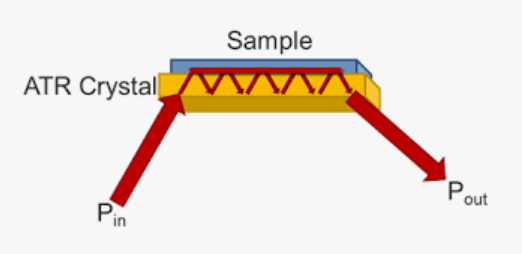
    When a beam of monochromatic light is incident from one optical medium 1 into another optical medium 2 at an incident angle θ, the light will be reflected and refracted at the interface of the two optical media. When the refractive index n1 of medium 1 is greater than the refractive index n2 of medium 2, and the incident angle θ is greater than the critical angle θc (sinθc= n2/n1), total reflection will occur. When total reflection occurs, an attenuated reflected wave is generated at the inflection point of light, as shown in Figure 1. The distance when the amplitude of the attenuated reflected wave attenuates to 1/e of the original amplitude is called penetration depth (Dp). The depth of the penetrating wave is determined by the wavelength λ of the incident wave, the refractive index n1 of the crystal, the refractive index n2 of the sample, and the incident angle θ of light in the crystal. Dp is calculated as formula (1):
    Dp = λ / 2πn1[sin2θ-(n2/n1)2]1/2   (1)
    Figure 1
    Attenuated total reflection ATR uses this technology to obtain the infrared spectrum of the sample. As shown in Figure 1, light undergoes total reflection on the ATR surface, and the reflected wave is attenuated according to the refractive index of the sample to a certain penetration depth. If the sample absorbs the incident light in the frequency region, the reflected light intensity will be at the frequency position where the sample absorbs It is weakened and can produce a spectrum similar to ordinary transmission and absorption, so it can be used for qualitative and quantitative analysis of chemical composition.
    Relevant properties of ATR crystals
    In the experiment, we need to select the ATR crystal according to actual needs. The main factors to consider are refractive index, critical angle, incident angle, penetration depth, applicable spectral range, number of reflections, effective optical path, crystal acid and alkali resistance, crystal hardness, etc.
    The refractive index of common organic compounds is around 1.5, and the refractive index of the ATR crystal is required to be greater than 1.5. Common ATR crystal materials include diamond (2.4), ZnSe (2.4), Ge (4.0), Si (3.4), KRS-5 (2.37), and AMTIR (2.5).
    According to the critical angle calculation formula sinθc= n2/n1, we can get the critical angles of various crystals. Assuming the refractive index of the sample is 1.5, the critical angles of ATR crystals are as follows: diamond (38o), ZnSe (38o), Ge (22o), Si (26o), KRS-5 (39o), AMTIR (37o).
    According to the penetration depth Dp = λ / 2πn1[sin2θ-(n2/n1)2]1/2, it can be seen that the greater the refractive index of the crystal, the shallower the penetration depth. The higher the refractive index of the sample, the deeper the penetration depth; the larger the incident angle θ, the shallower the penetration depth; the shorter the wavelength of light, the shallower the penetration depth (Figure 2). It can be seen that the infrared spectrum measured using the ATR accessory has different penetration depths at high wavenumbers and low wavenumbers. The peak intensity of the low wave number absorption peak is stronger than the peak intensity of the high wave number absorption peak. In order to compare with the ordinary transmission infrared spectrum, the spectrum measured by the ATR accessory needs to be corrected. Taking 1000 cm-1 as the benchmark, the correction formula is:
    ATR = AB * ν[cm-1] / 1000 [cm-1]   (2)
    Figure 2
    The number of reflections is related to the length l and thickness t of the ATR crystal and the incident angle θ (as shown in Figure 3). The calculation formula for the number of reflections is: N = l / 2t*tanθ. Then the effective optical path de = N* Dp.
    Figure 3
    Diamond has the highest hardness and is resistant to acid, alkali and chemical corrosion. It is widely used, but it has strong absorption in the 1800-2300 cm-1 band. Samples with absorption in this area need to be avoided; the applicable spectral range of ZnSe crystal is 20000 -650 cm-1, which meets the test of most samples, but it is not acid and alkali resistant, has low hardness, and is prone to scratches. The measurement spectrum range of Ge crystal is narrow, but its refractive index is high, and it can be used to measure high refractive index samples; KRS-5 has the widest spectrum measurement range, but it has the lowest hardness and is not corrosion-resistant, so it is rarely used.
    The relevant parameters of ATR crystals in the literature are shown in the following table:
    Issues that need to be paid attention to when using ATR
    (1)ATR cleaning
    Before infrared spectrum sampling, the background spectrum needs to be collected first. To ensure that the ATR crystal surface is clean and not contaminated, the ATR crystal needs to be cleaned. Often use a soft cloth or cotton ball using solvents such as water, ethanol, acetone, etc. to wipe the surface of the ATR crystal.
    (2)ATR sample preparation
    ATR is suitable for testing solid and liquid samples. When measuring a solid sample, the solid sample needs to be in close contact with the ATR crystal. Therefore, the indenter of the ATR accessory needs to be used to press the sample against the surface of the ATR crystal so that the attenuated reflected wave can penetrate into the sample. When testing liquid samples, for samples that can be coated on the ATR crystal to form a liquid layer, they can be tested directly after being applied. For volatile samples with low boiling points, an ATR accessory with a liquid cell is required.
    (3) ATR crystal maintenance
    Different ATR crystals have different degrees of hardness, acid resistance, alkali resistance and chemical corrosion resistance. When using them, you should first understand their properties to prevent scratches, corrosion or even cracks, which will affect the quality of the spectrum or fail to obtain effective spectra.
    Introduction to ATR attachment types
    There are many types of ATR accessories according to user needs. The most common ATR accessories are single total reflection and multiple total reflection.
    Figure 4
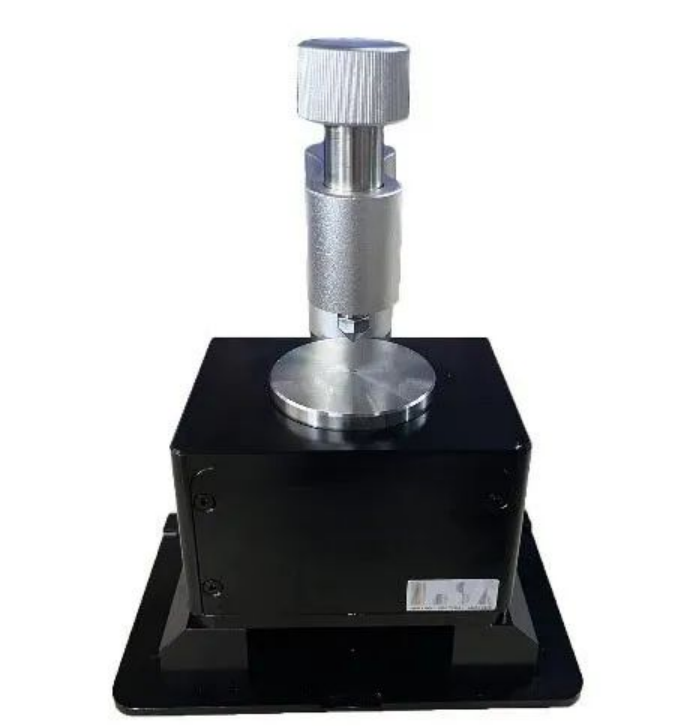
    The principle of single reflection is shown in Figure 1 above. The single total reflection ATR accessories of Optosky ATP8900plus series are available in pure diamond, Ge, and ZnSe. As shown in Figure 4, the upper surface of the ATR crystal is parallel to the stainless steel sample plate, and the bottom end is physically supported to make the sample easy to clean. Optosky ATP8900plus series is equipped with pure diamond ATR accessories, which can meet most usage scenarios. This accessory also provides a heated ATR module, which can control the temperature range from room temperature to above 120°C.
    In addition, Optosky independently designed ATR accessories suitable for laboratory desktop Fourier transform infrared spectrometers, as shown in Figure 5. It can match Optosky ATP8900plus series, ATP8900Pro Fourier transform infrared spectrometer, and ATP8900AD vacuum Fourier transform infrared spectrometer.

    Figure 5

    In addition to the commonly used ATR accessories mentioned above, there are also some special ATR accessories. Such as high-pressure diamond ATR for high-pressure testing (left in Figure 6), single or multiple reflection ATR accessories with variable incident angles (middle and right in Figure 6), high-temperature and high-pressure ATR accessories, and low-temperature ATR accessories.

    Figure 6

    The fiber-coupled ATR probe (Figure 7) accessory is an accessory often used in the study of chemical reaction processes and reaction mechanisms in recent years. This accessory is inserted into a container such as a reaction kettle, and can monitor the concentration changes of reactants and products in real time. Diamond crystals can withstand high temperatures and high pressures and are suitable for studying reaction processes under extreme conditions.
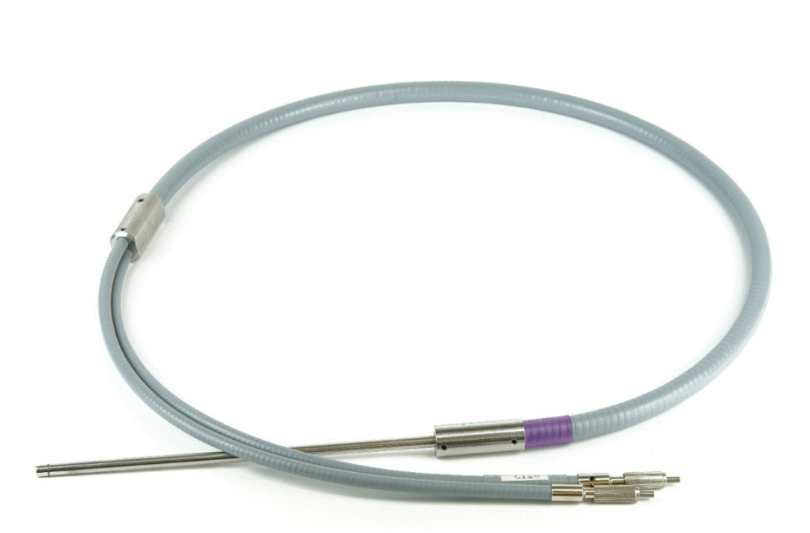
    Figure 7

    ATR Applications

    (1) Detection and characterization of unknown compounds. The ATR test method is simple and the test results are fast. It is widely used in laboratory organic compound characterization and detection, drug identification, mixture detection, etc.

    (2) Study on reaction kinetics. The advantage of ATR is that it can be measured in situ and tracked in real time, which is beneficial to the study of reaction kinetics and reaction mechanisms of some compounds, such as the study of isobutylene polymerization reaction kinetics in polymerization reactions, online monitoring of fermentation processes, and light-induced heterogeneous oxidation. reaction etc.

    (3) Interface research. ATR mainly obtains the spectral information of the surface of the sample, so it is very conducive to the study of interfaces. Such as surfactant adsorption, organic coating, metal surface reaction, etc.

    (4) Research on polymer materials. For traditional transmission methods, polymer materials are difficult to prepare and have poor permeability. However, ATR does not have such problems. Therefore, it has been widely used in structural analysis of polymer materials such as plastics, fibers, rubber, coatings, and adhesives. application.

    (5) Quality inspection and control. ATR sample preparation is simple, easy to operate, and fast to test, making it an important tool and method for analysis and detection in the field of industrial production. Such as SBS quantification in modified asphalt, urea quantification in diesel engines, fatty acid methyl ester (FAME) quantification in diesel, non-destructive testing of textile fibers, leather material analysis, tar and nicotine content determination in cigarettes, ethylene content determination in polypropylene, Quantitative analysis of pharmaceutical ingredients, wine quality control, essential oil classification, etc.

    Keywords

    infrared spectrometer;fourier transform infrared;diffuse reflection;specular reflection;ir spectrum;


    Share:

    FTIR Analysis Of Marine Plastic Litter And Debris

    Basic Principles and Applications of Infrared Transmission

    Related Article
    image
    This article mainly describes the application of fluorescence spectrometer in the development of organic room temperature phosphorescent materials.
    Fluorescence Spectrometer Develops Organic Room-Temperature Phosphorescent Materials
    2024-11-01
    image
    This article highlights the advantages of near-infrared (NIR) spectroscopy for real-time moisture analysis, focusing on its non-destructive nature and precision. It features a case study on silica granulates in the rubber industry, showcasing how accurate moisture measurements can enhance quality and efficiency. The piece encourages businesses across various sectors to leverage NIR technology for better decision-making and operational improvements.
    NIR Spectroscopy for Measuring Moisture in Granulates
    2024-10-24
    image
    Unlock the potential of Near-Infrared (NIR) spectroscopy for monitoring epoxy resin curing. This non-destructive method provides real-time, precise insights, enhancing product quality in manufacturing and 3D printing. Discover more in our application note!
    Quantitative Evaluation of Epoxy Resin Using NIR
    2024-10-24
    image
    This article primarily describes the application of the QuantaMaster 800 in the research of smart luminescent materials.
    Application Plan | Application of Raman Spectrometer on Fluorescent Materials
    2024-10-21


    Whatsapp :15345924185

    EMAIL: sales@optosky.net

    ADDRESS: No. 7, Tianjing International Intelligent Industrial Park, Tianxin District, Changsha City, Hunan Province, China

    Home
    Products

    About

    Contact

    Download

    SiteMap

    Powered by Optosky

    Optosky©2024

    (135891)
    0
    Service

    WhatsApp
    15345924185
    Wechat
    15345924185
    Phone
    +86-15345924185
    Email
    sales@optosky.net
    Inquiry
    Inquiry
    Top