
[Spectral knowledge] What is the difference between multispectral and hyperspectral?
author: cily
2022-04-26
As an important means of natural science analysis, spectral analysis is often used to detect the physical structure, chemical composition and other indicators of objects. Image spectrum measurement is a combination of spectral technology and imaging technology. It combines spectral resolution and graphic resolution to create surface spectral analysis in the spatial dimension, which is the current multispectral imaging and hyperspectral imaging technology.
Multispectral and hyperspectral are spectral imaging types with similar technologies, and their application directions are also very similar, so many people can't tell which is hyperspectral? Which is multispectral?
So what is the difference between multispectral and hyperspectral?
1. The number of bands is different
Multispectral images usually refer to 3 to 10 bands; hyperspectral images may have hundreds or thousands of bands.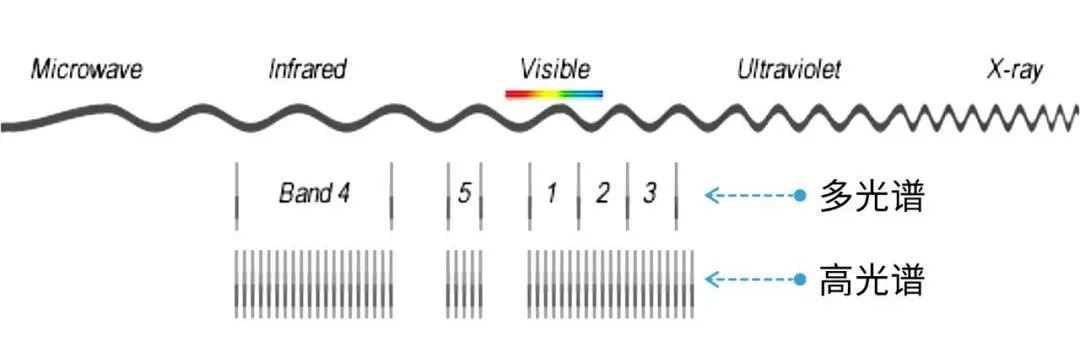
2. Spectral resolution difference
The spectral resolution of multispectral is poor, and due to the wide band, the number that can be captured is relatively small; while hyperspectral is composed of narrower bands (10-20 nm), has higher spectral resolution, and can detect objects Spectral special effects can provide more intangible data.
3. The difference in the amount of information
The low information content of multispectral images is one of the main reasons hindering its sustainable development. Hyperspectral images are rich in information and have a large space for application development.
4. Different levels of complexity
Due to the limited number of bands, multispectral is less complex and easier to understand and apply, while hyperspectral requires more work to process.
5. Different image features
Hyperspectral can present hundreds of points in each band, and more details can be observed, while multispectral cannot be achieved.
6. Camera differences
Hyperspectral cameras can measure various wavelengths, covering parts of the infrared and ultraviolet regions, while multispectral can only separate specific wavelengths.
7. The cost is different
Multispectral only needs to collect a few spectral bands, the technology is not complicated, and the purchase and maintenance costs are low, while the technical characteristics of hyperspectral require better and more technologies to support, and the cost is relatively high.
8. Pixel compositing differences
Multispectral is a discrete sample spectrum, each pixel may have 4 to 20 data points, and each pixel of hyperspectrum is a continuous or complete spectrum.
9. Treated differently
Multispectral deals with limited images, while hyperspectral deals with spectra and images, capable of presenting more dimensions.
Multispectral and hyperspectral are spectral imaging types with similar technologies, and their application directions are also very similar, so many people can't tell which is hyperspectral? Which is multispectral?
So what is the difference between multispectral and hyperspectral?
1. The number of bands is different
Multispectral images usually refer to 3 to 10 bands; hyperspectral images may have hundreds or thousands of bands.
2. Spectral resolution difference
The spectral resolution of multispectral is poor, and due to the wide band, the number that can be captured is relatively small; while hyperspectral is composed of narrower bands (10-20 nm), has higher spectral resolution, and can detect objects Spectral special effects can provide more intangible data.
3. The difference in the amount of information
The low information content of multispectral images is one of the main reasons hindering its sustainable development. Hyperspectral images are rich in information and have a large space for application development.
4. Different levels of complexity
Due to the limited number of bands, multispectral is less complex and easier to understand and apply, while hyperspectral requires more work to process.
5. Different image features
Hyperspectral can present hundreds of points in each band, and more details can be observed, while multispectral cannot be achieved.
6. Camera differences
Hyperspectral cameras can measure various wavelengths, covering parts of the infrared and ultraviolet regions, while multispectral can only separate specific wavelengths.
7. The cost is different
Multispectral only needs to collect a few spectral bands, the technology is not complicated, and the purchase and maintenance costs are low, while the technical characteristics of hyperspectral require better and more technologies to support, and the cost is relatively high.
8. Pixel compositing differences
Multispectral is a discrete sample spectrum, each pixel may have 4 to 20 data points, and each pixel of hyperspectrum is a continuous or complete spectrum.
9. Treated differently
Multispectral deals with limited images, while hyperspectral deals with spectra and images, capable of presenting more dimensions.
Global Conference | ATR8800 Confocal Raman Spectroscopy Imager
Raman Spectroscopy Analysis of Common Beverage Plastic Bottle Caps
Related Article

Visit Optosky at Analytica China 2026, Nov 16-18 in Shanghai. Explore Raman, FTIR, UV-Vis and infrared spectrometers at Hall E7, Booth 7106.
Sneak Peek: Meet Optosky at Analytica China 2026
Meet Optosky partner Thunder Optics at Gemworld Munich 2026, Booth A2.440, 22–25 Oct. See spectroscopy solutions for fast, non-destructive gemstone identification.
Meet Our Partner Thunder Optics at Gemworld Munich 2026 – Booth A2.440
Optosky’s exclusive Iranian distributor Petro Kimiyagar Badie showcased Optosky’s Raman spectrometer product line at Iran Pharma 2026, completing 70 customer meetings over three days. The exhibition highlighted Raman spectroscopy’s growing role in rapid, non-destructive pharmaceutical raw material identification, counterfeit drug detection, and quality control across Iran’s pharmaceutical market.
Optosky’s Iranian Distributor Petro Kimiyagar Badie Showcases Raman Solutions at Iran Pharma 2026
Optosky joined the 1st Malaysia Near Infrared Spectroscopy Meeting (MNIRSM 2026) at USM Penang as principal sponsor, showcasing hyperspectral imaging and AI-enabled spectroscopy solutions for Southeast Asia's research community.
Optosky Participates in the 1st Malaysia Near Infrared Spectroscopy Meeting (MNIRSM 2026)