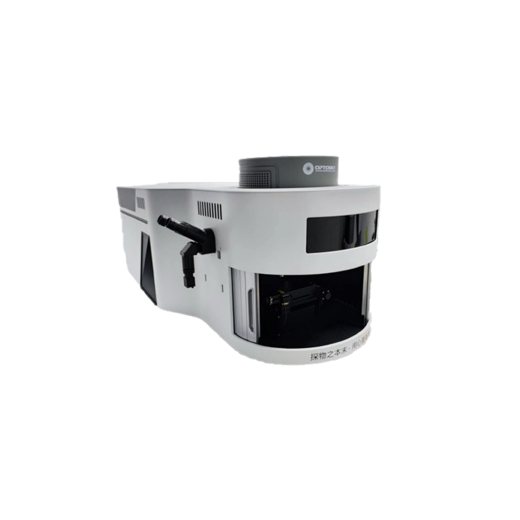
Applications | ATR3100 Portable Raman On-Site Identification
Imagine you are a market regulator inspecting pork at a wholesale market. You suspect a piece of meat has a problem—but the problem is, you cannot haul the entire stall back to the laboratory.
The traditional workflow is: sample, seal the bag, send the sample, pretreat, run the instrument, wait for the report. The whole process takes several hours or even a day or two. By then, the stall has long closed and the meat has long been sold. Is there a way to turn a spectrometer into a 5 kg box, carry it to the scene, place the probe on the sample, and know what it is within seconds? This is what portable Raman spectrometers have been doing in recent years. This article uses Optosky’s ATR3100 scientific-grade portable Raman as an example to clarify three things: what problem it actually solves, how it achieves portability, and—most importantly—what it can and cannot do on site.
01 The Dilemma of On-Site Rapid Testing: Labs Are Too Slow, Test Strips Are Too Coarse
At one end are precise laboratory instruments. GC-MS, LC-MS/MS, and FTIR are accurate for qualitative analysis and stable for quantitative analysis, but they are "fixed assets"—they require anti-vibration tables, stabilized power supplies, air-conditioned rooms, and professional operators. Samples require pretreatment, and reports require waiting. They are referees, but not sentinels.
At the other end are test strips and kits. Colloidal gold and ELISA rapid test cards cost a dozen yuan each; you drip the sample on and wait ten minutes for a result. But they can only test one target at a time, the false positive rate is not low, and positive results still need to be sent to a laboratory for confirmation. They are sentinels, but not referees.
What is missing in the middle is a device that can produce molecular-level evidence on site without building a laboratory. It does not need to replace the gold standard, but it must answer at the first opportunity: "What is this roughly, is there a problem, and should it be sent for further testing?" Portable Raman spectrometers are aimed at this gap.
02 Raman Spectroscopy: Taking a "Molecular Fingerprint" of Every Substance
Let us clarify the principle in one sentence. When a monochromatic laser beam hits a sample, the vast majority of photons bounce back unchanged. A very small number of photons "exchange" a little energy with the chemical bonds of the molecule, causing a slight frequency shift in the scattered light—this is Raman scattering. Different molecules have different chemical bond structures, so the position and intensity of the shift differ. Plotted as a spectrum, it becomes the unique fingerprint of that molecule.
The significance for on-site testing is very direct:
• Almost no pretreatment required. Glass, plastic, and water have weak Raman signals. Samples can be measured directly through packaging bags and glass bottles—no extraction, no staining, no sample destruction.
• One scan captures the full spectrum. Unlike test strips, which require one reaction per substance, a single spectrum contains fingerprints of multiple components simultaneously.
• Non-destructive. A laser exposure does not destroy the sample; it can still be used afterward.
• Fast. From hundreds of milliseconds to tens of seconds, depending on signal strength.
You can think of it as equipping the field with a "molecular-level barcode scanner."
03 Putting the Laboratory into a Suitcase: Key Design Choices for Portability
The Raman principle is not new. The real challenge is compressing a laboratory spectrometer into 5 kg while still operating outdoors from -25°C to 50°C. Several design choices of the ATR3100 deserve separate mention.
First, a cooled CCD detector. Without cooling, the detector's own thermal noise would drown out weak signals. The ATR3100 uses a TEC-cooled CCD, with the standard model cooled to -15°C and the higher-configuration DC model cooled to -70°C. Integration time can be as long as 1 hour. This means that even very weak signals can be "accumulated" by extending exposure.
Second, multiple selectable excitation wavelengths. This is often overlooked by non-specialists but is extremely important on site:
• 785 nm is general-purpose and works for most samples;
• 1064 nm is suitable for dark, colored, and highly fluorescent samples (such as plastic blocks and traditional Chinese medicinal materials), with low fluorescence interference;
• 830 nm penetrates biological tissue better;
• 532 nm is suitable for graphene, carbon materials, and SERS;
• 266 nm UV excitation is suitable for resonance Raman.
Different samples require different wavelengths—this is part of on-site experience.
Third, 600 mW narrow-linewidth laser + high numerical aperture probe. Laser power stability σ/μ is better than ±0.2%, linewidth is 0.08 nm, equipped with OD>8 blocking filters, and working distance is 6 mm—the gun-style probe can simply be pointed at the sample without complex focusing.
Fourth, the TP version has a built-in Android system, 6-inch touchscreen, and lithium battery with over 5 hours of runtime. It can be used without a computer: power on, point at the sample, view the spectrum, and compare against the library—one person can complete the work on site.
Fifth, temperature stability. Within 5–40°C, wavenumber drift is ≤1 cm⁻¹, and peak intensity variation is less than ±5%. This means spectra measured in a summer vegetable market and a winter warehouse are comparable.
The parameters themselves are not magical. What is magical is that these parameters are simultaneously packed into a 340 × 165 × 240 mm, 5.1 kg box.
04 A Look at Several Real Samples Actually Measured
A pile of parameters is less convincing than seeing what it has actually measured.
Pork tissue—785 nm, 500 mW, 60 s. With the probe placed directly on fresh pork, three characteristic peaks can be clearly measured: 1330 cm⁻¹ (protein C-H deformation), 1440 cm⁻¹ (fat C-H bending), and 1650 cm⁻¹ (protein amide I band). This means the spectrum can distinguish the relative proportion of fat and protein in the sample, further judging meat freshness and even identifying adulteration. Note: this is direct measurement with no pretreatment.
Banknote ink—785 nm, 30 mW, integration time 0.01–0.1 s. Shining the laser on the yellow ink of a euro banknote yields a set of characteristic peaks at 1242, 1328, 1364, 1446, 1517, and 1636 cm⁻¹ in just over ten milliseconds. This can be used directly in forensic identification, anti-counterfeiting, and security material research—no need to take the banknote back; you know on site whether the ink is correct.
Gray plastic block—1064 nm, 150 mW, 30 s. Under visible light excitation, the gray plastic has a heavy fluorescence background. After switching to 1064 nm, fluorescence is suppressed. Randomly taking 30 points on the same sample gives good spectral consistency. This is very useful for industrial incoming material inspection and recycled plastic sorting.
Synthetic diamond—532 nm, 100 mW, 200 ms. The 1332 cm⁻¹ diamond characteristic peak, the NV⁰ peak near 1420 cm⁻¹, and the NV⁻ peak near 3100 cm⁻¹ can be clearly seen. Peak symmetry can indicate internal stress and defects in the crystal, and NV center intensity can infer synthesis process and nitrogen doping levels. Useful for jewelry identification and quantum material quality control.
Gastrodia powder—1064 nm, 399 mW, 50 s. Traditional Chinese medicine powders have heavy fluorescence. Using 1064 nm is almost free of interference and can obtain clear characteristic peaks. This has direct value in authenticity identification and origin tracing of traditional Chinese medicinal materials—on-site preliminary judgment of whether this batch of Gastrodia is correct.
Calcium oxide/calcium carbonate mixture—785 nm, 400 mW, 2 s. Using the intensity ratio of the 1084 cm⁻¹ (calcium carbonate) and 280 cm⁻¹ (calcium oxide) peaks for linear fitting, the correlation coefficient R² > 0.98. Results in two seconds, suitable for rapid on-site quantification in the cement and building materials industries.
Looking at these cases together, a common point emerges: they are not "extreme trace detection," but "rapid on-site qualitative/semi-quantitative identification." The role of portable Raman on site is not to take over LC-MS's job, but to answer at the first opportunity: "What is this, is it roughly correct, and should it be sent for further testing?"
05 Which Scenarios Are Truly Suitable for It?
Matching the ATR3100's capabilities against real needs, there are roughly four categories of scenarios where it fits best.
Category 1: Market supervision and on-site inspection. Agricultural wholesale markets, customs ports, food stalls, pharmacies, jewelry cities—situations that require rapid on-site judgment of "whether this thing is correct," rather than issuing a legally valid report on the spot. Its value is screening out "suspicious samples" at the first opportunity.
Category 2: Industrial incoming materials and process quality control.Chemical raw materials, recycled plastics, building material powders, pharmaceutical intermediates—place one next to the production line, sample a few points from each incoming batch, and determine within seconds whether it is the specified raw material. Reject non-conforming materials on the spot.
Category 3: Forensic identification and public safety. Suspicious powders, unknown liquids, rapid drug screening, on-site identification of hazardous chemicals, counterfeit currency and documents—directly relevant to frontline operations of public security, emergency response, and customs.
Category 4: Research sites and teaching. Field geological samples, non-destructive testing of museum artifacts, university teaching experiments—take it out and measure without bringing samples back to the laboratory.
The common feature is: the sample cannot be taken away, time cannot wait, and a preliminary on-site judgment is needed.
06 Several Boundaries That Must Be Clarified
Before talking about capabilities, talk about boundaries first—otherwise it is just boasting.
First, portable does not mean replacing the laboratory. The resolution of a portable unit (4–20 cm⁻¹, depending on wavelength configuration) is slightly lower than that of a benchtop confocal Raman (3–6 cm⁻¹), and the ultimate detection sensitivity is also inferior to large equipment with long integration times. It performs on-site qualitative and semi-quantitative analysis, not precise trace quantification.
Second, the spectral library determines the upper limit. Being able to produce peaks does not mean being able to identify—identification depends on how many standard spectra are stored in the instrument and whether the library matching algorithm is reliable. When encountering a new substance not in the library on site, it can only tell you "this is an unknown peak," not "this is compound X."
Third, samples with strong fluorescence require the correct wavelength. Dark plastics, pigments, and traditional Chinese medicinal materials may have fluorescence overwhelming the signal at 785 nm; switching to 1064 nm helps a lot—but not all models are equipped with 1064 nm. Selection should be based on the main sample types.
Fourth, non-destructive does not mean non-contact. If laser power is too high or focusing on the same point is too long, heat-sensitive samples (especially biological tissues and soft plastics) may still be damaged. On-site use must control power and integration time according to specifications.
Conclusion
The real difficulty of on-site rapid testing has never been "whether it can be measured," but "whether a molecular-level preliminary answer can be obtained while the sample is still in place." Portable Raman does exactly this: it compresses the instrument once locked in a central laboratory into a 5 kg box and a probe that can be pointed directly at the sample.
It is not omnipotent—precise quantification of trace residues still requires LC-MS/MS, and legally valid reports still require national standard methods. But it moves the first scene of testing from the laboratory to ponds, stalls, warehouses, workshops, and ports. The value of technology often lies not in what it can do everything, but in reducing the cost of a certain task to the point where it can be done on site.
For more information, please contact:
Email: [email protected]
Web: www.optosky.net
Microscopic Raman Spectroscopy for Graphene Sample Testing
Unlocking Depth & Precision: Confocal Raman Microscopy in Pharmaceutical Analysis
Related Article