
Existing Standards,Guides and Practices for Raman Spectroscopy
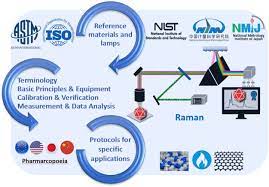
Over the past decades Raman spectroscopy has been extensively used both on an industrial and academic level. This has resulted in the development of numerous specialized Raman techniques and Raman active products, which in turn has led to the adoption and development of standards and norms pertaining to Raman unit’s calibration, performance validation, and interoperability. Purpose of the present review is to list, classify, and engage in a comprehensive analysis of the different standards, guides, and practices relating to Raman spectroscopy. Primary aim of the review is to consider the commonalities and conflicts between these standards and norms and to identify any missing aspects. Standardization in the field of Raman spectroscopy is dominated by the work of American institutions, namely, the American Society of Testing Materials (ASTM or ASTM International), with several active standards in place pertaining to terminology, calibration, multivariate analysis, and specific applications, and the National Institute of Standards and Technology (NIST), providing numerous certified reference materials, referred to as standard reference materials. The industrial application of Raman spectroscopy is dominated by the pharmaceutical industry. As such, pharmacopoeias provide not only important information in relation to pharmaceutical-related applications of Raman spectroscopy, but also invaluable insight, into the basic principles of Raman spectroscopy and important aspects that include calibration, validation, measurement, and chemometric analysis processes, usually by referring to ASTM and NIST standards. Given the fact that Raman spectroscopy is a modern and innovative field, the standardization processes are complex and constantly evolving. Despite the seemingly high number of existing standards, the standardization landscape is incomplete and has not been modernized according to the developments in Raman spectroscopy techniques in recent years. This is evident by the lack of protocols for numerous areas as well as by the fact that some of the existing standards have not been updated to reflect the advances in the technique. Therefore, it is important for the Raman community to actively engage in and contribute to a modernization process that will result in updating existing and introducing new terms, protocols, and guides. Indeed, the development of optimized common standards would be extremely beneficial and would further foster the development and application of Raman spectroscopy techniques, most notably those of surface enhanced Raman spectroscopy and low-resolution portable analyzers.
Standardization is crucial for any analytical technique in terms of terminology, performance, validation, data formats, and model transfer. Moreover, standards are used as valuable tools to facilitate communication and trust, measurement, commerce, and manufacturing; standardization is identified in the European Framework Programme for Research and Innovation (Horizon 2020) as one of the innovation support measures to bridge the gap between research and the market, helping the fast and easy transfer of research results to the European and international market. The use of Raman spectroscopy in the industry and academia and the already large number of specialized Raman techniques and Raman active products are readily increasing, which has fostered the development of standards and norms for Raman unit's calibration, performance validation, and interoperability, especially for some relevant applications. However, standardization in Raman spectroscopy has been necessary since the early stage of the development of the technique. For example, the use of the term "Raman shift" was accepted to describe the energy of the Raman bands correctly, since the wavelength of the Raman scattered light depends on the wavelength of the excitation light. Since then, a number of standards and protocols have appeared to successfully improve the use of the technique in a broad number of fields, and all manufacturers struggle to make Raman equipment that performs according to specifications in terms of wavelength accuracy, repeatability, and scan-to-scan precision that refer to standards.
This review aims at classifying and analyzing the existing standards, guides, and practices relevant for Raman spectroscopy, to serve as a reference catalog and to highlight any need for revision or improvement of existing Raman spectroscopy standards and to ensure that they incorporate the latest scientific research, practical experiences, and best practices from the various fields of application. It is not in the scope of this review to discuss the ease of implementation, as this depends on many factors, or to judge which are the best solutions, as some can be more accurate, but others can be viable and true as well. The objective is to compile a list of the existing standards and norms related to Raman spectroscopy and identify common, conflicting and/or missing points. The standardization activity related to Raman spectroscopy has greatly been led by American bodies, particularly the ASTM (American Society for Testing Materials, now ASTM international), with 14 active standards devoted to terminology, calibration, multivariate analysis, and specific applications, and NIST (National Institute of Standards and Technology), which provides a number of certified reference materials (CRMs), referred to as standard reference materials (SRM). Standards, guides, and practices related to Raman spectroscopy are grouped in this review in four main sections. The first section after the introduction deals with the terminology. The central sections of this review, Standards and Guidelines on Calibration and Certified (Standard) Reference Materials, focus on calibration and validation protocols from ASTM International and the pharmacopoeias (US, European, Chinese, and Japanese), and on certified reference materials and sources to be used for these purposes provided by national metrology institutes from the United States, China, and Japan. The following section covers technical documents published by the International Electrotechnical Commission (IEC), and the next one covers the International Organization for Standardization (ISO), IEC, and ASTM standards related to the use of Raman spectroscopy in specific applications, namely, microplastics, natural gas, and graphene (it is out of the scope of this review to discuss special fields of application of Raman spectroscopy such as military applications). It must be mentioned that sampling methods and sample preparation guidelines, which, for instance, are often needed to pre-concentrate or clean-up complex samples for microscope analysis, are reported just in some standards dealing with specific Raman applications. Hopefully, this will be better covered in the standardization landscape of the near future. Finally, a part of this review discusses the existing standards related to chemometric methodologies that can be applied in Raman spectroscopy.
As a big part of the reviewed documents are not open access (and thus most of their content cannot be disclosed here due to copyright reasons). This, together with the fact that national standards or guides are not translated, makes the review of the standardization landscape difficult and probably limits a wider adoption.
|
Table I. Terminology defined in ASTM and ISO standards related to Raman spectroscopy. |
||
|
Standard |
Main terms defined related to Raman spectroscopy |
|
|
|
Anti-Stokes line |
Raman shift |
|
|
|
|
|
Effluent |
||
|
Action limit |
Nearest neighbor distance inlier |
|
|
|
|
|
|
|
|
|
|
|
|
|
|
Spectrometer/spectrophotometer qualification |
||
|
Accumulations |
Raman spectroscopy |
|
|
ISO/TS 80004-13:2017 |
Raman spectroscopy |
|
|
ISO/TS 80004-6:2021 |
Fluorescence |
Surface-enhanced Raman spectroscopy (SERS) |
|
ISO 18115-1:2013 |
Data preprocessing |
Resolution, lateral |
|
|
Apertureless Raman microscopy |
Polarization |
|
Anti-Stokes Raman scattering |
Polarizer |
|
|
ISO 23978:2020 |
Raman effect |
Signal intensity |
|
ISO Guide 30:2015 |
Certified reference material (CRM) |
Lifetime |
|
Standards not further commented on in this review. |
||
|
ISO/TS 80004-13:2017 Nanotechnologies—Vocabulary—Part 13: Graphene and related two-dimensional (2D) materials currently published is to be replaced by ISO/AWI TS 80004-13 |
||
|
Measuring gas with a spectrograph outside and inside the laser, respectively. |
||
This section covers Raman spectrometer testing, calibration, and validation procedures published by standardization bodies (only ASTM has published standards on these topics) and by the European, American, Chinese, and Japanese pharmacopoeias; the following section covers the certified/standard reference materials (from NIST and the Japanese and Chinese Metrology Institutes) and light sources (from NIST and spectroscopy companies) proposed for that purpose. Calibration standards can refer to defining and verifying several different parameters, for example, the resolution of the spectrometer (ASTM E2529 and future ISO/AWI 23124), or the Raman shift x-axis calibration (ASTM E1840). They may also be specific to a type of instrumentation, for example, scanning Raman spectrometers (ASTM E1683). ASTM methods and external or internal NIST materials and sources are typically used by Raman equipment manufacturers for calibration and validation. Users of commercial Raman equipment and firmware may be afforded with different options in terms of calibration and validation depending on the manufacturer–model–technique and on the target user; standard practices are sometimes referred to in user’s manuals, but mainly for advanced equipment and users. Qualification and validation protocols associated with chemometrics are covered in the last section on standards of the document. Chemometric models for data analysis are often implemented in the industry and are mainly application specific.
Most standards related to Raman calibration currently used by manufacturers were developed in the United States under the ASTM. ASTM standards provide guidelines on obtaining correct Raman spectra through the alignment of optical elements of the spectrometers and calibration procedures using reference materials and guidelines regarding the evaluation of the performance of Raman devices. More specifically, the following subsections are dedicated to the standards providing information on procedures for relative intensity correction (ASTM E2911), Raman shift calibration (ASTM E1840), and testing and assessment of spectral resolution and calibration (ASTM E2529), as well as spectrometer performance (ASTM E1683 and ASTM E1866). Finally, ASTM E1654 covers the method for measuring ionizing radiation-induced spectral changes in optical fibers and cables. Fales et al. compare in Table I the topics covered by the main ASTM standards.
Pharmacopoeias provide general texts, standards, recommended procedures for analysis, and specifications to determine pharmaceutical substances and dosage. There are four predominant pharmacopoeias in the world, the European Pharmacopoeia (EP), the Japanese Pharmacopoeia (JP), the Chinese Pharmacopoeia (CP), and the United States Pharmacopeia (USP), all of which share the goal of publishing and producing quality standards for pharmaceuticals. All of them have dedicated chapters on Raman spectroscopy describing the equipment and basic principles, calibration and verification procedures, and the application to pharmaceuticals.
The certified reference materials that are available for Raman spectroscopy are reviewed in this section. The first certified reference materials for relative intensity correction were developed by NIST. These materials are six metal-doped borate or borosilicate glasses used for different laser wavelengths varying from 488 nm to 1064 nm and are presented in. Additional CRMs for relative intensity correction have been developed by the National Institute of Metrology of China (NIM) applicable for 514 nm laser excitation. Furthermore, four Raman-shifted CRMs developed by NIST, NIM, and the National Metrology Institute of Japan (NMIJ) are currently available in the market. The characteristics of all these certified reference materials are described and compared in the following sections.
The standardization landscape in Raman spectroscopy is incomplete, complex, and evolving, with some aspects covered by various documents and others still to be addressed or covered in standards that are under preparation. ASTM is the institution with most publications about Raman standardization, while only a couple of standards from ISO have been found to be relevant for Raman spectroscopy. National metrology institutes, mainly from the US and China, have some CRM for calibration, but they are expensive, with limited availability, and the list is incomplete,making the desirable harmonization of Raman spectroscopy remains difficult.Consequently, the Raman community can and should contribute to update and/or introduce new terms, protocols, and guides.
Application of Confocal Micro Raman Spectroscopy in Interface Research
ATR8800 Raman Imaging Technology
Related Article


Let's have a look!