
NEW PRODUCT| ATE2130-YLS ONLINE CHLOROPHYLL SENSOR

NEW PRODUCT| ATE2130-YLS ONLINE CHLOROPHYLL SENSOR
What is Chlorophyll?
Chlorophyll itself is not harmful to the environment; however, it is a key indicator for estimating phytoplankton biomass and directly reflects algae growth in water bodies. Higher chlorophyll content indicates greater algae presence, while lower levels suggest fewer algae. Excessive algae growth reduces water transparency and dissolved oxygen levels, impacting photosynthesis for organisms below the water surface, deteriorating water quality, and accelerating eutrophication, thus advancing the aging of water bodies. By measuring the chlorophyll content of phytoplankton, one can gauge primary productivity and the level of eutrophication in a body of water. In environmental monitoring, chlorophyll content serves as an indicator for evaluating water body eutrophication.
Importance of Monitoring Chlorophyll in Water
Chlorophyll measurement helps evaluate the effectiveness of ecological restoration efforts and guides the adjustment and optimization of restoration measures. For example, during the ecological restoration of lakes, rivers, and other water bodies, tracking changes in chlorophyll levels can provide insights into water recovery status, enabling the development of more scientifically based restoration strategies. Monitoring chlorophyll levels in water quality also contributes to the sustainable use and protection of water resources. Enhanced water quality monitoring and evaluation help in the timely identification and resolution of water environment issues, thereby protecting water resources from pollution and degradation.
Instrument Overview
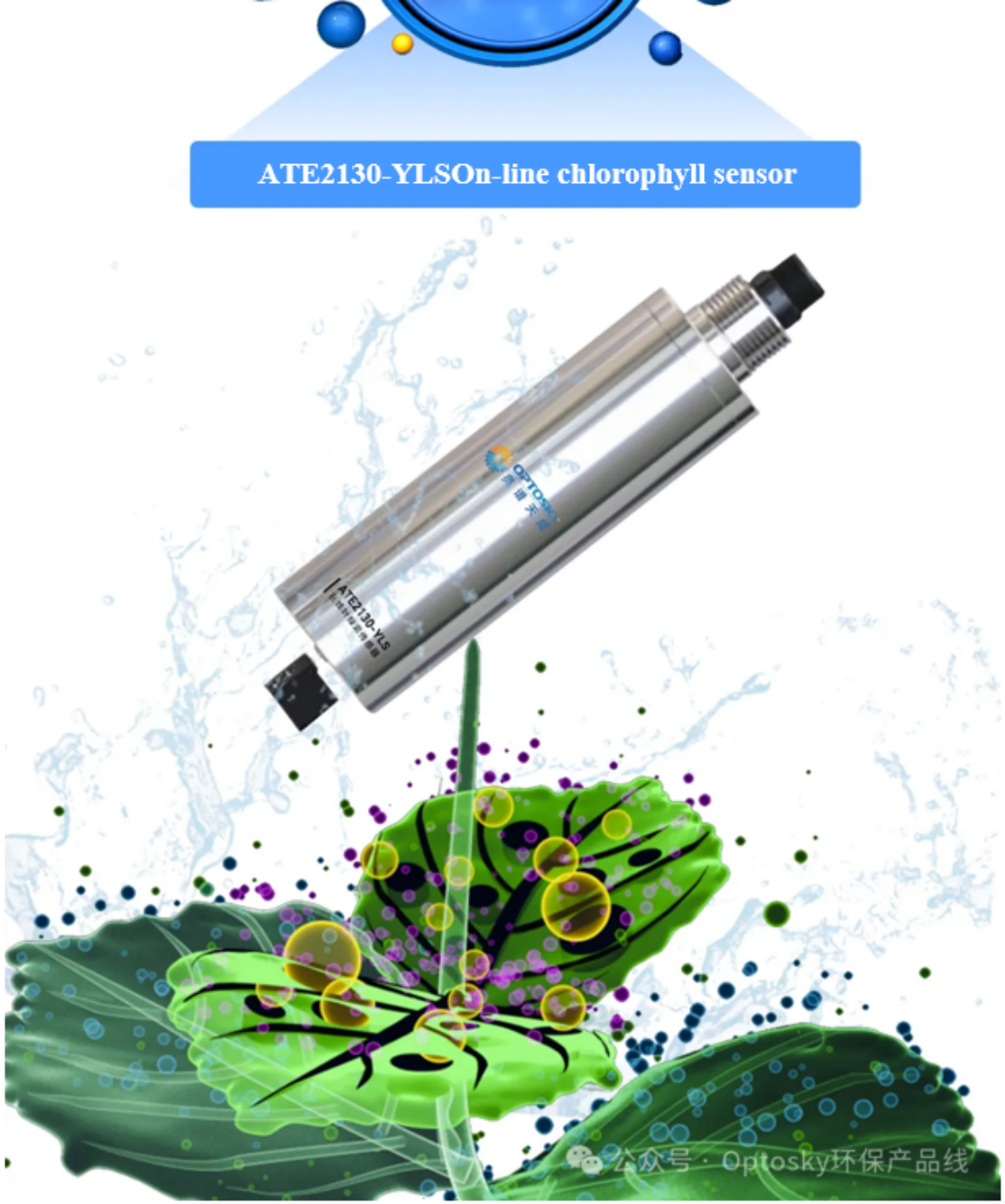
The ATE2130-YLS Online Chlorophyll Sensor is a high-precision, compact, submersible device that uses advanced optical technology. This sensor measures chlorophyll by utilizing its absorption and fluorescence characteristics at specific light wavelengths, precisely capturing variations in chlorophyll concentration within water bodies. Equipped with an automatic cleaning brush and integrated design, the sensor features high-efficiency power management, a rugged structure, stable sensor performance, compact size, and requires minimal maintenance and calibration. It enables real-time online chlorophyll monitoring and can be easily installed at various water quality monitoring points, including rivers, lakes, ponds, marine surveys, and aquaculture applications.
Operating Principle
The online chlorophyll sensor operates using a fluorescence detection method. The sensor emits an excitation light at a wavelength of 470 nm, which is absorbed by chlorophyll in the water sample. This absorption then leads to the release of fluorescence at a wavelength of 685 nm. The sensor calculates the chlorophyll content in the water by measuring the fluorescence intensity.
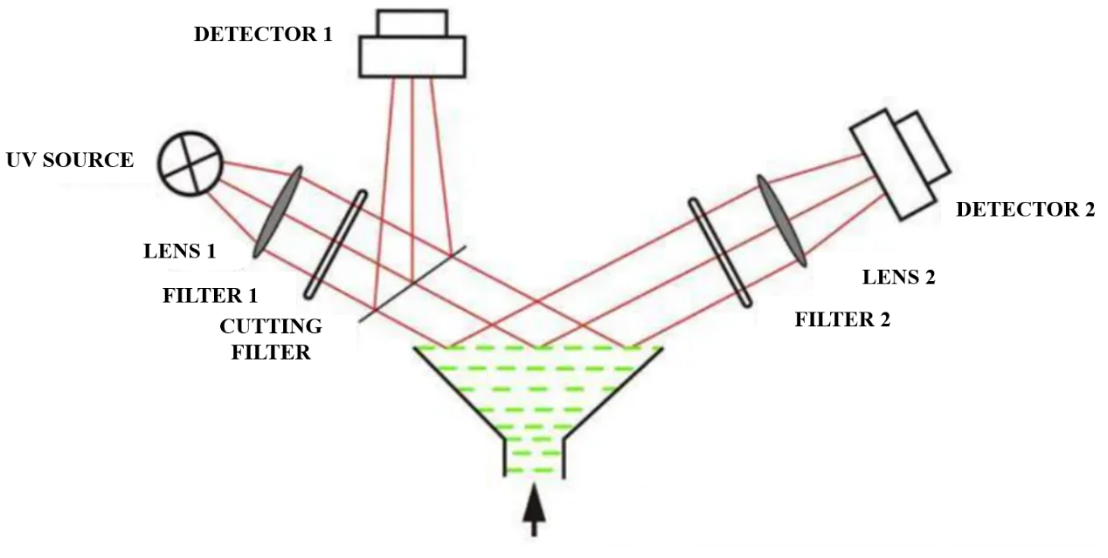
Schematic Diagram of the Fluorescence Method for Chlorophyll Detection
Installation Diagram of Chlorophyll Flow Cell
—————————————————————————————————————
Instrument Features
- Equipped with an automatic cleaning brush to prevent contamination and eliminate bubbles.
- Digital sensor for continuous online monitoring, providing real-time water quality data.
- Reagent-free, pollution-free, with low power consumption and minimal maintenance.
- Fast analysis speed, high sensitivity, and excellent stability.
- Low-power design for broader applicability, with internal memory to retain calibration and settings even in the event of a power outage.
- Easy to operate, requiring no complex sample processing or chemical reagents, which minimizes secondary pollution.
Key Specifications
- Principle: Fluorescence method
- Range: 0-500 μg/L
- Detection Limit: 0.03 μg/L
- Accuracy: ±5% or 0.5 μg/L
- Resolution: 0.01 μg/L
- Temperature Compensation: Automatic
- Maximum Pressure: 3 bar
Application Fields
- Surface water quality monitoring
- Algal bloom monitoring
- Swimming pool water quality control
- Research and education
- Reservoir management
- Studies of algae and phytoplankton conditions
- Effluent water quality monitoring
Application Of Ny6000 In Rapeseed Oil Fatty Acid Modeling
SOLUTION | RURAL WATER SUPPLY ONLINE MONITORING
Related Article