
Raman spectroscopic detection and analysis of Scutellaria baicalensis herbal tablets
author: cily
2022-12-23

Raman Spectroscopy Compared with other traditional techniques.The technique has the advantages of high detection sensitivity, short time, low sample volume, no sample preparation, non-destructive and no interference from water.
In this article, we used Raman microscopic spectroscopy to examine four different origins of Scutellaria baicalensis herbal tablets.The first-order derivative spectra were obtained and attributed to the vibration modes of the characteristic peaks.
The experimental test instrument was a confocal Raman microscopy spectrometer with a laser source excitation wavelength of 785 nm and the resolution of the measurement was 3-5 cm-1 , the integration time was 100 s, the microscope lens is 50x, the laser power on the sample surface is 50 mw, 100 mw quenching power, 25*1000 um optical lamb.
The spectral measurement range was 102-3775 cm-1, The Raman scattered light of the sample was collected by the CCD and input to the computer in real time.
The spectrum was measured by the CCD.
The Raman spectra of Scutellaria baicalensis from Anhui, Henan, Inner Mongolia and Shanxi were examined at the wavelength of 785 nm.
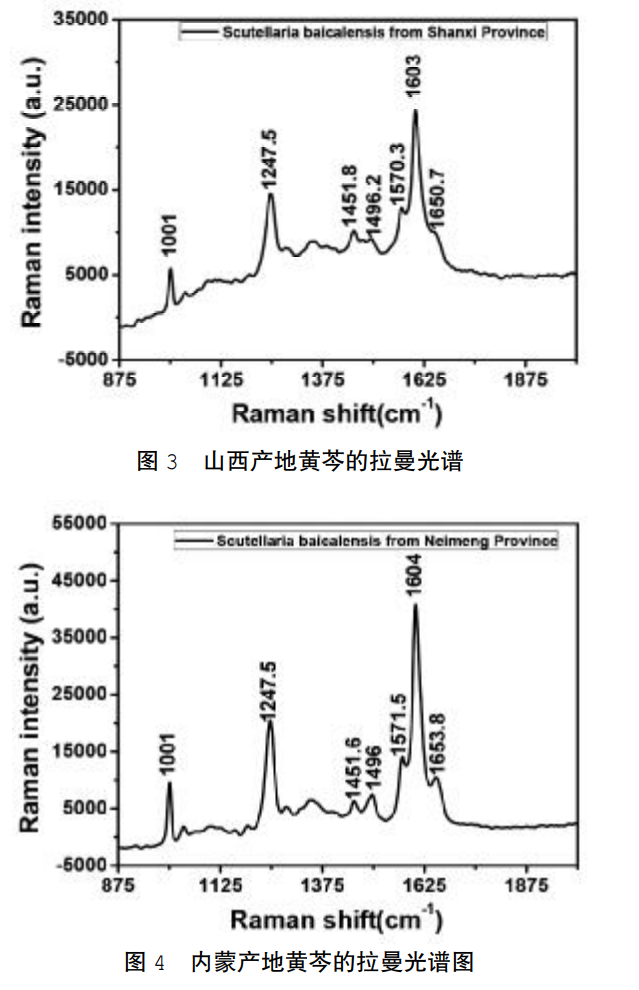
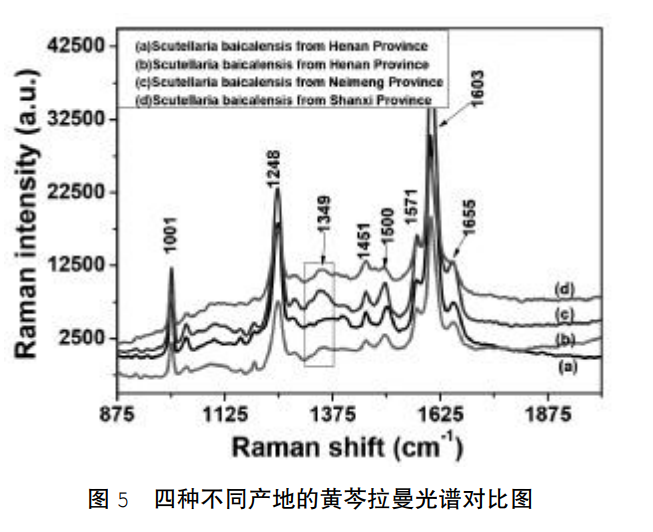
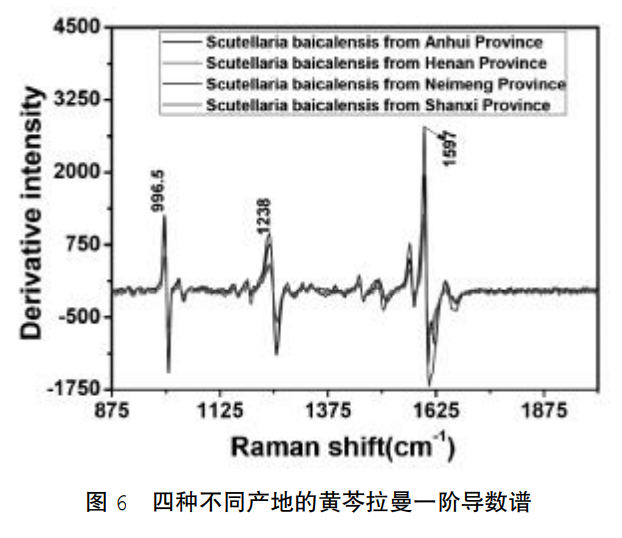
The Raman spectroscopy and the first-order derivative spectra of Scutellaria baicalensis from Anhui, Henan, Inner Mongolia and Xi are shown in Figs. 1-5, respectively.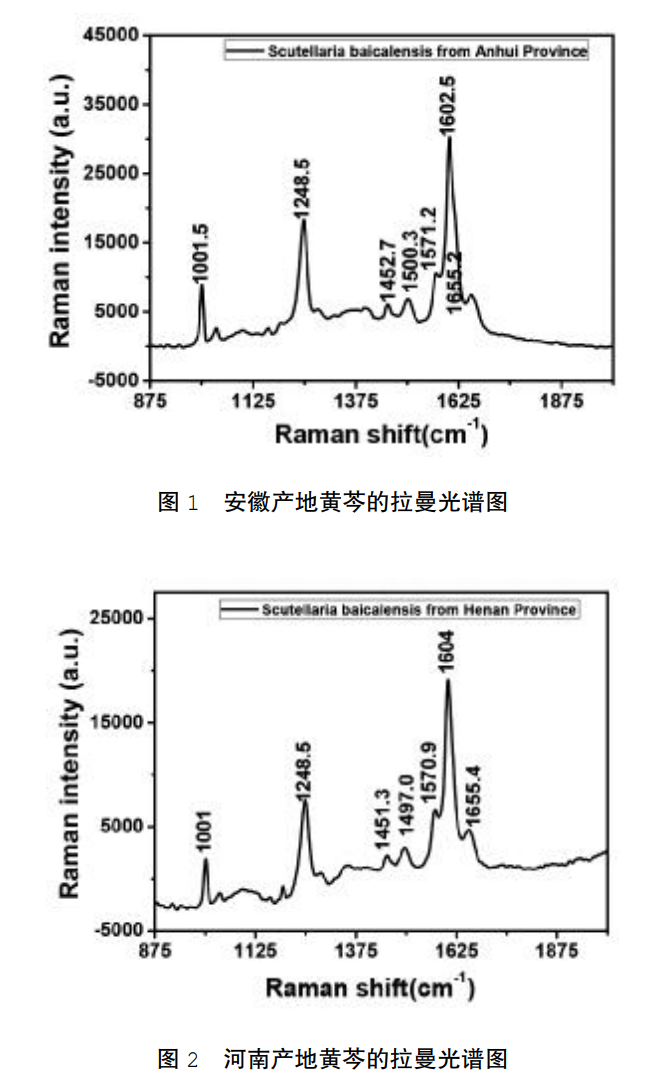
3 Conclusion
The Raman spectra of Scutellaria baicalensis herbal drink were tested by confocal Raman microscopy spectrometer.
The Raman spectroscopy showed that 996.5 cm-1, 1001 cm-1, 1238 cm-1 1248 cm-1, 1597 cm-1, 1603 cm-1 peaks can be used as the basis for the identification of The peaks can be used as a basis for the identification and recognition of Scutellaria baicalensis.
The study showed that laser Raman spectroscopy and its first-order derivative spectroscopy can provide a more accurate, direct and effective method for quality control of Chinese herbal medicines.
In this article, we used Raman microscopic spectroscopy to examine four different origins of Scutellaria baicalensis herbal tablets.The first-order derivative spectra were obtained and attributed to the vibration modes of the characteristic peaks.
1.Experimental apparatus and methods
1.2 Test apparatus and methodThe experimental test instrument was a confocal Raman microscopy spectrometer with a laser source excitation wavelength of 785 nm and the resolution of the measurement was 3-5 cm-1 , the integration time was 100 s, the microscope lens is 50x, the laser power on the sample surface is 50 mw, 100 mw quenching power, 25*1000 um optical lamb.
The spectral measurement range was 102-3775 cm-1, The Raman scattered light of the sample was collected by the CCD and input to the computer in real time.
The spectrum was measured by the CCD.
2.Experimental results of Raman spectroscopy detection with vibration mode attribution
2.1 Experimental results of Raman spectroscopy of Scutellaria baicalensisThe Raman spectra of Scutellaria baicalensis from Anhui, Henan, Inner Mongolia and Shanxi were examined at the wavelength of 785 nm.
The Raman spectroscopy and the first-order derivative spectra of Scutellaria baicalensis from Anhui, Henan, Inner Mongolia and Xi are shown in Figs. 1-5, respectively.
3 Conclusion
The Raman spectra of Scutellaria baicalensis herbal drink were tested by confocal Raman microscopy spectrometer.
The Raman spectroscopy showed that 996.5 cm-1, 1001 cm-1, 1238 cm-1 1248 cm-1, 1597 cm-1, 1603 cm-1 peaks can be used as the basis for the identification of The peaks can be used as a basis for the identification and recognition of Scutellaria baicalensis.
The study showed that laser Raman spectroscopy and its first-order derivative spectroscopy can provide a more accurate, direct and effective method for quality control of Chinese herbal medicines.
What is Raman Spectroscopy?
What is X-ray Fluorescence (XRF)
Related Article

Discover the Optosky ATR1600 ultra-micro Raman spectrometer—a 210g pocket-sized device for on-site, non-destructive gemstone identification. With a 20,000+ substance spectral library, dedicated jewelry edition, Bluetooth smartphone APP, and PDF reporting, it enables rapid screening of natural, synthetic, and treated gemstones at exhibitions, pawnshops, and markets.
ATR1600: The 210g Pocket Raman Gem Identifier
Explore how micro-confocal Raman spectroscopy, combined with SERS, enables rapid, non-destructive, molecular-level screening of veterinary drug residues such as malachite green, enrofloxacin, and chloramphenicol in aquatic products. Learn how Optosky’s ATR8100 supports microscopic localization, multi-wavelength excitation, mapping imaging, and portable on-site testing—while clarifying its role alongside LC-MS/MS confirmation.
Applications | Micro-Raman Drug Residue Screening in Seafood
Discover how Raman spectroscopy enables label‑free cancer diagnosis by reading molecular fingerprints of cells. From key Raman peaks and AI‑powered classification to the ATR8800 confocal platform, this article explores the frontiers, challenges, and clinical potential of Raman‑based cancer detection.
How Raman Spectroscopy Sees Through Cancer Cells: Label‑Free Cancer Diagnosis
Optosky successfully delivered and commissioned multiple ATP9100 field spectroradiometers at a university in Northwest China. The project included installation, performance verification, and on‑site training – supporting agricultural remote sensing, ecological monitoring, and geological surveys while building a standardized spectral research platform.
Case Study | ATP9100 Acceptance at Northwest University