
785 nm or 1064 nm? Fluorescence Is the Dividing Line
The same batch of samples: measured at 785 nm, the fluorescence background is so heavy that peaks are completely invisible. Switch to 1064 nm, and the spectrum is as clean as if you had used a different instrument. This is not an isolated case – if you have used Raman spectroscopy, you have most likely encountered this choice: short wavelength or long wavelength?
This article takes you from the underlying physics to real‑world case studies, clearly explaining the advantages, disadvantages, and suitable applications of 785 nm and 1064 nm once and for all.
01 Practical Opening: One Pesticide, Two Different Outcomes
A customs laboratory sent us a batch of pesticide samples, among which pirimicarb is a typical fluorescence‑prone compound. We tested it with both the ATR6500 (785 nm) and the ATR6600 (1064 nm) –
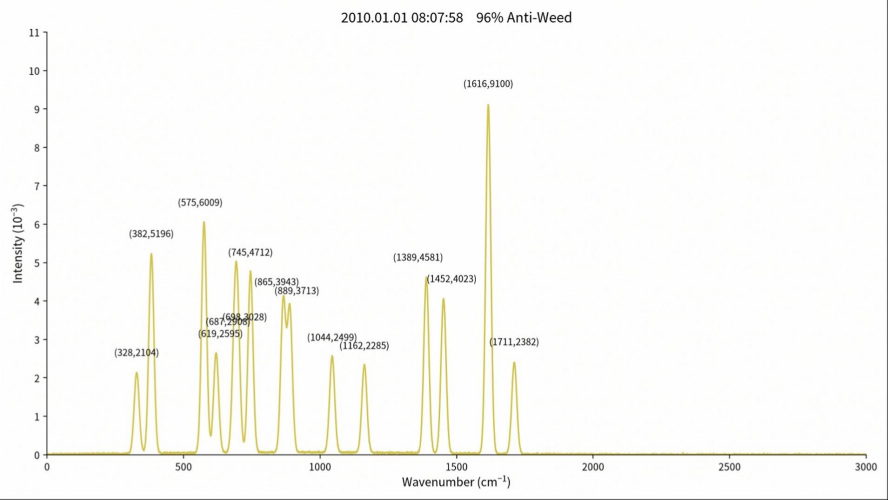
Figure 1 – ATR6500 (785 nm) measurement of pirimicarb – severe fluorescence background, characteristic peaks completely overwhelmed
Figure 2 – ATR6600 (1064 nm) measurement of pirimicarb – fluorescence significantly suppressed, characteristic peaks clearly distinguishable
The difference is stark. Why does changing the wavelength make such a huge difference? The answer lies in the physical nature of fluorescence.
02 Fluorescence: The "Natural Enemy" of Raman
Raman scattering and fluorescence are two entirely different physical processes. Raman scattering is the inelastic scattering of photons with molecular vibrational energy levels – the signal is extremely weak. Fluorescence, on the other hand, occurs when a molecule absorbs a photon, undergoes an electronic transition, and then re‑emits light – the signal is orders of magnitude stronger than Raman. Once fluorescence is excited, the Raman signal is like trying to find a firefly under a searchlight.
The key lies in the photon energy: E = hc/λ. The shorter the wavelength, the higher the photon energy. Photons at 785 nm have energy above the electronic transition thresholds of many organic molecules, easily triggering fluorescence. Photons at 1064 nm have lower energy, below the absorption bands of many fluorescent substances, making fluorescence much harder to excite.
Two critical physical relationships:
① Raman signal intensity ∝ 1/λ⁴ – shorter wavelengths give stronger signals. The Raman signal at 785 nm is roughly 3–3.5 times that at 1064 nm [1].
② Fluorescence intensity depends on whether the excitation light can trigger electronic transitions – shorter wavelengths do so more readily [2].
This creates a fundamental trade‑off: shorter wavelengths give stronger signals, but longer wavelengths are needed to avoid fluorescence. So there is no "better" wavelength – only the "more suitable" one for your sample.
03 LEFT CORNER · 785 nm
Advantages
- Strong signal: the λ⁻⁴ relationship gives roughly 3× the Raman signal of 1064 nm, allowing shorter integration times under the same conditions
- Mature detectors: silicon CCD detectors offer high sensitivity and cost‑effectiveness
- Higher spatial resolution: shorter wavelength means smaller diffraction limit, better lateral resolution for microscopy
- Wide applicability: the first choice for low‑fluorescence samples such as minerals, inorganics, carbon materials, and semiconductors
Disadvantages
- Easily excites strong fluorescence in dark‑coloured samples, organics, and biomolecules
- Some dyes, pigments, and pharmaceuticals produce spectra completely overwhelmed by fluorescence at 785 nm
- Limited penetration through dark‑coloured packaging
04 RIGHT CORNER · 1064 nm
Advantages
- Fluorescence suppression: photon energy is below the absorption bands of most organic fluorophores, drastically reducing fluorescence background
- Better penetration: superior through dark packaging (paper bags, plastic bottles, envelopes)
- Suitable for difficult samples: the "last resort" for highly fluorescent samples such as dyes, pigments, oils, biological tissues, and pharmaceuticals [3]
- A powerful tool for drug enforcement: while 785 nm is almost useless for detecting drugs inside dark packaging, 1064 nm can penetrate and identify the contents [4]
Disadvantages
- Weak signal: Raman signal is only about 1/3 of that at 785 nm, requiring much longer integration times (often 10–30×) [1]
- Higher detector cost: InGaAs detectors have lower sensitivity than silicon CCDs and are more expensive
- Slightly lower spatial resolution: longer wavelength gives a larger diffraction limit
- Extremely dark samples may still absorb laser energy and burn – power must be controlled.
Selection Decision Tree
Knowing the pros and cons, how do you choose in practice? Follow these three steps:
Step 1 – Is the sample dark‑coloured / organic / biological / containing fluorophores?
Yes → lean toward 1064 nm
No → go to Step 2
Step 2 – Do you need to measure through packaging? Is the packaging dark or opaque?
Yes → lean toward 1064 nm
No → go to Step 3
Step 3 – Is the sample a mineral / inorganic / semiconductor / metal? Do you require fast measurement?
Yes → choose 785 nm
Unsure → dual‑wavelength complementarity – get both
05 Drug Enforcement in Practice: The Home Ground of 1064 nm
Drug enforcement is one of the areas where 1064 nm delivers the greatest value. Drugs such as methamphetamine, ketamine, and cocaine are often enclosed in dark plastic bags, kraft paper envelopes, or multi‑layer packaging. With 785 nm, the fluorescence from the packaging itself and absorption by the dark background renders the spectrum useless. 1064 nm can penetrate these barriers and directly identify the substance inside.
International case: An AZoM experimental report showed that a 1064 nm handheld Raman system could detect fentanyl through kraft paper envelopes (match score 85.0) and N‑acetylaminobenzoic acid through HDPE plastic bottles (785 nm gave completely overwhelming fluorescence, while 1064 nm achieved a match score of 92.2) [3].
Domestic case: A study published in Forensic Science and Technology (2025, Issue 1) by the Shaanxi Branch of the National Narcotics Laboratory compared 532, 785, and 1064 nm on six seized drug samples, confirming the significant advantage of 1064 nm for highly fluorescent specimens [4].
A 2018 paper in Energetic Materials described the design concept of a 785/1064 nm dual‑wavelength handheld Raman system: 785 nm for low‑fluorescence explosives, 1064 nm for high‑fluorescence explosives – complementary coverage [5].
06 Product Portfolio: Dual‑Wavelength Coverage for All Scenarios
Optosky’s handheld Raman product line covers both wavelengths:
ATR6500 (785 nm) – The versatile workhorse
Strong signal, fast measurement, mature detector technology. The first choice for minerals, inorganics, white powders, and other low‑fluorescence samples. Ideal for quality control, mining, and rapid incoming material identification in pharmaceutical manufacturing.
ATR6600 (1064 nm) – The high‑fluorescence sample solution
Fluorescence suppression, packaging penetration, and suitability for difficult samples. Ideal for dyes, pharmaceuticals, biomolecules, and identification of substances inside dark‑coloured packaging. Perfect for drug enforcement, hazardous chemicals, food safety, and other complex scenarios.
If your applications cover a wide range of sample types – from low‑fluorescence inorganics to high‑fluorescence organics – the dual‑wavelength combination is the safest option. It is not about choosing one or the other; it is about using them together.
One‑Sentence Summary
785 nm gives strong signals but is vulnerable to fluorescence; 1064 nm resists fluorescence but has weaker signals. It is not about which is better – it is about whether your sample is afraid of fluorescence.
For more information, please contact:
Email: [email protected]
Web: www.optosky.net
Applications | ATH9010 Enables Water Quality and Membrane Fouling Monitoring for Desalination During Algal Blooms
From Science to the Field: Custom Hyperspectral Solutions by Optosky
Related Article