
From Science to the Field: Custom Hyperspectral Solutions by Optosky
author: Peggy
2026-09-08

In August 2026, Professor Zhang Jun's team published a landmark paper in Science titled "Hypervision: An on-chip hyperspectral microsystem for online video-rate computational imaging." The work demonstrates a compact, low-power hyperspectral system capable of real-time, video-rate analysis—a clear signal that hyperspectral technology is evolving from a purely offline scientific tool toward an embedded, intelligent sensing platform.
Yet the road from a brilliant lab prototype to widespread industrial adoption is not straightforward. The paper highlights three persistent challenges:
First, data acquisition and computation remain separate. Sensors capture information, while computers handle reconstruction and analysis elsewhere. Data must shuttle between devices, introducing latency and bottlenecks.
Second, computing resources are a heavy dependency. Complex hyperspectral reconstruction networks typically require GPUs or high-performance workstations, limiting deployment on drones, vehicles, and other mobile platforms.
Third, size, power, and real-time performance are difficult to reconcile. A system must deliver rich spectral information while keeping weight, energy consumption, and processing time under strict control—demanding tight co-design of optics, algorithms, and hardware.
The core question for hyperspectral industrialization is no longer just "how to obtain more bands," but rather: How can we deliver decision-ready information in real time, under limited power and computational resources?
From "Capture Then Analyze" to "Sense on Site"
The Science paper demonstrates promising applications in autonomous driving and air-ground monitoring. For intelligent vehicles, RGB cameras primarily rely on color and texture to identify roads, vehicles, and obstacles. But when targets look similar, lighting changes, or material properties must be distinguished, three-dimensional remote-sensing images alone may fall short. Hyperspectral information adds a new dimension—subtle spectral differences that enhance object recognition, scene understanding, and perception in complex environments.
In drone and aerial monitoring scenarios, video-rate hyperspectral systems can continuously observe ground changes, drastically shortening the traditional workflow of "fly, store, download, then process." By integrating object detection, classification, and anomaly recognition algorithms, such systems could perform preliminary analysis during flight, transmitting only the most valuable insights back to ground stations in real time.
This research signals more than a camera upgrade—it marks a paradigm shift:
-
From collecting data to delivering information;
-
From offline reconstruction to online computation;
-
From large-scale lab equipment to standalone embedded systems;
-
From optical performance alone to synergistic design of sensor + algorithm + compute.
Of course, moving from a research prototype to large-scale deployment requires solving long-term stability, environmental robustness, spectral calibration, manufacturing cost, and cross-domain model generalization. But one thing is now proven: video-rate, low-power, independently operating computational hyperspectral systems are technically feasible.
Optosky: Turning Cutting-Edge Hyperspectral Science into Custom Application Systems
A Science paper shows a technological direction—but true industrial adoption demands system-level redesign tailored to specific objects, site conditions, and business metrics.
Different scenarios impose very different requirements. Crop monitoring focuses on growth vigor, pests, diseases, and moisture content. Food inspection emphasizes sugar content, protein, ripeness, and defects. Industrial production lines prioritize inspection speed, stability, and equipment integration. UAV remote sensing needs wide coverage, high maneuverability, and large fields of view.
This is where Optosky's ATH series excels. We don't offer one-size-fits-all boxes—we deliver customized solutions designed around your unique application.
On the hardware side, we combine sensors, spectroscopic modules, lenses, light sources, scanning mechanisms, and mounting platforms across visible, near-infrared, and shortwave-infrared bands. Whether your system lives in a laboratory, on a production line, aboard a drone, or on a mobile vehicle, we handle full integration within your spatial and operational constraints.
On the algorithm side, we build complete pipelines—from raw hyperspectral data to precise outputs—including spectral calibration, whiteboard correction, image stitching, preprocessing, feature band selection, classification, and quantitative model development.
On the application side, we go further: constructing sample databases, training industry-specific models, deploying edge computing, developing intuitive software interfaces, and supporting iterative product refinement. The goal is simple: your hyperspectral system shouldn't just output a stack of spectral curves. It should directly deliver grades, concentrations, categories, defects, or early-warning alerts—information that drives decisions.
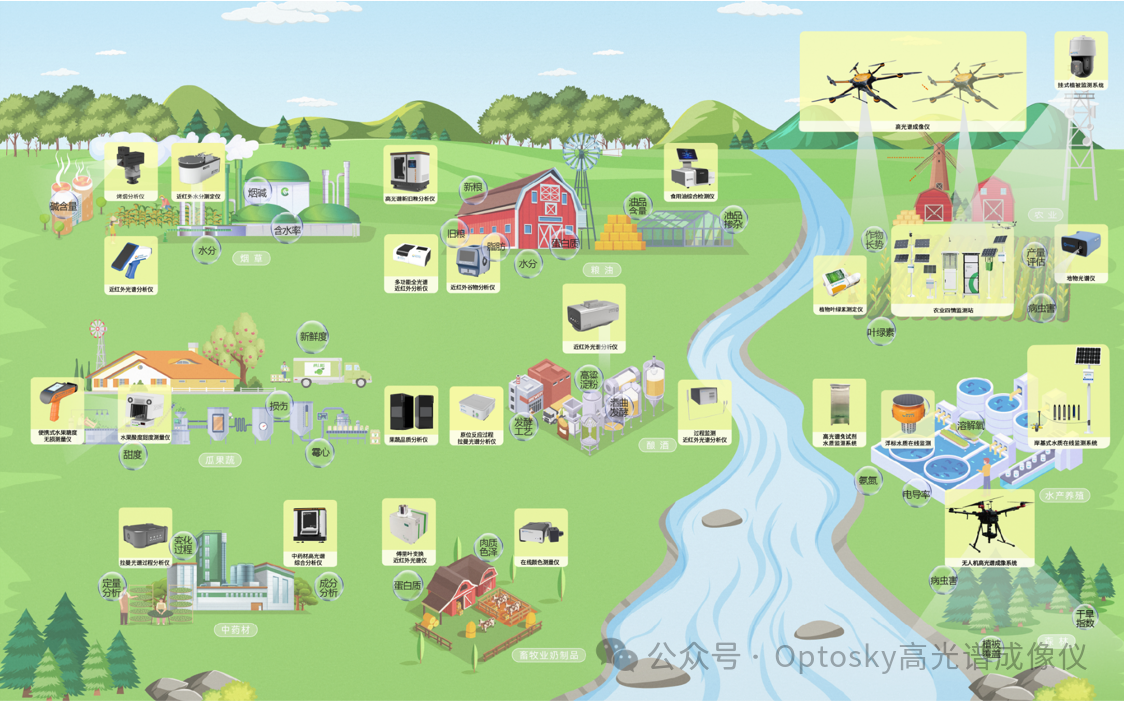
Ecology & Remote Sensing Product Line
Optosky's ATH series already serves diverse fields—precision agriculture, food safety, mineral exploration, environmental monitoring, and industrial quality control. By fusing multi-source data, we enable rapid processing and analysis that enhances crop health assessment, pest prediction, soil fertility evaluation, and more.
The future of hyperspectral is not in the lab—it's in the field, in the air, and on the production line, working in real time, under real conditions. And Optosky is ready to build that future with you.
Contact us today to turn your hyperspectral challenge into a tailored, deployable solution.
785 nm or 1064 nm? Fluorescence Is the Dividing Line
Case Study | Bulk NY3300Pro Installation Transforms Smart Farming
Related Article

Discover Optosky’s air–ground collaborative hyperspectral solution for mine ecological restoration monitoring. Combining UAV hyperspectral imaging, fixed-point rotating-scan systems, and field spectroradiometers, it supports vegetation, soil, mineral alteration, and water environment monitoring for green mine evaluation and restoration acceptance.
Applications | Hyperspectral Mine Restoration Monitoring
Compare single InGaAs and CMOS+InGaAs detector architectures in hyperspectral imaging. Learn why both can cover 400–1700 nm, how visible-light-extended InGaAs works, and the trade-offs in calibration, spectral registration, and system integration for applications in agriculture, food safety, and industrial inspection.
Technology | Single InGaAs vs. CMOS+InGaAs in Hyperspectral Imaging
Discover how hyperspectral imaging combined with multi-feature fusion (PCA + 2DCOS + CARS) enables non-destructive three-level grading of chili pepper sunburn with 97.2% accuracy. Learn about the ATH3000 system and Optosky's customized solutions for horticultural crop quality inspection and damage classification.
Can Sunburned Chili Peppers Be Non-Destructively Graded? Hyperspectral Imaging ATH3000 Offers a New Answer
Discover the Optosky ATH9600 multi-lens UAV-borne multispectral imaging system—featuring 67° ultra-wide FOV, synchronous snapshot, 3.75 μm large pixel, and native DJI X-Port integration. Ideal for large-area farmland monitoring, orchard management, pest early warning, water quality inversion, and complex crop classification. Born for efficient, all-weather low-altitude remote sensing.
Born for Large-Area Remote Sensing! Optosky Releases the ATH9600 Multi-Lens UAV-Borne Multispectral Imaging System