
Grape Quality Inspection Made Smarter: Choosing the Right Spectral Tool with Optosky ATH1010/ATP Series
As consumer demands for grape quality, taste, and safety continue to rise, traditional manual sorting methods can no longer meet the needs of modern agriculture for high efficiency, high precision, and non‑destructive inspection.
Currently, post‑harvest grape quality evaluation indicators mainly include external and internal parameters. External indicators include fruit size, colour, shape, surface defects, etc. Internal indicators include soluble solids content (SSC), sugar content, acidity, firmness, moisture content, and other key quality parameters.
Conventional machine vision can quickly acquire external information such as colour, size, and shape, but has limited capability for detecting internal quality attributes like sugar content, acidity, and moisture. In contrast, spectral analysis technology can achieve non‑destructive prediction of internal quality by analysing the absorption and reflection characteristics of materials at different wavelengths of light.
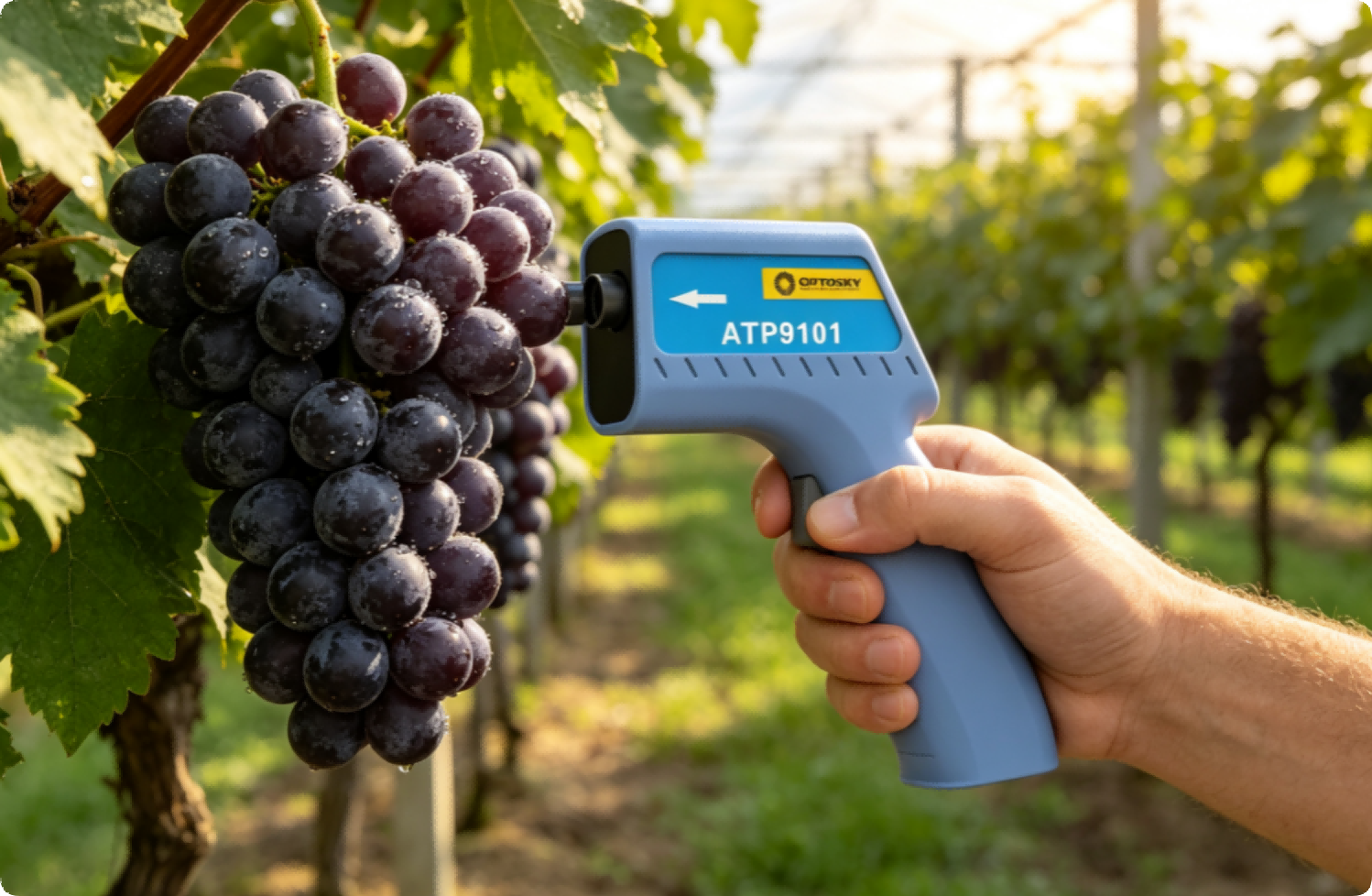
OPTOSKY ATP9101 data acquisition setup for grapes
Among these technologies, hyperspectral imaging further integrates spectral analysis with image information, achieving "spectrum‑image fusion" – making it a key technological direction for intelligent grape sorting.
Foreign grape sorting equipment
(a) WineGrapeTek grape sorter (Germany)
(b) TOMRA automated fruit grading line (Norway)
(c) Delta Vistalys HD wine grape sorter (France)
Domestic grape sorting equipment
(a) Lvmeng intelligent fruit sorting equipment
(b) Taihe small‑diameter fruit grader
(c) Kaipu Technology small‑fruit intelligent sorting system.
01 Machine Vision, Ordinary Spectroscopy, or Hyperspectral – Which One to Choose?
If only external appearance matters → Machine vision is more suitable
Machine vision mainly uses industrial cameras to capture grape images and analyse features such as colour, size, shape, bloom coverage, and surface defects.
Advantages:
- Fast detection speed
- Relatively low cost
- Suitable for online appearance grading
Limitations:
It cannot effectively obtain internal quality information such as sugar, acidity, or moisture, and has limited capability for complex quality evaluation.
- Suitable scenarios:
- Fruit size grading
- Surface defect screening
- Colour‑based ripeness assessment
If internal quality is the focus → Visible/NIR spectroscopy is more efficient
Visible/near‑infrared spectroscopy analyses reflected or transmitted spectral information from grapes and establishes predictive models between spectra and quality indicators, enabling detection of sugar content, acidity, vitamin C, and more.
Advantages:
- Fast and non‑destructive
- Simultaneous multi‑parameter analysis
- Devices can be made portable
For example, studies have shown that visible/NIR spectroscopy can predict multiple quality parameters of grapes, including SSC, total acidity, pH, firmness, and moisture content.
Suitable for:
- Grape sugar content detection
- Ripeness evaluation
- Rapid quality screening
If both appearance and internal quality need to be assessed → Hyperspectral is more comprehensive
Hyperspectral imaging simultaneously acquires spatial image information and continuous spectral data:
- Image dimension: identifies size, shape, and defect areas
- Spectral dimension: analyses sugar, moisture, and chemical composition
This truly enables:
"One image shows the grape's appearance; one spectrum reveals its internal quality."
Research papers indicate that hyperspectral imaging can simultaneously detect both external and internal grape quality by establishing relationships between pixel‑level spectral signatures and physicochemical properties, enabling comprehensive quality assessment.
02 Optosky Hyperspectral Solutions for Grape Inspection
1. Laboratory Quality Research
Suitable for:
- Grape sugar content model development
- Quality evaluation research
- New variety screening
Recommended: High‑resolution hyperspectral imaging system
Features:
✔ High spectral resolution
✔ Supports fine spectral analysis
✔ Ideal for research modelling
2. Production Line Online Sorting
Suitable for:
- Automated grading
- Rapid quality inspection
- Integration with smart equipment
Recommended: High‑speed hyperspectral imaging system
Features:
✔ Fast acquisition
✔ Supports online inspection
✔ Can integrate machine vision algorithms
3. Field Rapid Testing
Suitable for:
- Vineyard sampling
- On‑site quality assessment at origin
- Grading for procurement
Recommended: Portable spectrometer/hyperspectral device
Features:
✔ Flexible operation
✔ Fast data acquisition
✔ Lowers the barrier to testing
03 Not Higher Specs Are Always Better – Scenario Matching Matters Most
Selection Guide
*From "seeing colour" to "seeing quality" – hyperspectral is redefining intelligent agricultural inspection. *
Optosky’s hyperspectral imaging technology enables non‑destructive inspection, precise grading, and intelligent decision‑making for grapes, fruits, and more agricultural scenarios – driving the digital and smart transformation of agricultural production.
For more information, please contact:
Email: [email protected]
Web: www.optosky.net
Case Study | Bulk NY3300Pro Installation Transforms Smart Farming
Selecting the Right Remote Sensing Tool for Mineral Exploration: A Deep Dive into Optosky’s Hyperspectral ATH9010
Related Article