
A One-Stop Solution for Perovskite Thin Film Optical Absorption + Fluorescence Testing | ATP5020 + ATG1020‑H
2026-04-01

Perovskite optoelectronic materials, prized for their ultra-high carrier mobility, broad spectral response, and ease of fabrication, have become a central focus in next-generation photovoltaics and optoelectronic devices. Optical absorption and photoluminescence (PL) properties are key indicators of film crystallization quality, defect density, and luminescence efficiency. A stable, efficient, and ready-to-implement optical testing solution is essential for both research and industrial applications.
01 Application Background
Perovskite represents the third generation of solar cell technology. Over the past 60 years, three generations of solar cells have emerged:
-
First Generation: Silicon-based solar cells, currently the most mature and commercially dominant.
-
Second Generation: Thin-film solar cells, represented by CIGS and CdTe. While offering advantages such as reduced thickness and higher efficiency, their development is limited by factors like scarcity or toxicity of raw materials and complex manufacturing processes.
-
Third Generation: Emerging technologies including perovskite, dye-sensitized, organic, and quantum dot solar cells.
Since its debut in 2009, perovskite solar cells have garnered immense attention from both academia and industry due to their exceptional potential in theoretical efficiency, power generation, low production cost, and broad applicability. From 2021 to 2022 alone, investments in the perovskite field approached 10 billion RMB.
Unlike silicon or gallium arsenide—semiconductors with fixed bandgaps—perovskite materials exhibit tunable bandgaps. Depending on their composition, the bandgap can be continuously adjusted across a theoretical range of 1.15–3.06 eV. Generally, smaller A-site cations widen the bandgap, substituting Sn for Pb at the B-site narrows it, and Br doping at the X-site increases it.
This tunability allows perovskite to approach the theoretical maximum efficiency for single-junction solar cells. According to the Shockley-Queisser limit, the ideal bandgap for a single-junction cell is around 1.4 eV, corresponding to a theoretical conversion efficiency of 33.7%. With its adjustable bandgap, perovskite offers a path to surpass the 29.4% theoretical limit of silicon (bandgap ~1.12 eV).
02 Experimental Setup
2.1 Optical Absorption Testing of Perovskite Thin Films
2.1.1 Overview
The setup consists of a halogen light source, output fiber, integrating sphere, receiving fiber, and a fiber optic spectrometer. Light signals are transmitted via optical fibers, while the integrating sphere collects omnidirectional light from the sample. The spectrometer captures the data and transmits it to a computer for processing, yielding absorption-related spectral information.
2.1.2 Components
-
Halogen Light Source: Provides broadband continuous light covering the visible to near-infrared range.
-
Output Fiber: Transmits light from the source to the integrating sphere.
-
Integrating Sphere: Collects total reflectance from the sample, minimizing scattering errors.
-
Receiving Fiber: Transmits the homogenized light signal from the sphere to the spectrometer.
-
Spectrometer: Acquires and analyzes the spectral data.
2.1.3 Recommended Products
-
Light Source: ATG1020-H Deuterium-Halogen Combination Light Source
-
Spectrometer: ATP5020 High-Sensitivity, High-Resolution Miniature Spectrometer
2.2 520 nm Fluorescence Testing of Perovskite Thin Films
2.2.1 Overview
The PL testing setup comprises a laser source, a Y-shaped fiber, and a fiber optic spectrometer. The laser excites the sample via the Y-fiber, and the resulting photoluminescence signal is collected through the same fiber's return path, then transmitted to the spectrometer. The computer captures the PL spectrum for analysis.
2.2.2 Components
-
Laser Source: Provides stable excitation energy at a specific wavelength (520 nm) to trigger photoluminescence.
-
Y-Shaped Fiber: A core functional component. One leg connects to the 520 nm laser for excitation, while the common end illuminates the sample. The other leg collects the PL signal. An integrated filter blocks the excitation light, simplifying the optical path.
-
Spectrometer: Detects the PL signal and outputs the sample's PL spectrum.
2.2.3 Recommended Products
Spectrometer: ATP5020 High-Sensitivity, High-Resolution Miniature Spectrometer
03 Recommended Product
ATP5020 is a cooled, high-sensitivity miniature fiber optic spectrometer developed by Optosky. It offers two detector configurations to meet different application needs:
-
ATP5020P/R: Equipped with a high-sensitivity, back-thinned, cooled area CCD, achieving a minimum cooling temperature of -10°C.
-
ATP5020: Features a TEC-cooled linear CMOS detector, with a minimum cooling temperature of -5°C.
Both cooling mechanisms effectively reduce dark current and noise, significantly improving the spectrometer's dynamic range and signal-to-noise ratio.
Optosky provides a comprehensive and reliable range of spectral analysis instruments, including the ATP series of fiber optic spectrometers, ATR series Raman spectrometers, IR infrared spectrometers, and ATF fluorescence spectrometers, catering to a wide variety of application needs.
For more information, please contact:
Email: [email protected]
Web: www.optosky.net
Application case | How Spectral Technology is Transforming Duck Egg Farming
Fundamentals | Understanding Spectrometer Parameters: Stray Light and Stability
Related Article

The ATP7810 is a wide-band, high-resolution infrared grating spectrometer covering up to 0.9–5 μm. Featuring a motorized rotating grating, multiple detector options (InGaAs/MCT), and flexible interfaces (SMA905 or free space, USB/UART control), it delivers high SNR and stability for absorption/reflection/transmission spectroscopy, laser wavelength testing, and fiber optic sensing.
New Product Recommendation | ATP7810 Ultra-Wide Range Infrared Spectrometer Series

This study uses the ATP5200P UV-Vis spectrometer to investigate xanthate adsorption on chalcopyrite surfaces. By analyzing absorbance at 300 nm under controlled pH and temperature, the method optimizes flotation conditions for copper recovery, enabling real-time, sensitive detection of adsorption mechanisms in non-ferrous mineral processing.
Using the ATP5200P Spectrometer to Unravel Xanthate Adsorption and Separation Mechanisms
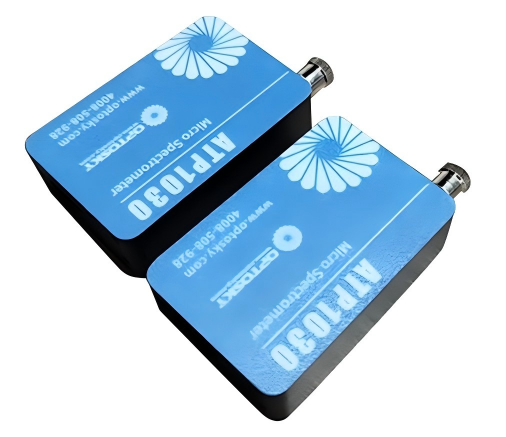
ATP1030 is an ultra‑compact, high‑resolution spectrometer covering 190–1100 nm. With a 1024‑pixel CMOS detector, adjustable integration time down to 1 ms, and USB‑powered design, it delivers reliable performance for applications like online water analysis, color measurement, handheld instruments, and Raman spectroscopy.
Product Recommendation | ATP1030 mini spectrometer Spectrometer

Vis-NIR transmission spectroscopy enables non-destructive identification of infertile duck eggs before incubation, achieving >95% accuracy. By detecting spectral fingerprints (e.g., 836 nm peak for fertile eggs), this method reduces energy waste and improves hatch rates, offering a low-cost, high-throughput solution for modern poultry farming.
Application case | How Spectral Technology is Transforming Duck Egg Farming