
Using the ATP5200P Spectrometer to Unravel Xanthate Adsorption and Separation Mechanisms
author: Peggy
2026-09-03

Xanthate (xanthogenate), with the general formula ROCSSM (where M is an alkali metal), is one of the most important organic collectors for sulfide mineral flotation. Its adsorption behavior on mineral surfaces is a central theme in mining engineering and environmental science. In non-ferrous mineral processing, flotation is the key technology for separating chalcopyrite from gangue minerals. Xanthate, as the most commonly used collector for sulfide ores, plays a decisive role in the flotation efficiency through its adsorption on chalcopyrite surfaces.
01 Application Background
China has long faced a copper supply deficit. In 2008, domestic copper production covered only 74% of annual consumption, with most copper derived from chalcopyrite. Chalcopyrite often coexists with molybdenite, complicating its utilization. The recovery of chalcopyrite is primarily achieved via flotation. The current copper‑molybdenum processing route typically involves bulk flotation followed by separation of the rougher concentrate. During the bulk flotation stage, powerful xanthate collectors are widely used to enhance recoveries. Understanding the thermodynamic and kinetic mechanisms of xanthate adsorption on chalcopyrite is therefore essential for optimizing flotation and improving copper recovery.
Figure 1. Xanthate structure
02 Experimental Design
Common quantitative methods for UV‑Vis absorption spectroscopy include absolute methods, standard comparison, specific absorbance coefficient, standard curve, standard addition, and simultaneous equations. Among these, the standard curve method is the most frequently used. To study the influence of calcium on xanthate adsorption on sphalerite surfaces, the standard curve method was employed, maintaining the measured absorbance of solutions in the 0.2–0.7 range.
Figure 2. Solution absorbance measurement setup
Wavelength Selection
The research team first performed a full‑range UV scan of xanthate solution and identified two distinct absorption peaks at 226.5 nm and 300 nm, with the 300 nm peak being more prominent. After measuring standard samples of various concentrations and performing linear fitting, 300 nm was selected as the optimal detection wavelength.
UV Absorption Spectrum Measurement
Solutions of different xanthate concentrations were prepared, and spectra were recorded against a distilled water reference (Figure 3). Both characteristic peaks (226.5 nm and 300 nm) were clearly observed, with absorbance increasing proportionally with concentration. Importantly, the peak positions did not shift with concentration.
Figure 3. Absorbance spectra of xanthate solutions
A stock solution (10 g·L⁻¹) was prepared by dissolving 0.5000 g of xanthate in distilled water and diluting to 50 mL in a volumetric flask. Dilution yielded a series of concentrations. Using the 300 nm peak, absorbance was measured for each dilution, and a standard curve was constructed by linear regression.
Figure 4. Standard curve of xanthate solution
pH Control
The stability and adsorption behavior of xanthate were systematically investigated across a pH range of 2–12. At pH 3, absorbance decreased (indicating the onset of decomposition); at pH 2, xanthate decomposed completely. In the pH 5–10 range, chalcopyrite showed good adsorption capacity, with the optimum adsorption at pH 9. This provides a scientific basis for adjusting pulp pH in industrial flotation.
Figure 5. Effect of pH on the adsorption capacity of xanthate on chalcopyrite
Temperature Gradient
The influence of temperature was examined over 288–303 K. Over this range, temperature had only a minor effect on adsorption capacity. Adsorption increased slightly with rising temperature, indicating that higher temperatures modestly favor the process, though the magnitude of increase was very small. This suggests that xanthate adsorption on chalcopyrite is relatively insensitive to temperature.
Figure 6. Fitted curves for xanthate adsorption on chalcopyrite at different temperatures
03 Recommended Product
Optosky offers a comprehensive and reliable range of spectral analysis instruments, including the ATP series fiber optic spectrometers, ATR series Raman spectrometers, IR series infrared spectrometers, and ATF series fluorescence spectrometers, meeting various requirements in ore flotation applications. The ATP5200P offers clear advantages for this type of work:
Broad spectral coverage (190–1100 nm):
The UV‑enhanced ATP5200P covers an ultra‑wide range, capturing both the characteristic UV absorption peaks of xanthate (e.g., 226.5 nm and 300 nm) and potential interferences in the near‑infrared region beyond 400 nm. This multi‑wavelength capability provides key data for concentration determination. NIR bands also assist in analyzing the interaction between xanthate and chalcopyrite surfaces, offering richer data for understanding the adsorption mechanism.
High sensitivity:
Equipped with a 2048‑pixel UV‑sensitive CCD operated at low temperature (cooled detector), the ATP5200P boasts exceptional sensitivity, capable of detecting xanthate absorption peaks at concentrations as low as 0.032 mg·L⁻¹. This enables researchers to study adsorption behavior at trace levels, revealing microscopic mechanisms and enabling precise control of xanthate dosage in industrial flotation.
Fast acquisition and real‑time online measurement:
ATP5200P integrates a high‑speed USB interface and 18‑bit A/D conversion, ensuring rapid and accurate data transfer. It captures intensity signals across all wavelengths simultaneously, supporting real‑time observation of the adsorption process. Researchers can monitor adsorption rate dynamics and identify critical events in real time, greatly facilitating kinetic studies.
Modular design:
The spectrometer features a modular design with both SMA905 fiber optic connector and free‑space optical path options. In complex flotation plants, the SMA905 interface easily connects to various fiber probes for online monitoring of xanthate concentration in slurry. The free‑space configuration is ideal for laboratory studies requiring specialized optical layouts, offering great flexibility across different research scenarios.
For more information, please contact:
Email: [email protected]
Web: www.optosky.net
Product Recommendation | ATP1030 mini spectrometer Spectrometer
Application case | How Spectral Technology is Transforming Duck Egg Farming
Related Article

The ATP7810 is a wide-band, high-resolution infrared grating spectrometer covering up to 0.9–5 μm. Featuring a motorized rotating grating, multiple detector options (InGaAs/MCT), and flexible interfaces (SMA905 or free space, USB/UART control), it delivers high SNR and stability for absorption/reflection/transmission spectroscopy, laser wavelength testing, and fiber optic sensing.
New Product Recommendation | ATP7810 Ultra-Wide Range Infrared Spectrometer Series
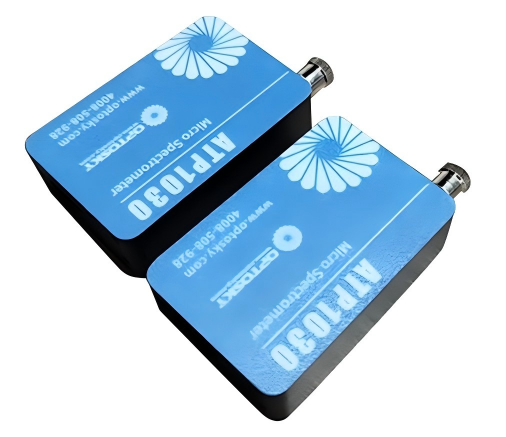
ATP1030 is an ultra‑compact, high‑resolution spectrometer covering 190–1100 nm. With a 1024‑pixel CMOS detector, adjustable integration time down to 1 ms, and USB‑powered design, it delivers reliable performance for applications like online water analysis, color measurement, handheld instruments, and Raman spectroscopy.
Product Recommendation | ATP1030 mini spectrometer Spectrometer

Vis-NIR transmission spectroscopy enables non-destructive identification of infertile duck eggs before incubation, achieving >95% accuracy. By detecting spectral fingerprints (e.g., 836 nm peak for fertile eggs), this method reduces energy waste and improves hatch rates, offering a low-cost, high-throughput solution for modern poultry farming.
Application case | How Spectral Technology is Transforming Duck Egg Farming

This solution presents a complete optical testing system for perovskite thin films using ATP5020 spectrometer and ATG1020-H light source. It enables both absorption and photoluminescence (PL) measurements, delivering stable, high-sensitivity performance essential for assessing film quality, defect density, and bandgap tunability in next-generation solar cells.
A One-Stop Solution for Perovskite Thin Film Optical Absorption + Fluorescence Testing | ATP5020 + ATG1020‑H