
Application case | How Spectral Technology is Transforming Duck Egg Farming
2026-04-17

In the commercial duck egg industry, the incubation of breeding eggs is a critical link in the entire value chain. Industry statistics reveal that around 30% of eggs in traditional incubation are infertile. These not only waste equipment resources but also risk decomposition, which can reduce the hatch rate of fertile eggs by 15–20%. Finding a way to accurately identify infertile eggs before incubation has been a persistent challenge for decades. Fiber optic spectroscopy, acting as a key to unlock the interaction between biomolecular information and intelligent inspection, now offers a solution. It not only greatly advances the detection window (pre-incubation) but also redefines industry standards with an accuracy exceeding 95%.
01 Pain Points of Traditional Detection vs. The Spectral Breakthrough
Conventional candling requires waiting 7 days after incubation begins and relies heavily on operator experience. The delay is problematic, and any deterioration of infertile eggs can compromise the incubation environment. A new non-destructive method based on Vis-NIR transmission spectroscopy (400–1100 nm) provides a low-cost, high-efficiency solution. It enables accurate spectral acquisition before incubation, addressing the root of the problem.
02 Detection Principle
Biochemical Information Carried by Spectral Signals
Figure 2. Absorption spectra of breeding duck eggs before incubation
The interaction of light with the internal components of a duck egg generates a unique "spectral fingerprint":
-
Fertile eggs: Due to early embryonic development, differences in organic compounds such as vitamin E and phospholipids in the yolk produce a characteristic absorption peak near 836 nm (C–H stretching vibration).
-
Infertile eggs: Differences in the distribution of yolk pigments lead to significant differences in the absorbance curve in the 450–525 nm range. Optosky spectrometers convert these subtle differences into quantifiable spectral data via fiber-optic light transmission.
Data Processing and Model Building
Based on raw spectral data, the process involves spectral augmentation, feature extraction, and construction of a bio-information spectral library. This is used to build a predictive model capable of distinguishing fertile from infertile eggs.
03 Reference Experimental Optical Path: Transmission Spectral Acquisition System
1. Optical fiber
2. Spectrometer (ATP5200 cooled model recommended)
3. Computer (acquisition software & prediction model)
4. Light receiving probe (cosine corrector or fiber collimator)
5. Sample under test
6. Sample holder
7. Light source (halogen lamp, ATG1100 recommended)
A dark-box enclosed design is recommended to effectively isolate ambient light interference, ensuring reliable and accurate spectral data. The sample holder should include a vertical fixing mechanism so that each breeding duck egg is positioned with the blunt end facing upward. This guarantees consistent optical path geometry for every egg, avoiding spectral deviations caused by varying placement angles.
04 Technical Advantages & Practical Value
-
Non‑destructive early screening: Detection is performed before incubation, so infertile eggs can still be sold as table eggs. This reduces incubation energy consumption by more than 20% per batch.
-
Integrated & scalable design: The modular optical path allows easy integration into production lines. A single device can inspect over 3,000 eggs per day.
-
Adaptable to different farms: Users can build their own models, tailoring the system to their specific breeding conditions.
Reference
1. Chen Zhuoting, Wang Qiaohua, Wang Dongqiao, Chen Yanbin, Li Shijun. Non-destructive detection of fertility information in pre-incubation breeding duck eggs using visible-near infrared spectroscopy and joint optimization strategy. Spectroscopy and Spectral Analysis, 2025,45(5): 1469-1475. DOI: 10.3964/j.issn.1000-0593(2025)05-1469-07.
For more information, please contact:
Email: [email protected]
Web: www.optosky.netApplication case | How Spectral Technology is Transforming Duck Egg FarmingApplication case | How Spectral Technology is Transforming Duck Egg Farming
Using the ATP5200P Spectrometer to Unravel Xanthate Adsorption and Separation Mechanisms
A One-Stop Solution for Perovskite Thin Film Optical Absorption + Fluorescence Testing | ATP5020 + ATG1020‑H
Related Article

The ATP7810 is a wide-band, high-resolution infrared grating spectrometer covering up to 0.9–5 μm. Featuring a motorized rotating grating, multiple detector options (InGaAs/MCT), and flexible interfaces (SMA905 or free space, USB/UART control), it delivers high SNR and stability for absorption/reflection/transmission spectroscopy, laser wavelength testing, and fiber optic sensing.
New Product Recommendation | ATP7810 Ultra-Wide Range Infrared Spectrometer Series

This study uses the ATP5200P UV-Vis spectrometer to investigate xanthate adsorption on chalcopyrite surfaces. By analyzing absorbance at 300 nm under controlled pH and temperature, the method optimizes flotation conditions for copper recovery, enabling real-time, sensitive detection of adsorption mechanisms in non-ferrous mineral processing.
Using the ATP5200P Spectrometer to Unravel Xanthate Adsorption and Separation Mechanisms
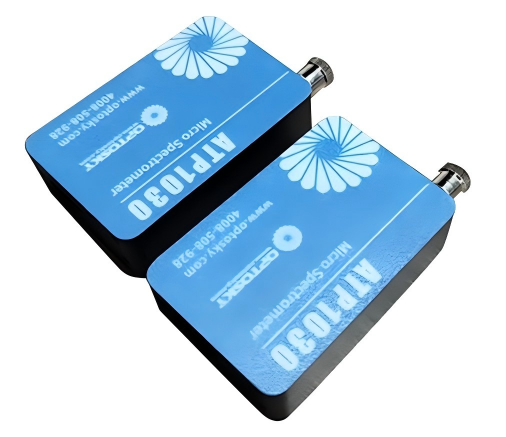
ATP1030 is an ultra‑compact, high‑resolution spectrometer covering 190–1100 nm. With a 1024‑pixel CMOS detector, adjustable integration time down to 1 ms, and USB‑powered design, it delivers reliable performance for applications like online water analysis, color measurement, handheld instruments, and Raman spectroscopy.
Product Recommendation | ATP1030 mini spectrometer Spectrometer

This solution presents a complete optical testing system for perovskite thin films using ATP5020 spectrometer and ATG1020-H light source. It enables both absorption and photoluminescence (PL) measurements, delivering stable, high-sensitivity performance essential for assessing film quality, defect density, and bandgap tunability in next-generation solar cells.
A One-Stop Solution for Perovskite Thin Film Optical Absorption + Fluorescence Testing | ATP5020 + ATG1020‑H