
ATP2000 Series: Enabling Research on the Broadband Optical Limiting Performance of Solid-State Nanocomposite Films
2026-01-30

Semiconductor Applications
With the rapid advancement of laser technology, effectively protecting sensitive optical components and human eyes from intense laser damage has become a crucial research focus. Optical limiting (OL) materials, which can automatically reduce transmittance under high laser intensity, are key to solving this challenge.
In a performance study of Tungsten Trioxide-Poly(vinyl alcohol) (WO₃/PVA) solid-state nanocomposite films, researchers utilized the Optosky ATP2000 series spectrometer, which provided essential data support for investigating the broadband and strong optical limiting effects of these composite films.
01 Research Highlights: High-Performance Solid-State Optical Limiting Films
This study successfully fabricated WO₃/PVA solid-state nanocomposite films with varying concentrations and systematically evaluated their nonlinear optical properties and optical limiting performance across ultraviolet (355 nm), visible (532 nm), and near-infrared (1064 nm) wavelengths.
Experimental Setup
*Figure 1. Open-aperture Z-scan experimental setup. BS: Beam Splitter, L1: Concave Lens, L2 & L3: Focusing Lenses, S: WO₃/PVA Sample, D1 & D2: Detectors.*
The Z-scan method is a widely used technique for measuring the nonlinear refractive index and nonlinear absorption coefficient of various materials. The nonlinear optical properties of the samples were investigated using an open-aperture (OA) Z-scan technique, with the setup shown in Figure 1. An Nd-YAG pulsed laser served as the source (10 Hz repetition rate, 4 ns pulse width) at wavelengths of 355, 532, and 1064 nm. The laser beam was split; one beam served as a reference while the other, after expansion, was focused onto the sample. Detectors D1 and D2 (pyroelectric sensors) collected and measured the reference beam and the beam transmitted through the film, respectively.
Research Results
*Figure 2. Optical absorption spectra of PVA and WO₃/PVA nanocomposite films. Inset: Optical band gap of the WO₃/PVA nanocomposite film.*
The linear optical properties of the WO₃/PVA films were measured using a spectrometer (ATP2000 Series, Optosky).
Optical absorption spectra of the composite films are shown in Figure 2. The strong absorption band near 300 nm corresponds to the absorption band of PVA. The WO₃ film exhibits a broad absorption band with a maximum around 590 nm.
Absorption spectra correspond to electron excitation from the valence to the conduction band. Therefore, the optical band gap (E_g) of the WO₃/PVA nanocomposite film was determined using the Tauc relation.
Experimental Conclusions
The results demonstrate:
-
Broadband Effectiveness: The nanocomposite film exhibits strong optical limiting effects across UV, visible, and IR wavelengths, with particularly outstanding performance in the 355 nm UV band.
-
Exceptional Performance: The film's nonlinear absorption coefficient (β) significantly surpasses that of previously reported materials like WO₃ nanoparticle suspensions, graphene oxide, and carbon nanotubes, indicating substantial application potential.
-
Clear Mechanism: The nonlinear effects are primarily attributed to free-carrier absorption in the UV and visible regimes and two-photon absorption in the IR regime.
02 Why the ATP2000 Series?
-
High Precision & Stability: Ensures accurate and reliable absorption spectral data, laying the foundation for quantitative analysis.
-
Flexible Fiber-Optic Design: Facilitates integration into various experimental optical paths, enabling straightforward transmission/absorption measurements of solid-film samples.
-
Professional Data Support: Provides experimental data crucial for evaluating the optical performance of materials.
03 Conclusion
This research highlights the significant potential of WO₃/PVA solid-state nanocomposite films as high-performance, broadband optical limiters, offering a valuable material choice for developing next-generation laser protection devices.
Simultaneously, it further validates the application potential of the Optosky ATP2000 spectrometer in the field of semiconductor testing.
Optosky remains committed to providing high-performance spectral detection solutions for scientific research and industrial users, supporting technological innovation by precisely capturing the scientific information within every beam of light.
References
1. Yu Li, Zhen Zhang, Jianhua Zhu, Broadband optical limiting properties of Tungsten Trioxide-Poly (Vinyl Alcohol) solid-state nanocomposite films, Optical Materials, Volume 119, 2021, 111359, ISSN 0925-3467, https://doi.org/10.1016/j.optmat.2021.111359.
For more information, please contact:
Email: [email protected]
Web: www.optosky.net
Spectral Analysis: Unlocking the Code of Bioarchaeology
Spectral Decoding: How Optosky Precisely Captures the "Optical Fingerprint" of Pigments
Related Article

The ATP7810 is a wide-band, high-resolution infrared grating spectrometer covering up to 0.9–5 μm. Featuring a motorized rotating grating, multiple detector options (InGaAs/MCT), and flexible interfaces (SMA905 or free space, USB/UART control), it delivers high SNR and stability for absorption/reflection/transmission spectroscopy, laser wavelength testing, and fiber optic sensing.
New Product Recommendation | ATP7810 Ultra-Wide Range Infrared Spectrometer Series

This study uses the ATP5200P UV-Vis spectrometer to investigate xanthate adsorption on chalcopyrite surfaces. By analyzing absorbance at 300 nm under controlled pH and temperature, the method optimizes flotation conditions for copper recovery, enabling real-time, sensitive detection of adsorption mechanisms in non-ferrous mineral processing.
Using the ATP5200P Spectrometer to Unravel Xanthate Adsorption and Separation Mechanisms
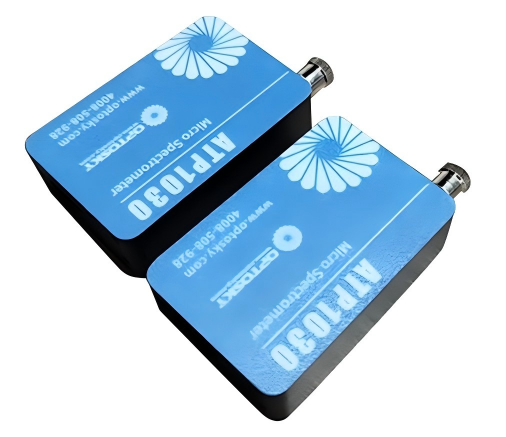
ATP1030 is an ultra‑compact, high‑resolution spectrometer covering 190–1100 nm. With a 1024‑pixel CMOS detector, adjustable integration time down to 1 ms, and USB‑powered design, it delivers reliable performance for applications like online water analysis, color measurement, handheld instruments, and Raman spectroscopy.
Product Recommendation | ATP1030 mini spectrometer Spectrometer

Vis-NIR transmission spectroscopy enables non-destructive identification of infertile duck eggs before incubation, achieving >95% accuracy. By detecting spectral fingerprints (e.g., 836 nm peak for fertile eggs), this method reduces energy waste and improves hatch rates, offering a low-cost, high-throughput solution for modern poultry farming.
Application case | How Spectral Technology is Transforming Duck Egg Farming