
Application Case | ATP2000 Spectrometer: Enabling In-Situ Plasma Diagnostics (OES) for Nanoparticle Synthesis
2025-11-28

In cutting-edge research at the intersection of nanomaterial synthesis and plasma technology, dusty plasma – a complex plasma system containing micro/nanoparticles – has shown significant potential in functional material preparation, energy conversion, and optoelectronic materials. How to accurately monitor plasma conditions in real-time and control nanoparticle synthesis has become a key focus for both scientific and industrial communities.
In a recent study published in Scientific Reports (a Nature Portfolio journal), researchers successfully utilized the Optosky ATP2000 optical fiber spectrometer to achieve in-situ electron temperature monitoring and spectral analysis during carbon nanoparticle synthesis in a DC glow discharge plasma, providing crucial data support for controlled nanomaterial synthesis.
Highlights of the Research Review
1. Real-time Electron Temperature Monitoring
In the study, the ATP2000 spectrometer was used to collect plasma emission spectra. By analyzing spectral line intensity ratios, researchers estimated the temporal evolution of electron temperature. The instrument was positioned perpendicular to the discharge tube and focused on the positive column region of the DC glow discharge. Results showed that the electron temperature reached its maximum value (1.3 eV) during the initial phase and gradually decreased as nanoparticles formed and grew. This process was closely correlated with the evolution of particle size and concentration.
2. Advantages of Non-contact Diagnostics
Compared with traditional probe methods, the Optical Emission Spectroscopy (OES) approach represented by the ATP2000 offers unique non-invasive and disturbance-free advantages, avoiding signal distortion caused by particle deposition on probe surfaces and ensuring data accuracy and reliability.
3. Multi-parameter Correlation Analysis
By combining laser attenuation measurements with ATP2000 spectral data, the research team systematically analyzed the dynamic relationships between particle size, concentration, and electron temperature, revealing the entire process of nanoparticle evolution from nucleation and coagulation to surface growth.
Application Advantages of ATP2000
-
Broad spectral range: Covers visible to NIR wavelengths, accurately capturing characteristic spectral lines in Ar/C₂H₂ plasma
-
High temporal resolution: Supports rapid sampling to adapt to transient changes in plasma parameters
-
Portability and ease of use: Modular design facilitates integration into various plasma experimental setups
-
Strong compatibility: Provides complete software and SDK support for secondary development and integration with platforms like LabVIEW, enabling automated data processing and analysis
Conclusion and Outlook
This research not only deepens the understanding of nanoparticle formation mechanisms in dusty plasmas but also demonstrates the powerful application potential of the ATP2000 spectrometer in plasma diagnostics and material synthesis processes. Whether for fundamental laboratory research or industrial-scale nanomaterial production, the ATP2000 provides researchers with reliable and efficient spectral solutions.
Reference
-
Ongaibergenov, Z., Orazbayev, S., Gabdullin, M. et al. Diagnostics and characterization of nanoparticles in dusty glow discharge plasma. Sci Rep 15, 37530 (2025). https://doi.org/10.1038/s41598-025-22182-0
Optosky ATP2000 Series Spectrometers
The ATP2000 series represents Optosky's high-performance optical fiber spectrometers, featuring high sensitivity, broad spectral range, and excellent stability. They are widely used in plasma diagnostics, environmental monitoring, biomedical applications, and materials analysis. We are committed to providing professional spectral measurement tools and system solutions for scientific research and industrial users.
Fundamentals | Decoding the Spectral Y-Axis: From Counts to Irradiance – Understanding Your Sample's Signal
Application Case | ATP2000H Spectrometer: High-Precision Prediction of Apple Firmness
Related Article

The ATP7810 is a wide-band, high-resolution infrared grating spectrometer covering up to 0.9–5 μm. Featuring a motorized rotating grating, multiple detector options (InGaAs/MCT), and flexible interfaces (SMA905 or free space, USB/UART control), it delivers high SNR and stability for absorption/reflection/transmission spectroscopy, laser wavelength testing, and fiber optic sensing.
New Product Recommendation | ATP7810 Ultra-Wide Range Infrared Spectrometer Series

This study uses the ATP5200P UV-Vis spectrometer to investigate xanthate adsorption on chalcopyrite surfaces. By analyzing absorbance at 300 nm under controlled pH and temperature, the method optimizes flotation conditions for copper recovery, enabling real-time, sensitive detection of adsorption mechanisms in non-ferrous mineral processing.
Using the ATP5200P Spectrometer to Unravel Xanthate Adsorption and Separation Mechanisms
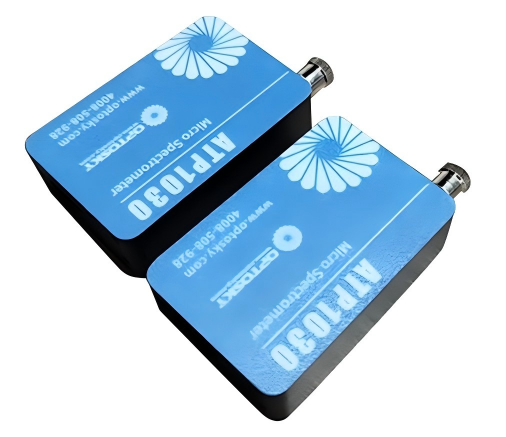
ATP1030 is an ultra‑compact, high‑resolution spectrometer covering 190–1100 nm. With a 1024‑pixel CMOS detector, adjustable integration time down to 1 ms, and USB‑powered design, it delivers reliable performance for applications like online water analysis, color measurement, handheld instruments, and Raman spectroscopy.
Product Recommendation | ATP1030 mini spectrometer Spectrometer

Vis-NIR transmission spectroscopy enables non-destructive identification of infertile duck eggs before incubation, achieving >95% accuracy. By detecting spectral fingerprints (e.g., 836 nm peak for fertile eggs), this method reduces energy waste and improves hatch rates, offering a low-cost, high-throughput solution for modern poultry farming.
Application case | How Spectral Technology is Transforming Duck Egg Farming