
Application Case | ATP5020R Spectrometer: Gaining In-Situ Raman Insights into Catalytic Reaction Processes
2025-12-12
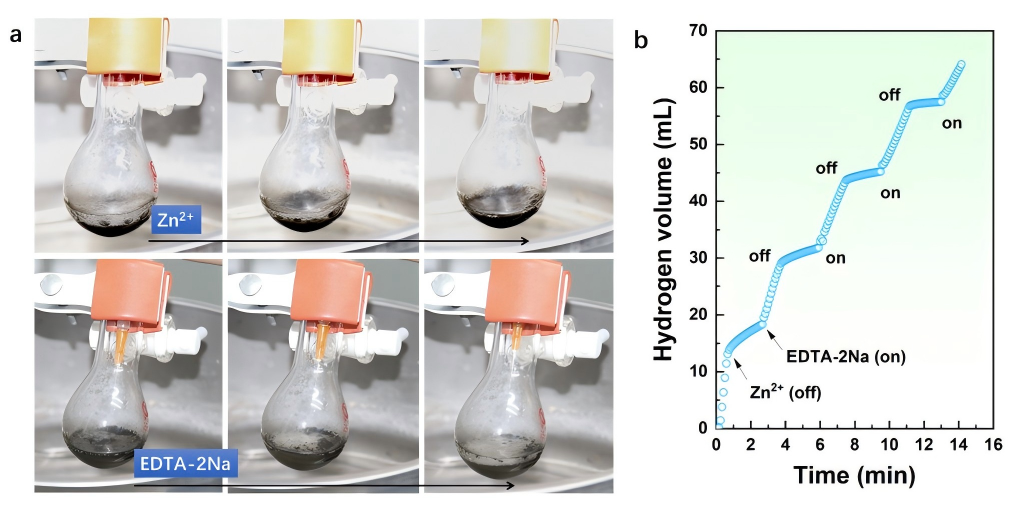
High-Performance Catalysis of Pt-Co₃O₄ in Dimethylamine Borane (DMAB) Hydrolytic Dehydrogenation
Amidst the global energy transition and rapid advancement of hydrogen technologies, efficient and controllable hydrogen production methods have become a key focus for both scientific research and industrial applications. A study published in the Journal of Alloys and Compounds demonstrated the exceptional performance of Pt-Co₃O₄ catalysts in the hydrolytic dehydrogenation of dimethylamine borane (DMAB), achieving an outstanding hydrogen generation rate of 64,063 mL·min⁻¹·gₚₜ⁻¹.
In this cutting-edge research, the Optosky ATP5020R Raman spectrometer served as a critical characterization tool, providing in-situ, dynamic molecular-level evidence to unravel the reaction mechanism.
Research Highlights: Synergistic Effects of Pt-Co₃O₄ Catalysts
Through a structural reconstruction strategy, the research team successfully developed a composite catalyst consisting of Pt nanoparticles supported on Pt-Co₃O₄ nanosheets rich in oxygen vacancies. This catalyst exhibited:
-
Exceptionally high hydrogen generation rates
-
Outstanding cycling stability
-
Controllable, "on-off" hydrogen production behavior
Key Contributions of the ATP5020R Spectrometer
In investigating the reaction mechanism, researchers utilized the ATP5020R spectrometer for in-situ Raman testing, with key contributions including:
-
Probing Water Molecule Dissociation on the Catalyst Surface
Using in-situ Raman spectroscopy, characteristic peaks were observed at 3273 cm⁻¹ and 3474 cm⁻¹, corresponding to the O-H stretching vibrations of water molecules in tetrahedrally and trihedrally coordinated structures on the catalyst surface. This directly demonstrated that oxygen vacancies facilitate efficient water molecule adsorption and dissociation.
-
Revealing Catalyst Structure and Metal-Support Interactions
A noticeable red-shift of the A₁g band in the Raman spectra confirmed that the introduction of Pt induces lattice distortion in Co₃O₄, enhancing metal-support interactions and providing a structural basis for the catalyst's high activity.
-
Helping Identify the Rate-Determining Step
Combined with kinetic isotope effect experiments, the Raman data further supported the conclusion that the cleavage of the O-H bond in water molecules is the rate-determining step in DMAB hydrolysis, providing clear direction for catalyst design.
ATP5020R Product Advantages
-
High Sensitivity: Easily detects weak signals from surface-adsorbed species.
-
In-Situ Capability: Supports real-time monitoring in various reaction environments, including solid-liquid and gas-solid interfaces.
-
532 nm Laser Source: Well-suited for a wide range of samples, including oxides, carbon materials, and metal catalysts.
-
User-Friendly Operation: Ideal for routine high-throughput laboratory testing and educational demonstrations.
Conclusion
The in-situ Raman system centered around the ATP5020R spectrometer not only acts as a "mechanism probe" in fundamental research but also provides a powerful analytical tool for applied fields such as catalytic material development, energy conversion, and environmental remediation. As this study demonstrates, Raman spectroscopy serves as an indispensable bridge connecting material structure and performance.
Reference
1. Jing Jiang, Jiayi Zhang, Baihao Wu, Sheng Tu, When Pt nanoparticles meet oxygen-deficient Co3O4: Enabling superior performance towards on-demand hydrogen generation from hydrolytic dehydrogenation of dimethylamine borane, Journal of Alloys and Compounds, Volume 969, 2023, 172369, ISSN 0925-8388, https://doi.org/10.1016/j.jallcom.2023.172369.
Spectrometer-Based Reflectance Measurement Solutions
Spectrometer-Based Transmittance Measurement Solutions
Related Article

The ATP7810 is a wide-band, high-resolution infrared grating spectrometer covering up to 0.9–5 μm. Featuring a motorized rotating grating, multiple detector options (InGaAs/MCT), and flexible interfaces (SMA905 or free space, USB/UART control), it delivers high SNR and stability for absorption/reflection/transmission spectroscopy, laser wavelength testing, and fiber optic sensing.
New Product Recommendation | ATP7810 Ultra-Wide Range Infrared Spectrometer Series

This study uses the ATP5200P UV-Vis spectrometer to investigate xanthate adsorption on chalcopyrite surfaces. By analyzing absorbance at 300 nm under controlled pH and temperature, the method optimizes flotation conditions for copper recovery, enabling real-time, sensitive detection of adsorption mechanisms in non-ferrous mineral processing.
Using the ATP5200P Spectrometer to Unravel Xanthate Adsorption and Separation Mechanisms
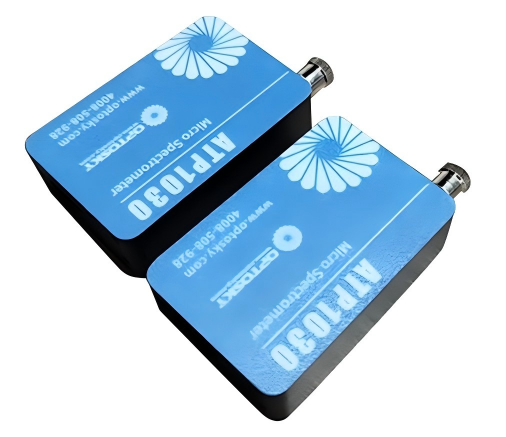
ATP1030 is an ultra‑compact, high‑resolution spectrometer covering 190–1100 nm. With a 1024‑pixel CMOS detector, adjustable integration time down to 1 ms, and USB‑powered design, it delivers reliable performance for applications like online water analysis, color measurement, handheld instruments, and Raman spectroscopy.
Product Recommendation | ATP1030 mini spectrometer Spectrometer

Vis-NIR transmission spectroscopy enables non-destructive identification of infertile duck eggs before incubation, achieving >95% accuracy. By detecting spectral fingerprints (e.g., 836 nm peak for fertile eggs), this method reduces energy waste and improves hatch rates, offering a low-cost, high-throughput solution for modern poultry farming.
Application case | How Spectral Technology is Transforming Duck Egg Farming