
Application Case | ATP5020R Spectrometer: Gaining In-Situ Raman Insights into Pollutant Degradation Catalyzed by MBene
2025-12-18

In the fields of water treatment and environmental pollution control, advanced oxidation technologies are highly regarded for their effectiveness in degrading organic pollutants. Recently, two-dimensional MBene materials, the boron analogues of MXenes, have demonstrated exceptional catalytic performance, particularly in activating peroxymonosulfate (PMS). In a published study, researchers successfully constructed a Co-MoAl₁₋ₓB/PMS catalytic system, achieving highly efficient degradation of the typical antibiotic ornidazole (ONZ).
This research employed the Optosky ATP5020R-RM Raman Spectrometer for in-situ monitoring and mechanistic analysis of the degradation process.
01 Raman Spectroscopy: The 'Eye' into Reaction Processes
In this study, researchers utilized the ATP5020R Raman Spectrometer for real-time, in-situ tracking of the PMS activation process on the surface of the Co-MoAl₁₋ₓB catalyst. By monitoring changes in key vibrational peaks, such as those from the O–O and S–O bonds within PMS molecules, the decomposition pathway of PMS and the generation mechanism of reactive species were revealed.
Key findings include:
-
PMS was rapidly activated on the Co-MoAl₁₋ₓB surface, indicated by a significant weakening of S–O bond signals.
-
The intensity ratio of the SO₄²⁻ peak to the HSO₅⁻ peak (I₉₇₈/I₁₀₅₇) increased markedly over time, confirming effective PMS decomposition.
-
The HSO₅⁻ peak shifted from 1057 cm⁻¹ to 1045 cm⁻¹, signifying strong electronic interaction between the catalyst and PMS, which promotes the generation of reactive oxygen species.
These in-situ Raman data provided direct evidence for understanding the synergistic radical and non-radical degradation mechanisms and offered guidance for optimizing catalyst design.
02 ATP5020R Performance Features
Optosky ATP5020R Raman Spectrometer possesses the following advantages, making it an ideal tool for environmental catalysis research:
-
High Sensitivity & Stability: Delivers clear, highly reproducible spectral signals even within reaction systems.
-
In-situ Detection Capability: Enables real-time process monitoring without sampling, avoiding interference.
-
532 nm Laser Source: Well-suited for studying the surface structure of various catalysts and molecular adsorption behaviors.
-
User-friendly Operation & Intelligent Analysis: Supports rapid spectrum interpretation and kinetic fitting.
03 Research Insights and Environmental Prospects
This study not only successfully applied MBene materials in a PMS catalytic system but also, through advanced characterization techniques like the ATP5020R Raman spectrometer, revealed the intrinsic mechanism behind their high pollutant degradation efficiency. This provides both theoretical and technical support for designing next-generation water treatment catalysts and promoting the application of MBene materials in environmental remediation. Moving forward, Optosky remains committed to collaborating with researchers, leveraging precise and efficient spectral technology to support the development of green technologies and contribute to protecting our environment.
References
Xinyu Zheng, Lunhong Ai, Jia Ran, Sheng Tu, Aike Liu, Jing Jiang, Two-dimensional MBene combined with cobalt nanoparticles enabling highly efficient peroxymonosulfate activation for ornidazole degradation, Separation and Purification Technology, Volume 354, Part 1, 2025, 128647, ISSN 1383-5866, https://doi.org/10.1016/j.seppur.2024.128647.
Application Case | Precision Control of ALD Process: ATP5020P Supports the Industrialization of Perovskite Quantum Dots
Spectrometer-Based Reflectance Measurement Solutions
Related Article

The ATP7810 is a wide-band, high-resolution infrared grating spectrometer covering up to 0.9–5 μm. Featuring a motorized rotating grating, multiple detector options (InGaAs/MCT), and flexible interfaces (SMA905 or free space, USB/UART control), it delivers high SNR and stability for absorption/reflection/transmission spectroscopy, laser wavelength testing, and fiber optic sensing.
New Product Recommendation | ATP7810 Ultra-Wide Range Infrared Spectrometer Series

This study uses the ATP5200P UV-Vis spectrometer to investigate xanthate adsorption on chalcopyrite surfaces. By analyzing absorbance at 300 nm under controlled pH and temperature, the method optimizes flotation conditions for copper recovery, enabling real-time, sensitive detection of adsorption mechanisms in non-ferrous mineral processing.
Using the ATP5200P Spectrometer to Unravel Xanthate Adsorption and Separation Mechanisms
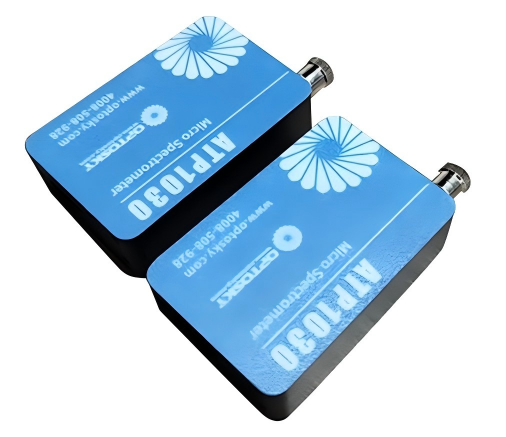
ATP1030 is an ultra‑compact, high‑resolution spectrometer covering 190–1100 nm. With a 1024‑pixel CMOS detector, adjustable integration time down to 1 ms, and USB‑powered design, it delivers reliable performance for applications like online water analysis, color measurement, handheld instruments, and Raman spectroscopy.
Product Recommendation | ATP1030 mini spectrometer Spectrometer

Vis-NIR transmission spectroscopy enables non-destructive identification of infertile duck eggs before incubation, achieving >95% accuracy. By detecting spectral fingerprints (e.g., 836 nm peak for fertile eggs), this method reduces energy waste and improves hatch rates, offering a low-cost, high-throughput solution for modern poultry farming.
Application case | How Spectral Technology is Transforming Duck Egg Farming