
Enhancing Tissue Identification with Spectroscopy Precision
2024-10-22

Advances in medical technology continue to shape the way healthcare is delivered, with spectroscopy emerging as a game-changer for tissue identification. Spectroscopy, the study of the interaction between matter and electromagnetic radiation, is now playing a crucial role in enhancing the precision of medical procedures, from surgeries to diagnostics. With its ability to provide real-time data and detailed tissue characterization, spectroscopic tools are transforming how physicians and surgeons approach patient care.
Spectroscopy in Medicine
Spectroscopy has long been used in scientific research, but recent developments have unlocked its potential in clinical settings. The core advantage of spectroscopy lies in its precision—by analyzing the way tissues absorb and scatter light, spectrometers can provide unique "signatures" for different types of tissues. This makes it possible to identify and characterize tissues with remarkable accuracy without the need for invasive procedures.
Real-Time Surgical Precision
One of the most significant applications of spectroscopy in medicine is in surgical settings. Traditionally, surgeons have relied on visual cues and experience to distinguish between healthy and diseased tissues. This can sometimes lead to uncertainty, especially in complex cases like tumor resections, where identifying clear margins between cancerous and healthy tissue is crucial.
With spectrometers integrated into surgical tools, surgeons can receive real-time feedback on the composition of the tissue they are cutting. For example, during brain surgery or tumor excision, spectroscopy can help differentiate between malignant and non-malignant tissue with precision that surpasses the human eye. This leads to more effective surgeries with fewer complications and a lower likelihood of leaving behind malignant cells.
Spectroscopy in Anesthesia and Monitoring
Beyond surgical applications, spectroscopy also enhances the precision of anesthesia delivery and patient monitoring. Anesthesia is typically delivered based on estimates of body mass and physiological response, but this process can be refined through spectroscopic monitoring. By analyzing the body's metabolic signals, spectrometers provide real-time feedback on how the body is processing anesthetics, allowing doctors to fine-tune dosage in response to the patient's unique biology. This not only improves the safety of anesthesia but also reduces the risk of over- or under-dosing, both of which can have serious consequences.
Smart Biopsies and Non-Invasive Diagnostics
In diagnostics, spectroscopic methods are enabling "smart biopsies" that improve the accuracy of tissue sampling. Traditionally, biopsies are performed by extracting tissue and sending it to a lab for analysis, which can be time-consuming and may result in inconclusive results if the sample misses key areas. Spectroscopic tools, on the other hand, can provide immediate feedback on the nature of the tissue during a biopsy, ensuring that the sample comes from the most relevant area.
Furthermore, spectroscopy offers a pathway to non-invasive diagnostics. Instead of relying on tissue extraction, spectrometers can analyze tissues in situ, meaning physicians can gain insights into a patient's condition without the need for incisions. This is particularly useful for patients who are at higher risk from invasive procedures or for detecting diseases at an earlier stage when symptoms may not yet be apparent.
Depth Determination for Targeted Treatments
Another groundbreaking application of spectroscopy is in determining tissue depth and structure for targeted treatments. This is essential for procedures like radiation therapy or focused ultrasound, where precise depth targeting is crucial for maximizing effectiveness and minimizing damage to surrounding tissues. Spectroscopy provides detailed information about the layers of tissue, ensuring that treatments reach the intended area with pinpoint accuracy.
The Future of Spectroscopic Innovations in Medicine
The future of spectroscopy in healthcare looks incredibly promising. As technologies continue to evolve, we can expect even greater precision in tissue identification, leading to more personalized and effective medical treatments. Spectroscopy could become a standard feature in operating rooms and diagnostic centers, enabling doctors to perform procedures that are not only more accurate but also less invasive.
With its applications ranging from smarter surgeries to safer anesthesia and more efficient biopsies, spectroscopy is paving the way for a new era of medical precision. As these tools become more widely adopted, patients will benefit from faster recovery times, fewer complications, and more targeted treatments tailored to their unique needs.
Spectroscopic innovations are reshaping the landscape of healthcare, offering real-time data that empowers physicians to make more informed decisions. By enhancing tissue identification with spectroscopic precision, we are moving toward a future where medical procedures are not only more effective but also far less invasive.
Conclusion
Spectroscopy is revolutionizing the medical field, providing unparalleled precision in tissue identification, improving surgical outcomes, and leading to smarter, safer, and more efficient treatments. Its role in enhancing medical diagnostics and treatment strategies marks a significant leap forward in modern healthcare.
Spectroscopy-Driven In-line Process Optimization in Smart Manufacturing
Product Introduction | ATP2000 Series Cost-effective Spectrometer
Related Article

The ATP7810 is a wide-band, high-resolution infrared grating spectrometer covering up to 0.9–5 μm. Featuring a motorized rotating grating, multiple detector options (InGaAs/MCT), and flexible interfaces (SMA905 or free space, USB/UART control), it delivers high SNR and stability for absorption/reflection/transmission spectroscopy, laser wavelength testing, and fiber optic sensing.
New Product Recommendation | ATP7810 Ultra-Wide Range Infrared Spectrometer Series

This study uses the ATP5200P UV-Vis spectrometer to investigate xanthate adsorption on chalcopyrite surfaces. By analyzing absorbance at 300 nm under controlled pH and temperature, the method optimizes flotation conditions for copper recovery, enabling real-time, sensitive detection of adsorption mechanisms in non-ferrous mineral processing.
Using the ATP5200P Spectrometer to Unravel Xanthate Adsorption and Separation Mechanisms
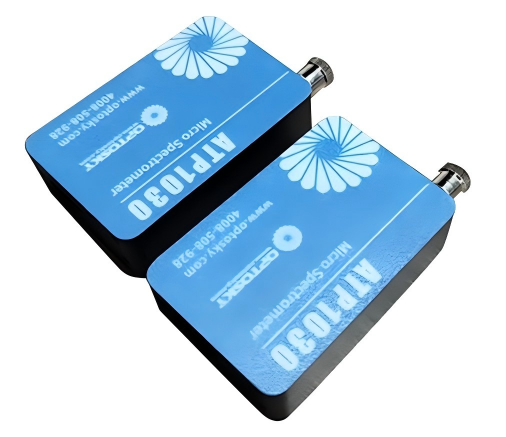
ATP1030 is an ultra‑compact, high‑resolution spectrometer covering 190–1100 nm. With a 1024‑pixel CMOS detector, adjustable integration time down to 1 ms, and USB‑powered design, it delivers reliable performance for applications like online water analysis, color measurement, handheld instruments, and Raman spectroscopy.
Product Recommendation | ATP1030 mini spectrometer Spectrometer

Vis-NIR transmission spectroscopy enables non-destructive identification of infertile duck eggs before incubation, achieving >95% accuracy. By detecting spectral fingerprints (e.g., 836 nm peak for fertile eggs), this method reduces energy waste and improves hatch rates, offering a low-cost, high-throughput solution for modern poultry farming.
Application case | How Spectral Technology is Transforming Duck Egg Farming