Product Recommendation | Grating Spectrometer ATP7330
Product Recommendation | Grating Spectrometer ATP7330
A spectrometer is an advanced scientific device that primarily functions by using the principles of refraction or diffraction to decompose polychromatic light into its spectral components. In scientific research and industrial production, spectrometers play a crucial role. Among them, grating spectrometers stand out in the field of spectral measurement due to their exceptional performance and wide applications. The grating spectrometer utilizes advanced grating technology to achieve high-precision spectral measurement. It boasts high measurement accuracy, excellent stability, and strong anti-interference capabilities, making it widely used across various fields. Whether in scientific research, environmental monitoring, energy development, or industrial production and quality control, the grating spectrometer plays an indispensable role.
Optical Path Structure of the Grating Spectrometer
When a beam of composite light passes through the entrance slit of a monochromator, it is first focused into parallel light by an optical collimating mirror. Next, these parallel rays pass through a diffraction grating, where they are dispersed into different wavelengths (colors). Since each wavelength exits the grating at a different angle, after being focused by a focusing mirror, the light is directed onto a CCD (in the case of the ATP7330 Grating Spectrometer) or forms monochromatic light through an exit slit (in the case of the ATP7300 Grating Monochromator). This instrument can be controlled via a computer to precisely adjust the wavelength range or the output wavelength. When combined with a detector, the grating monochromator forms a grating spectrometer.
Introduction to Grating Spectrometer ATP7330
The ATP7330 series grating spectrometer, developed by Optosky based on over 20 years of expertise in spectrometer research and development, integrates advanced technology from various imported international products. Thanks to its outstanding performance and innovative design, it represents a new generation of grating spectrometers. This series has received widespread acclaim from users and has become a leader in the field of scientific research. Featuring a reflective grating, it offers high precision and strong stability. With precise software control, the grating turret operates with high accuracy, ensuring precise alignment between the grating and the tested wavelength. This provides researchers with reliable data sources, significantly enhancing measurement accuracy and reliability.
Compared to traditional prism-based spectrometers or transmission gratings, the ATP7330 series demonstrates significant advantages. It can cover a broad spectral range from ultraviolet to near-infrared and mid-longwave infrared, a feature unmatched by other types of spectrometers. Researchers can easily swap out the grating and detector to gain greater flexibility in selecting wavelengths and resolution, allowing them to better adapt to various experimental conditions and requirements.
The ATP7330 utilizes a back-to-back turret with three high-diffraction-efficiency gratings.
The turreted rotating grating, built into the ATP7330 series, is its core component, designed with exceptional precision and craftsmanship. The ATP7330 adopts a staggered back-to-back registration technique to ensure the highest diffraction efficiency and the fastest positioning speed. Each grating undergoes rigorous testing, and the precision registration system allows for independent three-dimensional adjustment for each grating. Fine clock-like calibration ensures a verticality of up to 99.9%. Its fully enclosed assembly combines mechanical design with high-strength optical adhesives, enhancing overall stability. A precision optical encoder controls the absolute pointing angle of the grating, with a minimum rotational angle of 0.0016°, ensuring each grating is positioned at its optimal working angle. The ATP7330 can accommodate 2 to 4 gratings, offering diverse options ranging from 90 lines, 150 lines, to 3600 lines, meeting the needs of researchers for different resolution and measurement accuracy requirements.
ATP7330-FL210 Spectral Measurement Graph
ATP7330-FL510 Spectral Measurement Graph (Applied in Raman Spectroscopy with 1200-line Grating)
The ATP7330-FL510 demonstrates exceptional performance in Raman spectroscopy, utilizing a 1200-line grating. This configuration enhances spectral resolution and accuracy, making it highly suitable for detailed Raman spectral analysis. Overall, the ATP7330 series, with its outstanding performance, innovative design, and diverse configuration options, opens up endless possibilities for researchers. Its introduction will undoubtedly bring unprecedented efficiency and precision to laboratory experiments, advancing the progress of scientific research.
Advantages of the ATP7330 Series Grating Spectrometer
Only Two Cables Required
The ATP7330 requires only a +12V/24V DC power supply and a single USB cable for motorized control and spectral data measurement via software. By reducing the number of cables, the convenience of the device is significantly enhanced, eliminating the hassle of cable clutter. Fewer connection points also greatly improve the reliability of the equipment, reducing the risk of potential malfunctions. Additionally, this connection method ensures high efficiency, offering faster connection speeds and data transfer rates, making the device much more user-friendly.
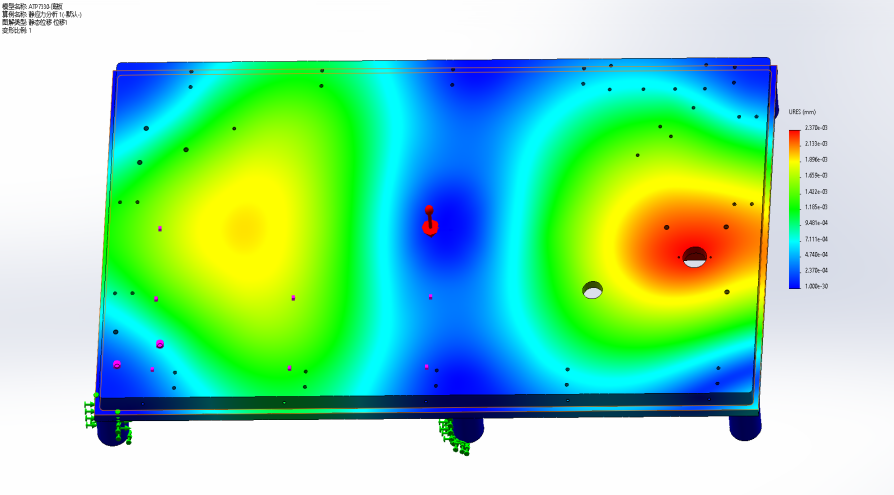
Detailed Stress Analysis and Reliability Design
Comprehensive stress analysis and reliability design effectively predict product performance, optimize structure, and reduce failure risks and maintenance costs, thereby extending the product's lifespan. Reliability design focuses not only on meeting performance requirements but also on enhancing product reliability and availability, ensuring stable operation under various environments and conditions, thus increasing user satisfaction. These methods also help shorten the product development cycle, lower costs, and improve product quality and reliability, reducing the risk of failures and malfunctions during use, thereby enhancing performance, extending lifespan, and improving production efficiency.
Automatic wavelength calibration technology uses advanced algorithms and sensors to achieve high-precision wavelength calibration, ensuring measurement accuracy and precision. Unlike traditional wavelength calibration methods, which require manual operation and measurement and are time-consuming and labor-intensive, automatic wavelength calibration technology completes the entire calibration process automatically, significantly improving work efficiency. By executing calibration tasks through automated programs, it eliminates potential human error, enhancing the objectivity and fairness of the calibration results.
ATP7330 Grating Spectrometer Application Scenarios
The ATP7330 rotating grating spectrometer is a high-performance spectral analysis instrument with a wide range of applications and excellent performance. It can perform various types of spectral analysis, including fluorescence, Raman, transmission/reflection, and absorption, making it suitable for research in fields such as biology, chemistry, materials science, and environmental science.
In fluorescence spectroscopy, the ATP7330 is renowned for its high sensitivity and rapid scanning capabilities, accurately capturing fluorescence signals and providing robust support for biological and chemical research. Additionally, its exceptional reliability design ensures accurate measurement results.
For Raman spectroscopy, the ATP7330 grating spectrometer is a critical component of high-performance microscopic Raman systems like Optosky's ATR8300PRO and ATR8800, enabling precise and efficient sample detection. This provides a convenient tool for materials science research and chemical analysis.
Overall, the ATP7330 rotating grating spectrometer is a powerful and versatile spectral analysis device. It demonstrates outstanding performance and reliable measurement results in both research and everyday applications, offering strong technical support to researchers and industry professionals.
Do You Really Know about Modular Spectrometer?
Solution|Application of Fiber Optic Spectrometers in Color Measurement
Related Article