
Application Case | IR2300 Near-Infrared Grain Analyzer Enhances Grain Station Receiving and Storage Efficiency
2026-03-24
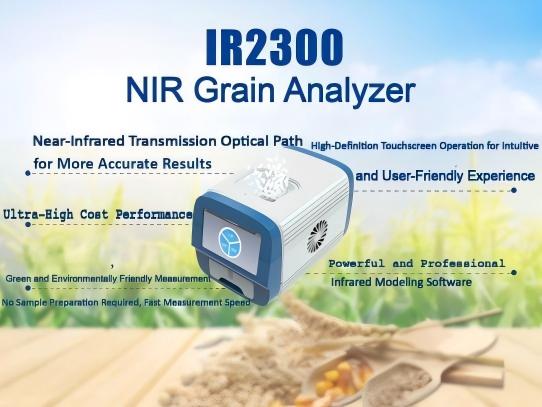
Optosky's near-infrared spectroscopy instrument series includes handheld inspection devices, laboratory testing equipment, and on-site testing tools, fully leveraging the advantages of near-infrared technology in rapid, non-destructive, and accurate detection. These instruments are applied in smart agriculture, water quality testing, food safety, public safety, industrial inspection, and other fields. This edition focuses on the application of the IR2300 Near-Infrared Grain Analyzer in grain quality testing.
01 Application Overview
Application Direction: Rapid Monitoring of Grain Quality Parameters
In the grain industry chain, indicators such as moisture content, protein content, amylose content, and fatty acid value directly affect the processing quality and nutritional value of grains. Traditional testing methods often require tedious sample preparation and experimental procedures, which are time-consuming and inefficient. This not only affects the pace of grain purchasing and shipping but also easily leads to quality judgment errors due to testing delays, increasing the operational risks for enterprises. Customers urgently need a fast, stable, and accurate testing tool to meet the demands of large-scale sample testing and high-frequency detection.
02 Application Cases
Recently, the IR2300 Near-Infrared Grain Analyzer was successfully deployed at a local grain quality inspection center, helping customers achieve rapid detection of parameters such as moisture content, protein content, and amylose content in grains.
The IR2300 Near-Infrared Grain Analyzer has a maximum spectral range of 570nm to 1100nm, enabling it to sensitively capture the spectral information of grains and quickly and accurately analyze parameters such as moisture, protein, and amylose in rice, as well as moisture and fatty acids in paddy. Users simply pour the grain sample into the instrument without tedious sample preparation and obtain test results within 30 seconds.
Customers have deployed the IR2300 at the grain purchasing stage to quickly determine moisture and amylose content, significantly improving detection efficiency at the acquisition site and avoiding purchasing delays caused by manual waiting or data lag. At the grain shipping stage, the IR2300 is used for quality verification and stability control, helping enterprises effectively prevent quality risks.
Customer Site
▲Grain Testing
▲Rice Testing
03 Application Results
Customer feedback indicates that the IR2300 has solved the problem of cumbersome and inefficient testing processes, greatly improving work efficiency in grain reception and shipping.
-
Significantly Improved Detection Efficiency
Single test time: 30-60 seconds
-
Stable and Reliable Data
Relative error for parameters such as moisture, protein, and amylose controlled within ±10%; repeatability CV ≤5%; inter-instrument difference ≤3%
-
Easy Operation
Built-in models and professional modeling software support; users can operate directly on site without building models from scratch
-
High Cost Performance
Core components are independently developed and produced, ensuring instrument durability and reducing maintenance costs.
Currently, the IR2300 Near-Infrared Grain Analyzer, independently developed by Optosky, has been applied in multiple fields such as grain and oil centers, purchasing and storage facilities, and grain processing enterprises: In rice and paddy purchasing, it helps procurement personnel quickly assess quality and avoid economic losses; in processing stages, it monitors key parameters in real time, optimizing processes and ensuring quality; in corn and other grain applications, it also provides stable and efficient testing support.
For more information, please contact:
Email: [email protected]
Web: www.optosky.net
Fundamentals | Understanding Spectrometer Parameters: Stray Light and Stability
Application Case | ATP8600: Enabling Intelligent Online Quality Inspection for Kiwifruit
Related Article

The ATP7810 is a wide-band, high-resolution infrared grating spectrometer covering up to 0.9–5 μm. Featuring a motorized rotating grating, multiple detector options (InGaAs/MCT), and flexible interfaces (SMA905 or free space, USB/UART control), it delivers high SNR and stability for absorption/reflection/transmission spectroscopy, laser wavelength testing, and fiber optic sensing.
New Product Recommendation | ATP7810 Ultra-Wide Range Infrared Spectrometer Series

This study uses the ATP5200P UV-Vis spectrometer to investigate xanthate adsorption on chalcopyrite surfaces. By analyzing absorbance at 300 nm under controlled pH and temperature, the method optimizes flotation conditions for copper recovery, enabling real-time, sensitive detection of adsorption mechanisms in non-ferrous mineral processing.
Using the ATP5200P Spectrometer to Unravel Xanthate Adsorption and Separation Mechanisms
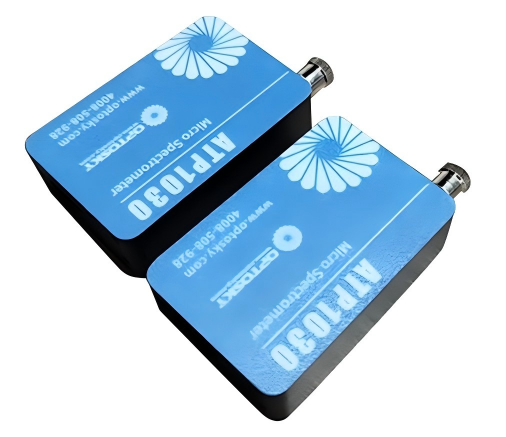
ATP1030 is an ultra‑compact, high‑resolution spectrometer covering 190–1100 nm. With a 1024‑pixel CMOS detector, adjustable integration time down to 1 ms, and USB‑powered design, it delivers reliable performance for applications like online water analysis, color measurement, handheld instruments, and Raman spectroscopy.
Product Recommendation | ATP1030 mini spectrometer Spectrometer

Vis-NIR transmission spectroscopy enables non-destructive identification of infertile duck eggs before incubation, achieving >95% accuracy. By detecting spectral fingerprints (e.g., 836 nm peak for fertile eggs), this method reduces energy waste and improves hatch rates, offering a low-cost, high-throughput solution for modern poultry farming.
Application case | How Spectral Technology is Transforming Duck Egg Farming