
Revolutionizing Point-of-Care Diagnostics and Treatment with Spectroscopy
2024-10-18

In today’s fast-paced healthcare environment, having quick and reliable diagnostic tools is more crucial than ever. Our article, “Enhancing Point-of-Care Diagnostics and Treatment through Spectroscopy,” delves into how spectroscopic technologies are transforming point-of-care (POC) diagnostics and treatment, paving the way for more efficient and effective healthcare delivery.
The Role of Spectroscopy in POC Diagnostics
Spectroscopy is revolutionizing POC diagnostics by providing rapid and accurate results, which are vital in critical care situations where every second counts. Many spectroscopic techniques are non-invasive, making them particularly valuable in pediatrics and geriatrics, where traditional sample collection methods can be challenging and stressful for patients. This non-invasive nature allows for easier monitoring of patients without the discomfort associated with blood draws or other invasive procedures.
Versatility of Spectroscopic Techniques
The versatility of spectroscopy enables the analysis of a wide range of biological samples, including blood, urine, saliva, and even tissues. This capability allows for comprehensive diagnostics, helping healthcare providers make informed decisions swiftly. By analyzing these diverse samples, clinicians can detect various conditions and monitor patient health in real-time.
Innovative Spectroscopic Products
Recent advancements have led to the development of innovative products like handheld spectrometers and portable diagnostic kits. Notable examples include the SCIO and Scan-Eat, which allow for real-time nutritional analysis and detection of various biomarkers from just a few drops of saliva or blood. These devices not only enhance diagnostic capabilities but also empower patients to monitor their health more proactively, fostering a more engaged approach to personal health management.
Accessibility and Convenience
Advancements in technology have facilitated the creation of portable and handheld spectroscopic devices, making it possible to conduct tests in various settings—from bustling urban hospitals to remote rural clinics. This accessibility ensures that high-quality diagnostics are available regardless of location, bridging the gap in healthcare disparities and making timely interventions possible.
Future Implications for Healthcare
As we continue to explore the ultimate potential of spectroscopy in healthcare, its integration into everyday clinical practice holds the promise of not only improving diagnostic accuracy but also enhancing treatment outcomes. By making sophisticated diagnostics available at the point of care, we can significantly improve patient experiences and foster timely interventions, ultimately leading to better health outcomes.
In summary, the intersection of spectroscopy and point-of-care diagnostics is set to redefine healthcare delivery, making it faster, more accurate, and more accessible for all patients.
Enhancing the Solar Industry with Spectroscopy
Different Principles: Implementing MIR Spectrometers
Related Article

The ATP7810 is a wide-band, high-resolution infrared grating spectrometer covering up to 0.9–5 μm. Featuring a motorized rotating grating, multiple detector options (InGaAs/MCT), and flexible interfaces (SMA905 or free space, USB/UART control), it delivers high SNR and stability for absorption/reflection/transmission spectroscopy, laser wavelength testing, and fiber optic sensing.
New Product Recommendation | ATP7810 Ultra-Wide Range Infrared Spectrometer Series

This study uses the ATP5200P UV-Vis spectrometer to investigate xanthate adsorption on chalcopyrite surfaces. By analyzing absorbance at 300 nm under controlled pH and temperature, the method optimizes flotation conditions for copper recovery, enabling real-time, sensitive detection of adsorption mechanisms in non-ferrous mineral processing.
Using the ATP5200P Spectrometer to Unravel Xanthate Adsorption and Separation Mechanisms
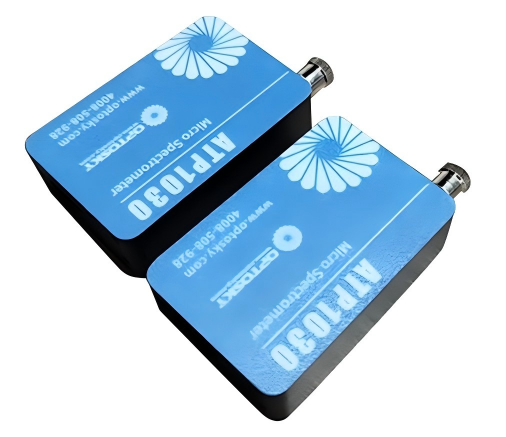
ATP1030 is an ultra‑compact, high‑resolution spectrometer covering 190–1100 nm. With a 1024‑pixel CMOS detector, adjustable integration time down to 1 ms, and USB‑powered design, it delivers reliable performance for applications like online water analysis, color measurement, handheld instruments, and Raman spectroscopy.
Product Recommendation | ATP1030 mini spectrometer Spectrometer

Vis-NIR transmission spectroscopy enables non-destructive identification of infertile duck eggs before incubation, achieving >95% accuracy. By detecting spectral fingerprints (e.g., 836 nm peak for fertile eggs), this method reduces energy waste and improves hatch rates, offering a low-cost, high-throughput solution for modern poultry farming.
Application case | How Spectral Technology is Transforming Duck Egg Farming