
Spectral Analysis: Detecting Moisture Content in Xuan Paper via Near-Infrared Spectroscopy (NIRS)
2025-08-19

Application Introduction
In the field of cultural heritage preservation, maintaining the condition of paper artifacts has long been a key challenge. As the traditional carrier for Chinese calligraphy and painting, Xuan paper’s moisture content directly impacts the artifacts’ lifespan—excessive humidity causes mold, while insufficient moisture leads to cracking.
Near-Infrared Spectroscopy (NIRS) has emerged as a crucial solution for Xuan paper moisture detection, thanks to its non-destructive and rapid testing advantages.
01 Technical Principles
Fig. 1 Image of Xuan Paper
-
Detection Principle
Xuan paper is mainly composed of cellulose, and the O-H bonds in water molecules exhibit characteristic absorption in the near-infrared band (900~1700 nm). When NIR light irradiates Xuan paper, varying moisture contents alter the intensity of absorption peaks around 1000 nm and 1500 nm:
-
High moisture content: Enhanced stretching and bending vibrations of O-H bonds lead to a significant increase in the absorption peak near 1500 nm.
-
Low moisture content: Reduced absorption peak intensity, resulting in a flatter spectral curve.
-
Technical Advantages: Non-Destructive Testing
Compared with traditional oven-drying methods, NIR reflectance spectroscopy offers three major breakthroughs:
-
Non-destructive: No sampling required; tests are conducted directly on intact calligraphy/paintings, avoiding paper embrittlement caused by high-temperature drying.
-
Fast and efficient: Single spectral acquisition takes only milliseconds. Combined with the reflectance probe of Optosky spectrometers, on-site real-time analysis is achievable.
-
Accurate data: Through chemometric modeling, it can detect moisture fluctuations as small as 0.5%, more reliable than visual observation.
02 Practical Applications: From Laboratory to Relic Depositories
-
Experimental Design: Simulating Relic Preservation Environments
As configured in referenced studies, the research team used cotton-based four-foot single-layer Xuan paper as samples. Seven types of humidity-regulating salts were used to create environments with different relative humidity (RH) gradients, stabilizing the paper’s moisture content between 6% and 16%. A fiber optic spectrometer was employed to collect extensive spectra; subsequent dataset division and preprocessing provided data support for building a moisture content prediction model.
-
Practical Application Scenarios
-
Humidity Monitoring in Relic Depositories
In calligraphy/painting studios and repositories of museums like the Palace Museum, NIRS spectrometers can be integrated into constant temperature and humidity systems to real-time monitor the moisture content of Xuan paper artifacts in display cabinets. When the spectrum shows an abnormal rise in the 1500 nm absorption peak, the system automatically activates dehumidification equipment to prevent mold growth.
(2) Condition Assessment Before Restoration
Before restoring an ancient Ming Dynasty painting, NIRS scanning can generate a "moisture content distribution map":
-
Yellowed areas: Moisture content is often below 8%, requiring gentle humidification.
-
Moldy areas: Moisture content may exceed 12%, requiring drying before cleaning.
(3) Establishing Digital Preservation Archives
" Spectral archives" are created for each paper artifact to record spectral changes across different eras and preservation environments. For example, NIRS data of Dunhuang manuscripts shows that each 1% decrease in moisture content accelerates cellulose degradation by 3%, providing quantitative basis for formulating preservation plans.
-
Future Development Directions & Potential
Fig. 4 Physical Image of ATP8130
Currently, portable NIRS spectrometers (e.g., those from Optosky) feature palm-sized, lightweight designs. Equipped with fiber optic probes, they enable non-destructive testing of complex-shaped artifacts like scroll paintings.
In the future, the technology will advance in two directions:
Multi-parameter simultaneous detection: Beyond moisture content, it will synchronously analyze cellulose crystallinity, dye components, etc., to build "health archives" for cultural relics.
AI intelligent early warning: By deep learning spectral databases, it will predict risks such as paper embrittlement and fading in advance, enabling preventive preservation.
Fig. 5 ATP8000 - Cooled Near-Infrared Spectrometer
Conclusion
From laboratory spectral modeling to real-time museum monitoring, NIRS, with its accuracy and non-destructive nature, provides strong support for the preservation and inheritance of paper cultural relics. Choose Optosky spectrometers to ensure Xuan paper remains well-preserved for millennia—allowing copies of Wang Xizhi’s Lanting Xu and Dunhuang manuscripts to continue telling the stories of China’s thousand-year-old civilization under scientific protection.
References
Wang Jianxu, Tan Yinyu, Qin Dan, Tang Bin, Tang Huan, Fan Wenqi, Yang Wen, Zhong Nianbing, Zhao Mingfu. Non-Destructive Detection of Moisture Content in Xuan Paper Based on Near-Infrared Reflectance Spectroscopy[J]. Spectroscopy and Spectral Analysis, 2025, 45(6): 1629-1638. DOI:10.3964/j.issn.1000-0593(2025)06-1629-10
Spectrometers: From Coal-Rock Identification to Coal Quality Analysis
Spectral Analysis: The Ecological Code to Safeguard the Oceans
Related Article

The ATP7810 is a wide-band, high-resolution infrared grating spectrometer covering up to 0.9–5 μm. Featuring a motorized rotating grating, multiple detector options (InGaAs/MCT), and flexible interfaces (SMA905 or free space, USB/UART control), it delivers high SNR and stability for absorption/reflection/transmission spectroscopy, laser wavelength testing, and fiber optic sensing.
New Product Recommendation | ATP7810 Ultra-Wide Range Infrared Spectrometer Series

This study uses the ATP5200P UV-Vis spectrometer to investigate xanthate adsorption on chalcopyrite surfaces. By analyzing absorbance at 300 nm under controlled pH and temperature, the method optimizes flotation conditions for copper recovery, enabling real-time, sensitive detection of adsorption mechanisms in non-ferrous mineral processing.
Using the ATP5200P Spectrometer to Unravel Xanthate Adsorption and Separation Mechanisms
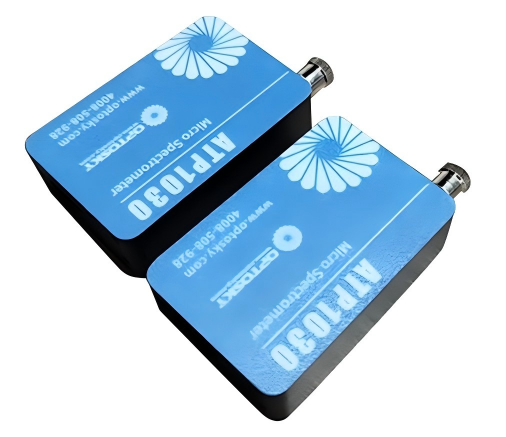
ATP1030 is an ultra‑compact, high‑resolution spectrometer covering 190–1100 nm. With a 1024‑pixel CMOS detector, adjustable integration time down to 1 ms, and USB‑powered design, it delivers reliable performance for applications like online water analysis, color measurement, handheld instruments, and Raman spectroscopy.
Product Recommendation | ATP1030 mini spectrometer Spectrometer

Vis-NIR transmission spectroscopy enables non-destructive identification of infertile duck eggs before incubation, achieving >95% accuracy. By detecting spectral fingerprints (e.g., 836 nm peak for fertile eggs), this method reduces energy waste and improves hatch rates, offering a low-cost, high-throughput solution for modern poultry farming.
Application case | How Spectral Technology is Transforming Duck Egg Farming