
Spectral Analysis: Applications in the Industrial Manufacturing Field
2025-08-04

01 Material Analysis
-
Precise Control of Metal Composition (LIBS)
In the aerospace field, the composition ratios of superalloys used to manufacture aircraft engine blades require strict control. Fiber optic spectrometers can determine the content of various elements (such as nickel, chromium, titanium, etc.) in the alloy within a short time, with precision down to the ppm level. Through real-time monitoring, they ensure consistent composition for each batch of material, guaranteeing the stable performance of blades under extreme conditions like high temperature and high pressure. This enhances the reliability and safety of aero-engines.
Typical Characteristic Spectrum of Alloy Steel Sample
-
Structural Depth Profiling of Composite Materials
Spectrometers can perform in-depth analysis of composite material structures. Taking carbon fiber composites, commonly used in automotive manufacturing, as an example, spectrometers can analyze their infrared spectra to understand the bonding condition between the carbon fiber and the resin matrix, assessing the internal structural integrity of the composite. This helps optimize the manufacturing process of composites, enhance material performance, reduce vehicle weight, and improve fuel efficiency.
Product Recommendation:
ATL30007 Multi-Channel Spectrometer (Suitable for LIBS) ATP8000 Short-Wave Infrared Spectrometer
02 Quality Control
-
Quality Inspection of Surface Coatings
Many industrial products are coated with various layers for protection, decoration, or other functions. Fiber optic spectrometers can perform multi-faceted inspection of coatings. In the inspection of coatings on electronic product casings, measuring the coating's reflection spectrum can determine its thickness, uniformity, and color consistency.
-
Non-Destructive Flaw Detection of Components
Non-destructive testing is crucial for critical components. Fiber optic spectrometers utilize the scattering and absorption properties of light to detect minute internal flaws in components.
In mechanical manufacturing, for important parts like engine crankshafts, spectrometers can detect internal hidden defects such as cracks and pores.
Compared to traditional inspection methods, it offers the advantages of being non-contact, fast, and accurate. It does not damage the components and enables real-time inspection on production lines, improving production efficiency and reducing the defective rate.
Product Recommendation:
ATP5200&5020 | High-Sensitivity, High-Resolution Miniature Spectrometers
03 Production Process Monitoring
-
Real-Time Tracking of Chemical Reaction Processes
In chemical production, fiber optic spectrometers can monitor spectral changes in the reaction system in real-time, obtaining information such as substance concentration and reaction progress.
Taking polymerization reactions as an example, by monitoring the spectral signals of reactants and products at specific wavelengths, the progress of the polymerization reaction can be grasped in real-time. This allows for timely adjustment of reaction conditions (such as temperature, pressure, catalyst dosage), ensuring the reaction proceeds as expected. This improves product quality and yield while preventing safety accidents caused by runaway reactions.
-
Quality Assurance in 3D Printing Processes
As 3D printing technology becomes increasingly widespread in industrial manufacturing, ensuring print quality is key. Fiber optic spectrometers can monitor the melting and solidification states of materials in real-time during the 3D printing process.
By analyzing the spectral characteristics of the printing material at different stages, abnormalities during printing, such as material inhomogeneity or temperature fluctuations, can be promptly detected. This allows for adjustment of printing parameters, ensuring the precision and quality of 3D printed products, and promoting the large-scale application of 3D printing technology in the industrial field.
ATP6500 High-Sensitivity Scientific Spectrometer
04 Summary
Spectrometers are playing an increasingly important role in the industrial manufacturing field. From microscopic material analysis to macroscopic production process control, they provide strong support for quality improvement and innovation in industrial manufacturing. With the advancement of Industry 4.0 and smart manufacturing, the application of fiber optic spectrometers will become deeper and more extensive, helping industrial manufacturing reach a higher level.
Spectral Analysis: Study on UV-VIS Absorption Spectra of Green Jadeite from Different Origins
Spectrometer Detector Selection Guide
Related Article

The ATP7810 is a wide-band, high-resolution infrared grating spectrometer covering up to 0.9–5 μm. Featuring a motorized rotating grating, multiple detector options (InGaAs/MCT), and flexible interfaces (SMA905 or free space, USB/UART control), it delivers high SNR and stability for absorption/reflection/transmission spectroscopy, laser wavelength testing, and fiber optic sensing.
New Product Recommendation | ATP7810 Ultra-Wide Range Infrared Spectrometer Series

This study uses the ATP5200P UV-Vis spectrometer to investigate xanthate adsorption on chalcopyrite surfaces. By analyzing absorbance at 300 nm under controlled pH and temperature, the method optimizes flotation conditions for copper recovery, enabling real-time, sensitive detection of adsorption mechanisms in non-ferrous mineral processing.
Using the ATP5200P Spectrometer to Unravel Xanthate Adsorption and Separation Mechanisms
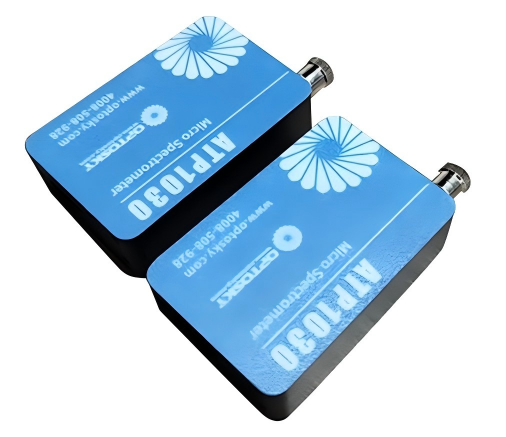
ATP1030 is an ultra‑compact, high‑resolution spectrometer covering 190–1100 nm. With a 1024‑pixel CMOS detector, adjustable integration time down to 1 ms, and USB‑powered design, it delivers reliable performance for applications like online water analysis, color measurement, handheld instruments, and Raman spectroscopy.
Product Recommendation | ATP1030 mini spectrometer Spectrometer

Vis-NIR transmission spectroscopy enables non-destructive identification of infertile duck eggs before incubation, achieving >95% accuracy. By detecting spectral fingerprints (e.g., 836 nm peak for fertile eggs), this method reduces energy waste and improves hatch rates, offering a low-cost, high-throughput solution for modern poultry farming.
Application case | How Spectral Technology is Transforming Duck Egg Farming