
Spectrometer-Based Reflectance Measurement Solutions
2025-12-12

01 Principle of Reflectance Measurement
Reflection phenomena can be categorized into two primary types: specular reflection and diffuse reflection. When light strikes an extremely smooth surface (such as a mirror or glass), specular reflection occurs, where the angle of reflection equals the angle of incidence. In contrast, when light encounters a rough or matte surface, diffuse reflection takes place, scattering light in various directions. In everyday life, most object surfaces exhibit a combination of both reflection types. Optosky's measurement software calculates reflectance using a standard formula based on background and reference spectra:
Sλ= Intensity of the sample spectrum at wavelength λ
Dλ= Intensity of the background spectrum at wavelength λ
Rλ= Intensity of the reference spectrum at wavelength λ
Background Spectrum: The spectrum measured by the spectrometer with no active light source.
Reference Spectrum: The spectrum obtained from a calibrated diffuse reflectance standard (white reference).
02 Typical System Configuration
A typical system for measuring reflectance includes the following components:
-
PC with spectrometer control software
-
Spectrometer
-
Light Source
-
Optical Fibers
-
Reflectance Integrating Sphere
-
Diffuse Reflectance Standard (White Board)
Table 1: Reflectance Measurement System Configuration
|
UV-Vis Range
|
NIR Range
|
|
|
Spectrometer
|
ATP2000P
|
ATP8000
|
|
Light Source
|
ATG1020H
|
ATG1020H
|
|
Reflectance Integrating Sphere
|
ATST150R or ATST150
|
ATST150R or ATST150
|
|
Diffuse Reflectance Whiteboard
|
Reflectance Whiteboard
|
Reflectance Whiteboard
|
|
Optical Fiber
|
UV Fiber *2
|
IR Fiber *2
|
|
Attenuator
|
(Optional, requires an additional fiber)
|
|
*You can see all the products in this website: www.optosky.net
ATG1020H Light Source Overview
Optosky's ATG1020H Deuterium-Halogen Combination Light Source employs a high-stability Hamamatsu deuterium lamp bulb for consistent output from 180-400 nm. Its halogen component utilizes a long-life, highly stable Osram bulb with a lifespan of up to 5,000 hours, paired with a custom-designed, reliable constant-current driver. The ATG1020H is characterized by its long operational life, minimal intensity decay, and high output power, making it suitable for both benchtop and portable micro-spectrometer applications. An optional cuvette holder accessory allows the ATG1020H to be used directly for transmission and absorption testing of liquid samples or filters.
Basic Operational Steps for the Light Source
-
Connect the 12V power adapter to the source and turn on the main power switch.
-
Start the light source and allow a 10-minute warm-up period to achieve stable output.
-
Once optical fibers are connected, the deuterium and halogen lamps can be activated independently via their respective switches.
03 Hardware Operation for Reflectance Measurement
To set up and perform a reflectance measurement, follow these steps:
-
Connect the light source to the integrating sphere's input port, and connect the sphere's output port to the spectrometer using optical fibers.
-
Connect the spectrometer to a PC via USB and launch the control software.
-
Power on the light source using its 12V adapter.
-
With the light source OFF, collect a Dark Signal spectrum (no light input to the spectrometer).
-
Turn the light source ON, allow it to warm up for 10 minutes, place the Diffuse Reflectance Standard White Board at the sample port of the integrating sphere, and collect the Reference Signal spectrum.
-
Replace the white board with your Sample at the sample port and measure its reflectance spectrum.
04 Reflectance Test Cases
Reference Spectrum (Air/White Board)
Test data from a diffuse reflectance standard white board.
Test Sample: 50% Reflectance Panel
Test data from a 50% reflectance panel.
Test Sample: Leaf
(Left) Typical reflectance curve reference for a healthy leaf; (Right) Measured reflectance curve data for a leaf sample.
Application Case | ATP5020R Spectrometer: Gaining In-Situ Raman Insights into Pollutant Degradation Catalyzed by MBene
Application Case | ATP5020R Spectrometer: Gaining In-Situ Raman Insights into Catalytic Reaction Processes
Related Article

The ATP7810 is a wide-band, high-resolution infrared grating spectrometer covering up to 0.9–5 μm. Featuring a motorized rotating grating, multiple detector options (InGaAs/MCT), and flexible interfaces (SMA905 or free space, USB/UART control), it delivers high SNR and stability for absorption/reflection/transmission spectroscopy, laser wavelength testing, and fiber optic sensing.
New Product Recommendation | ATP7810 Ultra-Wide Range Infrared Spectrometer Series

This study uses the ATP5200P UV-Vis spectrometer to investigate xanthate adsorption on chalcopyrite surfaces. By analyzing absorbance at 300 nm under controlled pH and temperature, the method optimizes flotation conditions for copper recovery, enabling real-time, sensitive detection of adsorption mechanisms in non-ferrous mineral processing.
Using the ATP5200P Spectrometer to Unravel Xanthate Adsorption and Separation Mechanisms
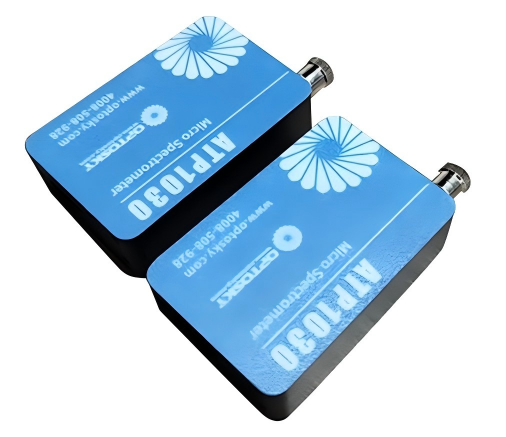
ATP1030 is an ultra‑compact, high‑resolution spectrometer covering 190–1100 nm. With a 1024‑pixel CMOS detector, adjustable integration time down to 1 ms, and USB‑powered design, it delivers reliable performance for applications like online water analysis, color measurement, handheld instruments, and Raman spectroscopy.
Product Recommendation | ATP1030 mini spectrometer Spectrometer

Vis-NIR transmission spectroscopy enables non-destructive identification of infertile duck eggs before incubation, achieving >95% accuracy. By detecting spectral fingerprints (e.g., 836 nm peak for fertile eggs), this method reduces energy waste and improves hatch rates, offering a low-cost, high-throughput solution for modern poultry farming.
Application case | How Spectral Technology is Transforming Duck Egg Farming