
Spectrometer-Based Transmittance Measurement Solutions
2025-12-12
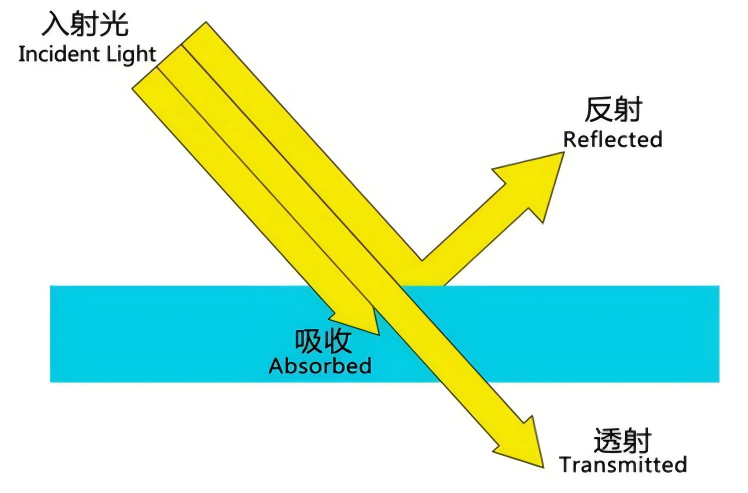
From everyday eyeglass lenses to advanced optical sensors, material transmittance is a key performance indicator. Spectrometer-based transmittance measurement solutions, with their precise measurement capabilities, have become essential tools across various industries.
Principles of Transmittance Measurement
When light strikes a material, it can be reflected, absorbed, or transmitted. Different materials transmit light of varying wavelengths differently based on their intrinsic properties. In transmittance measurements, materials like glass and optical filters are categorized as transparent or semi-transparent. Colorless transparent materials, for instance, allow most light to pass through. To quantify this property, transmittance is defined as: Transmittance (T) = (Transmitted Light Intensity / Incident Light Intensity) × 100%
Core Components of the Solution
-
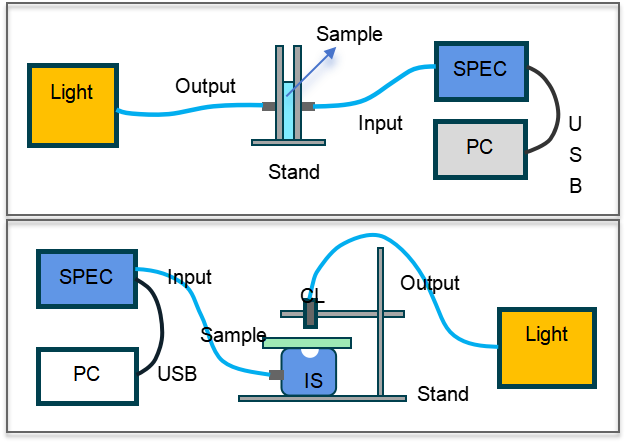
Spectrometer: Taking the Optosky ATP2000P spectrometer as an example, its advantages include a broad spectral range (200-1100nm), high resolution (0.1-2nm), excellent stability, fast response (up to 4K fps in ultra-high-speed versions), and flexible integration.
-
Light Source: Commonly used sources include stable deuterium-halogen combi lamps, such as the Optosky ATG1020. These typically require a 10-minute warm-up period to ensure optimal and stable output.
-
Optical Fiber: Enable flexible transmission of light signals, expanding potential measurement scenarios.
-
Transmittance Integrating Sphere Holder: Constructed from special materials to diffuse transmitted light uniformly, ensuring stable and reliable measurements. Features strong interface compatibility for easy setup.
Measurement Workflow
-
System Setup: Connect all components using optical fibers. Connect the spectrometer to a computer and launch the control software. Power on the light source.
-
Calibration: First, measure and record a dark background spectrum (with the light source off). Then, measure a reference spectrum (with no sample in place). This step eliminates system noise and baseline drift.
-
Sample Measurement: Place the sample securely in the holder. The spectrometer software automatically performs the measurement, calculates the transmittance, and generates a transmittance curve.
Application Areas
-
Optical Material R&D and Production: Aids in the research and optimization of material properties. Enables rapid quality inspection during manufacturing to ensure product consistency.
-
Solar Photovoltaic Industry: Helps optimize components to improve energy conversion efficiency. Facilitates the detection and screening of substandard products. Assists in the maintenance of solar power stations.
-
Biomedical Field: Supports disease diagnosis through optical methods. Used for quality control testing of medical optical components, ensuring the reliable performance of healthcare devices.
Application Case | ATP5020R Spectrometer: Gaining In-Situ Raman Insights into Catalytic Reaction Processes
Fundamentals | Decoding the Spectral Y-Axis: From Counts to Irradiance – Understanding Your Sample's Signal
Related Article

The ATP7810 is a wide-band, high-resolution infrared grating spectrometer covering up to 0.9–5 μm. Featuring a motorized rotating grating, multiple detector options (InGaAs/MCT), and flexible interfaces (SMA905 or free space, USB/UART control), it delivers high SNR and stability for absorption/reflection/transmission spectroscopy, laser wavelength testing, and fiber optic sensing.
New Product Recommendation | ATP7810 Ultra-Wide Range Infrared Spectrometer Series

This study uses the ATP5200P UV-Vis spectrometer to investigate xanthate adsorption on chalcopyrite surfaces. By analyzing absorbance at 300 nm under controlled pH and temperature, the method optimizes flotation conditions for copper recovery, enabling real-time, sensitive detection of adsorption mechanisms in non-ferrous mineral processing.
Using the ATP5200P Spectrometer to Unravel Xanthate Adsorption and Separation Mechanisms
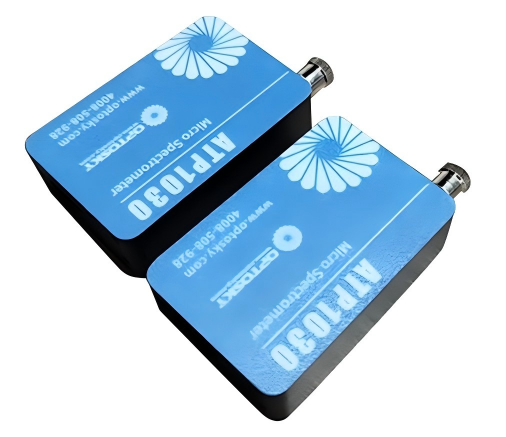
ATP1030 is an ultra‑compact, high‑resolution spectrometer covering 190–1100 nm. With a 1024‑pixel CMOS detector, adjustable integration time down to 1 ms, and USB‑powered design, it delivers reliable performance for applications like online water analysis, color measurement, handheld instruments, and Raman spectroscopy.
Product Recommendation | ATP1030 mini spectrometer Spectrometer

Vis-NIR transmission spectroscopy enables non-destructive identification of infertile duck eggs before incubation, achieving >95% accuracy. By detecting spectral fingerprints (e.g., 836 nm peak for fertile eggs), this method reduces energy waste and improves hatch rates, offering a low-cost, high-throughput solution for modern poultry farming.
Application case | How Spectral Technology is Transforming Duck Egg Farming