
Spectroscopy-Driven In-line Process Optimization in Smart Manufacturing
2024-10-22

Introduction
Traditional manufacturing is undergoing a significant transformation due to rapid technological advancements. Modern data science is driving the emergence of “smart manufacturing,” fundamentally changing how processes are developed, monitored, and assessed. Smart manufacturing aims to boost productivity, sustainability, and economic performance by seamlessly integrating all operational systems within industrial enterprises.
In this article, we will explore the crucial role of spectroscopy in revolutionizing smart manufacturing. We’ll highlight how this advanced analytical technique fosters improved product quality, consistency, and proactive process optimization. Join us as we navigate the transformative impact of spectroscopy across various industries, from pharmaceuticals to semiconductors. Through case studies and real-world examples, we will showcase the benefits of integrating advanced spectroscopic techniques into manufacturing processes.
Understanding Spectroscopy in Manufacturing
Spectroscopy is the study of how matter interacts with electromagnetic radiation. This interaction provides valuable information about the molecular composition and structure of materials. In manufacturing, spectroscopy can be employed for real-time monitoring of raw materials, in-process materials, and finished products. By incorporating spectroscopy into manufacturing processes, companies can achieve enhanced accuracy in quality control, leading to improved product consistency and reduced waste.
Benefits of Spectroscopy in Smart Manufacturing
Improved Product Quality
One of the primary advantages of utilizing spectroscopy in manufacturing is its ability to ensure high product quality. By continuously monitoring materials and processes, manufacturers can detect deviations from specified parameters. This real-time feedback enables immediate corrective actions, ensuring that the final products meet the desired quality standards.
Enhanced Process Consistency
Consistency is critical in manufacturing, particularly in industries such as pharmaceuticals and food production. Spectroscopic techniques help standardize processes by providing detailed insights into the chemical and physical properties of materials. This standardization reduces variability, leading to more reliable production outcomes.
Proactive Process Optimization
Traditional manufacturing methods often rely on periodic inspections, which can lead to delays in identifying issues. In contrast, spectroscopy enables proactive monitoring, allowing manufacturers to optimize processes in real-time. By analyzing spectral data, companies can make informed decisions to improve efficiency and reduce production costs.
Case Studies and Real-World Examples
To illustrate the benefits of spectroscopy in smart manufacturing, let’s examine a few case studies:
Pharmaceutical Industry
A leading pharmaceutical company integrated near-infrared (NIR) spectroscopy into its production line to monitor tablet formulation. By analyzing the spectral data in real-time, the company was able to ensure uniformity in active ingredient distribution, resulting in enhanced bioavailability and patient safety.
Food and Beverage Sector
In the food industry, a beverage manufacturer employed Raman spectroscopy to monitor the fermentation process. This real-time analysis allowed for adjustments to be made during production, improving flavor consistency and reducing batch rejections.
Semiconductor Manufacturing
A semiconductor company utilized Fourier-transform infrared (FTIR) spectroscopy for quality control in wafer production. This approach enabled them to detect impurities at early stages, minimizing defects and improving yield rates.
Conclusion
The integration of spectroscopy in smart manufacturing represents a significant leap forward in process optimization and quality assurance. By leveraging advanced spectroscopic techniques, manufacturers can enhance product quality, achieve consistency, and adopt proactive approaches to process management. As industries continue to embrace smart manufacturing principles, spectroscopy will play a vital role in shaping the future of production.
Through the adoption of these innovative technologies, companies can not only boost their operational efficiency but also contribute to a more sustainable and economically viable manufacturing landscape. The transformative impact of spectroscopy is just beginning to be felt, and the potential for further advancements is immense.
Product Introduction | ATP3000 Series High Resolution Spectrometers
Enhancing Tissue Identification with Spectroscopy Precision
Related Article

The ATP7810 is a wide-band, high-resolution infrared grating spectrometer covering up to 0.9–5 μm. Featuring a motorized rotating grating, multiple detector options (InGaAs/MCT), and flexible interfaces (SMA905 or free space, USB/UART control), it delivers high SNR and stability for absorption/reflection/transmission spectroscopy, laser wavelength testing, and fiber optic sensing.
New Product Recommendation | ATP7810 Ultra-Wide Range Infrared Spectrometer Series

This study uses the ATP5200P UV-Vis spectrometer to investigate xanthate adsorption on chalcopyrite surfaces. By analyzing absorbance at 300 nm under controlled pH and temperature, the method optimizes flotation conditions for copper recovery, enabling real-time, sensitive detection of adsorption mechanisms in non-ferrous mineral processing.
Using the ATP5200P Spectrometer to Unravel Xanthate Adsorption and Separation Mechanisms
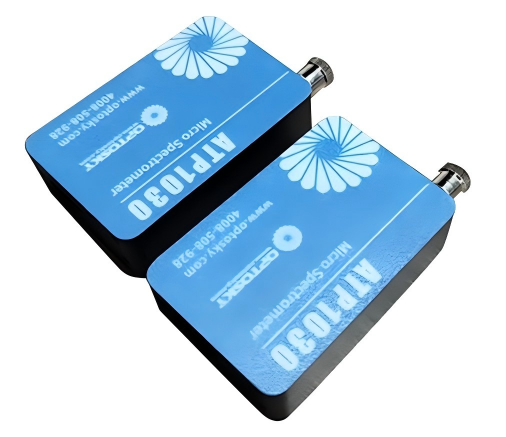
ATP1030 is an ultra‑compact, high‑resolution spectrometer covering 190–1100 nm. With a 1024‑pixel CMOS detector, adjustable integration time down to 1 ms, and USB‑powered design, it delivers reliable performance for applications like online water analysis, color measurement, handheld instruments, and Raman spectroscopy.
Product Recommendation | ATP1030 mini spectrometer Spectrometer

Vis-NIR transmission spectroscopy enables non-destructive identification of infertile duck eggs before incubation, achieving >95% accuracy. By detecting spectral fingerprints (e.g., 836 nm peak for fertile eggs), this method reduces energy waste and improves hatch rates, offering a low-cost, high-throughput solution for modern poultry farming.
Application case | How Spectral Technology is Transforming Duck Egg Farming