
Spectroscopy: A Crucial Tool for Quality Control in Various Industries
2024-10-12
In today’s competitive market, ensuring top product quality is essential. Spectroscopy has become a transformative tool for quality control across various industries, offering precise, real-time analysis. Its applications span sectors like food, pharmaceuticals, manufacturing, and environmental monitoring.
Food & Beverage
In the food industry, spectroscopy—especially near-infrared (NIR)—enables noninvasive analysis of moisture, fat, protein content, and contaminants. This helps ensure products meet safety standards and reduces waste, optimizing production processes.
Pharmaceuticals
In pharmaceuticals, techniques like UV-VIS and Raman spectroscopy ensure consistency and purity by measuring active ingredients and detecting impurities, safeguarding the quality of medications.
Manufacturing
In manufacturing, spectroscopy provides real-time insights into materials' chemical and physical properties. This is crucial for industries like plastics and automotive, where consistency directly affects product performance and reduces defects.
Environmental Monitoring
For industries concerned with environmental impact, spectroscopy offers fast, accurate analysis of soil, water, and air quality. It helps monitor pollutants and ensures compliance with environmental regulations.
Conclusion
Spectroscopy’s precision and efficiency make it a critical tool for quality control, helping industries achieve higher standards of safety, consistency, and productivity. Incorporating spectroscopic solutions drives success in today’s demanding markets.
Carbon Quantum Dots: Advances and Applications
Introduction to the optical path of a spectrometer
Related Article

The ATP7810 is a wide-band, high-resolution infrared grating spectrometer covering up to 0.9–5 μm. Featuring a motorized rotating grating, multiple detector options (InGaAs/MCT), and flexible interfaces (SMA905 or free space, USB/UART control), it delivers high SNR and stability for absorption/reflection/transmission spectroscopy, laser wavelength testing, and fiber optic sensing.
New Product Recommendation | ATP7810 Ultra-Wide Range Infrared Spectrometer Series

This study uses the ATP5200P UV-Vis spectrometer to investigate xanthate adsorption on chalcopyrite surfaces. By analyzing absorbance at 300 nm under controlled pH and temperature, the method optimizes flotation conditions for copper recovery, enabling real-time, sensitive detection of adsorption mechanisms in non-ferrous mineral processing.
Using the ATP5200P Spectrometer to Unravel Xanthate Adsorption and Separation Mechanisms
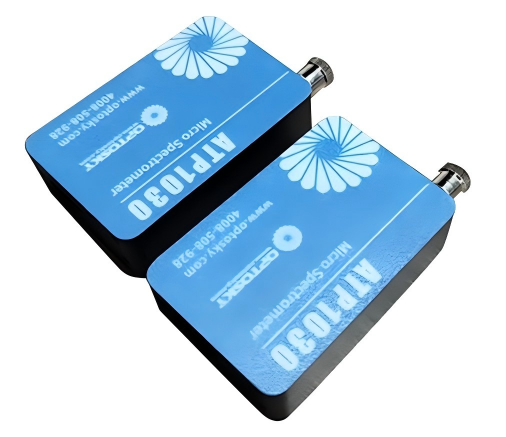
ATP1030 is an ultra‑compact, high‑resolution spectrometer covering 190–1100 nm. With a 1024‑pixel CMOS detector, adjustable integration time down to 1 ms, and USB‑powered design, it delivers reliable performance for applications like online water analysis, color measurement, handheld instruments, and Raman spectroscopy.
Product Recommendation | ATP1030 mini spectrometer Spectrometer

Vis-NIR transmission spectroscopy enables non-destructive identification of infertile duck eggs before incubation, achieving >95% accuracy. By detecting spectral fingerprints (e.g., 836 nm peak for fertile eggs), this method reduces energy waste and improves hatch rates, offering a low-cost, high-throughput solution for modern poultry farming.
Application case | How Spectral Technology is Transforming Duck Egg Farming