
Spectral Analysis: Study on UV-VIS Absorption Spectra of Green Jadeite from Different Origins
2025-08-14
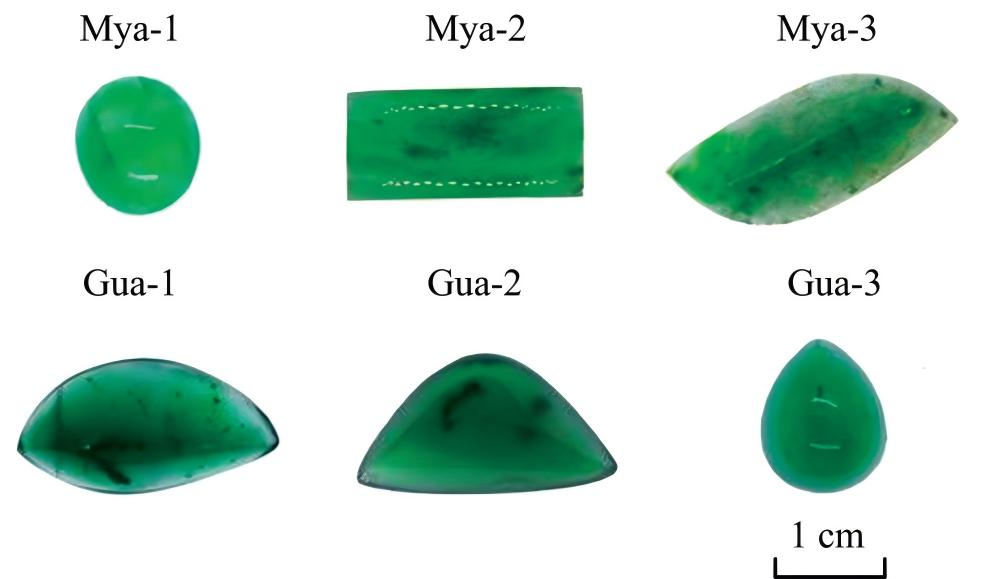
Jadeite, a high-value high-pressure low-temperature jadeitite or pyroxenite, is mainly composed of jadeite or other sodium-rich, sodium-calcium pyroxenes (e.g., omphacite, kosmochlor). Its vivid colors are well-known, with green jadeite holding particularly high commercial value. In jadeite identification, the similar appearance of Myanmar and Guatemalan jadeite often poses challenges.
Researchers selected gem-quality green jadeite from both regions to study their chromogenic mineral characteristics and coloring mechanisms using UV-visible spectroscopy (UV-Vis). Below, combined with professional research, we analyze the application logic and practical value of this method in jadeite identification.
The Principle of Jadeite's "Optical Fingerprint"
Figure 1. Q-Jd-Ko-Ae Ternary Diagram of Green Chromogenic Minerals in Myanmar and Guatemalan Green Jadeite
The color of jadeite is essentially determined by electron transitions of internal metal ions. When UV-visible light irradiates the sample, ions like Cr³⁺ and Fe³⁺ selectively absorb light of specific wavelengths, forming characteristic absorption spectra:
-
Myanmar jadeite: Due to Cr³⁺-bearing jadeite or jadeite-omphacite assemblages, it shows combined Cr³⁺ absorption bands at 636, 660, and 690 nm, along with narrow bands at 380 nm and 437 nm from forbidden d-d orbital transitions of Fe³⁺.
-
Guatemalan jadeite: Its chromogenic mineral is Fe³⁺-rich omphacite, with spectra showing narrow bands at 333 nm (Fe³⁺-O²⁻ charge transfer), 391 nm (spin-allowed Fe³⁺ transition), 437 nm (forbidden Fe³⁺ transition), and a Cr³⁺ absorption band at 640 nm.
Key distinguishing point: Guatemalan jadeite has stronger absorption in the blue-violet region (380-450 nm), resulting in a narrower green transmission window (481-586.5 nm) that often gives a grayish tint, while Myanmar jadeite has a wider green transmission window (479-582.5 nm) with purer green.
Application Scenarios of UV-VIS Absorption Spectra in Identification
-
Rapid Origin Discrimination
Green jadeite from Myanmar and Guatemala has similar green hues but distinct UV-Vis absorption features. Compared to Myanmar samples, Guatemalan ones lack 660 nm and 690 nm broad absorption bands but have an additional 333 nm narrow absorption band, indicating their Cr³⁺-poor and Fe³⁺-rich nature—one of the criteria for origin differentiation.
Figure 2. Comparison of UV-Visible Absorption Spectra of Myanmar and Guatemalan Green Jadeite
Taking samples Mya-3 (Myanmar) and Gua-2 (Guatemala) from references as examples: The Myanmar sample has narrow absorption bands at 380 nm and 437 nm with intensities 0.8 and 1.0, a 636-690 nm absorption band peak of 1.2, and over 60% green region transmittance. The Guatemalan sample has a 391 nm absorption peak (intensity 1.1), a 333 nm shoulder peak (intensity 0.5), a 640 nm absorption band peak of 0.9, and ~50% green region transmittance.
Instrument requirements: Full wavelength coverage (200-1100 nm) and resolution ≤2 nm to capture weak signals like 333 nm.
-
Quality Control in Processing and Market Circulation
Raw material sorting: Spectroscopy helps screen high-Cr³⁺ Myanmar jadeite raw materials (strong red-region absorption) for priority use in high-end jewelry processing.
Finished product identification: For the common grayish tint in Guatemalan jadeite, spectroscopy guides cutting thickness—thinner cuts reduce blue-violet light absorption, enhancing green brightness.
Transaction certification: Spectral reports serve as scientific evidence for jadeite origin, avoiding commercial disputes where Guatemalan jadeite is passed off as Myanmar jadeite.
-
In-depth Applications in Research and Collection
In academic research, UV-visible spectroscopy can be combined with electron probe microanalysis (EPMA) and X-ray photoelectron spectroscopy (XPS): Correlating Fe³⁺/Cr³⁺ ratios with spectral absorption intensities to build quantitative models of jadeite's coloring mechanism; establishing "spectral archives" for collectible jadeite to record optical stability over time.
Industry Value
Compared to traditional jadeite identification methods relying on visual observation of color roots or specific gravity tests, UV-visible spectroscopy offers:
-
Objectivity: Uses data-based absorption peak positions and intensities as criteria, avoiding subjective judgment biases.
-
Precision: Identifies nanoscale spectral differences, such as red shifts of absorption peaks in Guatemalan jadeite caused by Ca²⁺ and Mg²⁺ substitution.
-
Standardization: Enables the establishment of industry-wide jadeite spectral databases, promoting the standardization of identification systems.
Conclusion
When UV-visible light penetrates jadeite, the recorded absorption curves not only reflect light absorption but also scientifically reveal mineral composition and coloring mechanisms. From mining areas to counters, this technology provides crucial support for the transparent development of the jadeite industry. Choose Optosky ATP series spectrometers to accurately decode the "origin password" of every jadeite piece, freeing consumers from "gambling on stones"-like transaction risks.
References
-
Tong Zida, Yan Xiaoxu, Liu Xifeng, He Rongrong. Comparative Study on Mineralogical and Spectroscopic Characteristics of Green Jadeite from Myanmar and Guatemala[J]. Spectroscopy and Spectral Analysis, 2025, 45(6): 1687-1692. Doi:10.3964/j.issn.1000-0593(2025)06-1687-06
Spectral Analysis: The Ecological Code to Safeguard the Oceans
Spectral Analysis: Applications in the Industrial Manufacturing Field
Related Article

The ATP7810 is a wide-band, high-resolution infrared grating spectrometer covering up to 0.9–5 μm. Featuring a motorized rotating grating, multiple detector options (InGaAs/MCT), and flexible interfaces (SMA905 or free space, USB/UART control), it delivers high SNR and stability for absorption/reflection/transmission spectroscopy, laser wavelength testing, and fiber optic sensing.
New Product Recommendation | ATP7810 Ultra-Wide Range Infrared Spectrometer Series

This study uses the ATP5200P UV-Vis spectrometer to investigate xanthate adsorption on chalcopyrite surfaces. By analyzing absorbance at 300 nm under controlled pH and temperature, the method optimizes flotation conditions for copper recovery, enabling real-time, sensitive detection of adsorption mechanisms in non-ferrous mineral processing.
Using the ATP5200P Spectrometer to Unravel Xanthate Adsorption and Separation Mechanisms
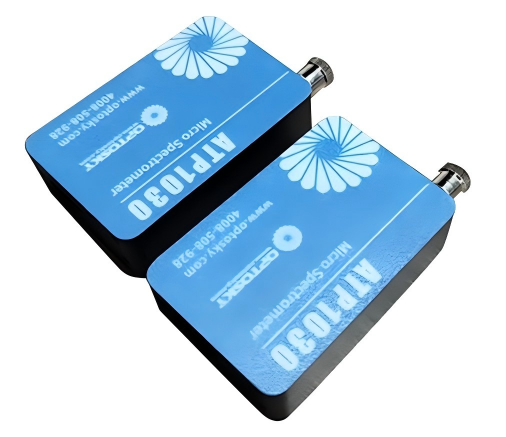
ATP1030 is an ultra‑compact, high‑resolution spectrometer covering 190–1100 nm. With a 1024‑pixel CMOS detector, adjustable integration time down to 1 ms, and USB‑powered design, it delivers reliable performance for applications like online water analysis, color measurement, handheld instruments, and Raman spectroscopy.
Product Recommendation | ATP1030 mini spectrometer Spectrometer

Vis-NIR transmission spectroscopy enables non-destructive identification of infertile duck eggs before incubation, achieving >95% accuracy. By detecting spectral fingerprints (e.g., 836 nm peak for fertile eggs), this method reduces energy waste and improves hatch rates, offering a low-cost, high-throughput solution for modern poultry farming.
Application case | How Spectral Technology is Transforming Duck Egg Farming