
Fundamentals | Understanding Spectrometer Parameters: Stray Light and Stability
2026-03-26

In applications ranging from LED sorting and online water quality analysis to food safety testing, miniature fiber optic spectrometers—exemplified by Optosky's instruments—are playing an increasingly vital role. However, users often encounter challenges such as poor data repeatability or difficulty detecting weak signals. These issues frequently trace back to two critical performance parameters: stray light and stability. Together, they define the performance boundaries of an instrument, and understanding their distinction is essential for making informed selection decisions and obtaining reliable data.
01 Core Differences: From Definition to Impact
Stray Light Testing
Stability Testing
Put simply, stray light concerns the purity of a measurement, while stability concerns its repeatability.
02 Technical Implementation: Optimizing Key Parameters
|
Feature dimension
|
Stray light
|
Stability
|
|
Nature
|
Interfering light at all non-target wavelengths reaching the detector.
|
The instrument's ability to resist external changes (e.g., temperature fluctuations).
|
|
Primary sources
|
Scattering from optical components; internal reflections within the optical path.
|
Opto-mechanical deformation due to temperature changes; electronic circuit drift.
|
|
Measurement method
|
Method 1: Use a cut-off filter to measure signal intensity ratio within the stopband (e.g., <0.05%).
Method 2: Use a laser to illuminate the spectrometer, measuring the ratio of signal far from the laser wavelength to the primary peak signal.
|
Monitor wavelength drift (e.g., ±0.1 nm) or intensity fluctuation (e.g., ±0.3%) of a standard light source.
|
|
Core impact
|
Reduces signal-to-noise ratio (SNR), causing weak signals to be overwhelmed and data in high-absorption regions to become distorted.
|
Measurement results drift over time, requiring frequent calibration and compromising long-term reliability.
|
|
Optimizations approach
|
Optimize optical design (e.g., M-type or concave grating path); employ internal light-absorbing treatments.
|
Reinforce mechanical structure; use temperature-controlled detectors (e.g., cooled CCD); implement software algorithm compensation.
|
1. Reducing Stray Light—Improving Optical Design
Stray light is essentially "optical noise" within the instrument. Suppressing it hinges on the optical architecture:
-
M-Type Optical Path: Leveraging its symmetrical design, this configuration effectively minimizes stray light and is well-suited for high-resolution models.
-
Concave Grating Optical Path: This design integrates dispersion and focusing functions, reducing the number of reflective surfaces to achieve ultra-low stray light. When combined with internal light-absorbing treatments, stray light can be further eliminated.
2. Enhancing Stability—Minimizing Thermal Drift
The primary challenge to stability comes from spectral drift caused by temperature fluctuations. Common solutions for compact fiber optic spectrometers include:
-
Hardware Temperature Control: Equipping the detector with a thermoelectric cooler (TEC), as seen in Optosky's ATP5020P and ATP6500 series, stabilizes the sensor temperature at a set point (e.g., -10°C), effectively suppressing thermal drift.
-
System and Software Compensation: Embedding calibration parameters directly into the hardware or employing dynamic algorithms to compensate for environmental changes helps ensure long-term measurement repeatability.
03 Safeguarding Quality from Field to Shelf
03 Selection Guide
Prioritization should align with the core requirements of your application:
Prioritize Low Stray Light Spectrometers (e.g., ATP5020, ATP6500) when:
-
Measuring high-concentration (high absorbance) samples.
-
Detecting weak signals (e.g., fluorescence, Raman).
-
Conducting precise transmittance/reflectance analysis.
Prioritize High Stability Spectrometers (e.g., ATP2000P) when:
-
Performing long-term, in-line process monitoring.
-
Operating in environments with significant temperature and humidity fluctuations (e.g., industrial plants).
-
Implementing quality control protocols that demand consistent data with minimal recalibration frequency.
For High-End Applications Requiring Both:
Certain models, such as the ATP5334 and ATP5040, combine low-stray-light M-type optical paths with active detector cooling technology. This enables them to meet the stringent demands for both high signal purity and exceptional measurement repeatability.
04 Conclusion
Stray light and stability represent two sides of the same coin in spectrometer performance, safeguarding the accuracy and reliability of your data, respectively.
The key to optimal instrument selection lies in clearly identifying the primary challenge of your specific application: Is it the need for higher signal purity to detect weak signals, or the need for greater resilience to maintain performance in fluctuating environments? Matching the instrument's strengths to your core requirement ensures perfect fit for your measurement tasks.
For more information, please contact:
Email: [email protected]
Web: www.optosky.net
A One-Stop Solution for Perovskite Thin Film Optical Absorption + Fluorescence Testing | ATP5020 + ATG1020‑H
Application Case | IR2300 Near-Infrared Grain Analyzer Enhances Grain Station Receiving and Storage Efficiency
Related Article

The ATP7810 is a wide-band, high-resolution infrared grating spectrometer covering up to 0.9–5 μm. Featuring a motorized rotating grating, multiple detector options (InGaAs/MCT), and flexible interfaces (SMA905 or free space, USB/UART control), it delivers high SNR and stability for absorption/reflection/transmission spectroscopy, laser wavelength testing, and fiber optic sensing.
New Product Recommendation | ATP7810 Ultra-Wide Range Infrared Spectrometer Series

This study uses the ATP5200P UV-Vis spectrometer to investigate xanthate adsorption on chalcopyrite surfaces. By analyzing absorbance at 300 nm under controlled pH and temperature, the method optimizes flotation conditions for copper recovery, enabling real-time, sensitive detection of adsorption mechanisms in non-ferrous mineral processing.
Using the ATP5200P Spectrometer to Unravel Xanthate Adsorption and Separation Mechanisms
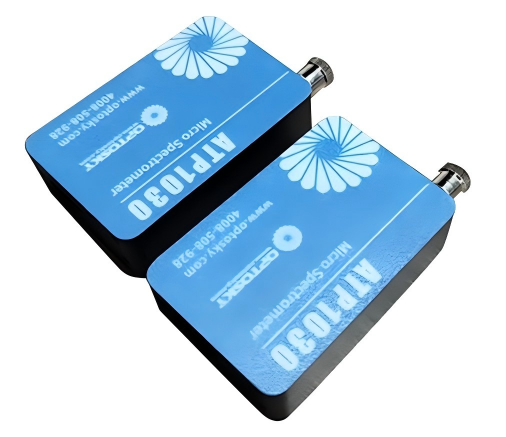
ATP1030 is an ultra‑compact, high‑resolution spectrometer covering 190–1100 nm. With a 1024‑pixel CMOS detector, adjustable integration time down to 1 ms, and USB‑powered design, it delivers reliable performance for applications like online water analysis, color measurement, handheld instruments, and Raman spectroscopy.
Product Recommendation | ATP1030 mini spectrometer Spectrometer

Vis-NIR transmission spectroscopy enables non-destructive identification of infertile duck eggs before incubation, achieving >95% accuracy. By detecting spectral fingerprints (e.g., 836 nm peak for fertile eggs), this method reduces energy waste and improves hatch rates, offering a low-cost, high-throughput solution for modern poultry farming.
Application case | How Spectral Technology is Transforming Duck Egg Farming