Application Of NIR Spectrometer In Garbage Sorting
Infrared fiber spectrometer
Waste and waste sorting methods include floating and sinking sorting, wind sorting, electrostatic sorting, flotation and manual sorting, etc. However, these methods have shortcomings such as high energy consumption, low efficiency and secondary pollution, and are difficult to adapt to the development needs of the modern recycling industry. Near-infrared spectroscopy sorting technology has been gradually applied as early as the middle and late part of the last century. In recent years, with the development of theoretical technologies such as chemometrics, coupled with the promulgation of domestic and foreign environmental protection laws and regulations, the implementation of near-infrared spectroscopy has promoted Sorting has gradually become one of the mainstream technologies for garbage sorting.
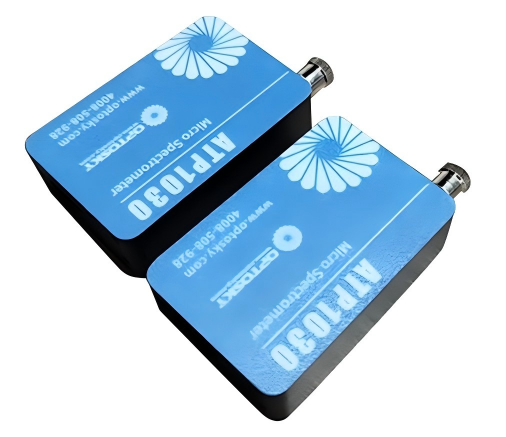
This paper uses the near-infrared fiber spectrometer ATP8000, with the fiber spectrometer as the core detector, and performs spectral analysis based on reflection measurement. The detector used by this instrument has a response wavelength of 900~1700nm and mainly tests the near-infrared region.
Application principle
In the current four-point classification of domestic waste, other waste classified at the source contains a variety of components with high value utilization potential, which can be divided into cellulose, vinyl polymers, wood and bamboo, etc. The composition and structure of these garbage are different, so they have different infrared spectra. Based on the characteristic bands of their infrared spectra, machine learning can be used to establish corresponding classification models to sort the above types of garbage from other garbage.
This document collects four types of waste products: PP (polypropylene), PE (polyethylene), ABS (acrylonitrile-butadiene-styrene copolymer), and polyester. Verify the possibility and scientificity of infrared spectroscopy combined with machine learning to achieve deep sorting of other garbage, and provide a reference for the future development of fast deep sorting equipment.
Samples and test methods
The test samples are four types of waste products: PP (polypropylene), PE (polyethylene), ABS (acrylonitrile-butadiene-styrene copolymer), and polyester.
The near-infrared fiber spectrometer ATP8000 produced by Aopu Tiancheng (Xiamen) Optoelectronics Co., Ltd. was used. Test conditions: integration time 20 ms, average times 2 times, scanning range 900~1700nm, room temperature.
Test results and analysis
4.1 PP (polypropylene) material reflectance spectral data
4.2 PE (polyethylene) material reflectance spectral data
4.3 ABS (acrylonitrile-butadiene-styrene copolymer) material reflectance spectral data
4.4 Reflectance spectral data of polyester materials
4.5 Comparative data of reflectivity of four types of waste products
Conclusion
1. The characteristic peaks of PP and PE material samples are close to each other and cannot be clearly distinguished. However, they are similar to the waveforms and absorption peaks of several other materials and can still be screened out for in-depth classification and recycling.
2.ABS can be distinguished from PP and PE according to the 1100-1200 band range.
3. There are obvious spectral differences between polyester and the other three materials.
In summary, accurate and efficient sorting technology is crucial for efficient recycling of waste. This involves not only the economic benefits of the enterprise, but also the social environmental benefits and consumer safety. At present, although near-infrared spectrum sorting technology has many bottlenecks such as difficulty in identifying dark-colored garbage and low versatility of calibration models, future applications and development are still foreseeable.
Near-infrared spectrum analysis technology has great potential in the field of garbage sorting, especially the multi-technology joint sorting system including near-infrared spectrum sorting technology, which will be the best way to solve the problem of garbage sorting and realize the sustainable utilization of resources. The ideal solution.
VIS-NIR Spectrometer in Transmittance Applications
Application of spectrometer in color measurement
Related Article