Application of Spectrometer Sensor for Automatic Cobalt Ion Detection in Wet Zinc Smelting
01. Background: Cobalt ions are common impurities in zinc solutions and pose a significant risk to zinc hydrometallurgy. Even trace amounts of cobalt ions exceeding the standard can cause zinc plate burning during electrolysis, reducing zinc content and quality. Therefore, accurate detection of cobalt ion concentration is crucial for both cobalt measurement precision and zinc metallurgy stability.
Several methods for detecting cobalt ions, such as electrochemical, fluorescence spectroscopy, and chromatography, have been proposed. However, these methods are mainly designed for laboratory or environmental monitoring and are not suitable for the complex conditions of zinc hydrometallurgy. Due to the presence of various impurities and high zinc ion concentrations, most methods struggle to capture cobalt ion information. Moreover, costly equipment and complex preparation processes limit some techniques. Currently, spectrophotometry based on color reactions is widely used in the zinc industry for cobalt ion detection.
Figure 1.Zinc powder and solution samples.
The current process for detecting cobalt ions in zinc hydrometallurgy enterprises includes the following steps:
- Collecting zinc solution from the production site and transferring it to the laboratory
- Adding nitrosyl R salt, sodium acetate solution, and nitric acid sequentially to the zinc solution, then boiling to induce the cobalt ions in the solution to form a color
- Cooling the resulting mixture to room temperature and measuring its absorbance at a sensitive wavelength using a single-wavelength spectrophotometer
- Estimating the cobalt ion concentration based on an empirical regression equation.
However, this detection method has several issues.
First, the accuracy and repeatability of the detection largely depend on the expertise of the technicians.
Second, the detection cycle is long, and it cannot provide timely feedback for the cobalt removal process.
Finally, estimating cobalt ion concentration using absorbance information from a single wavelength is susceptible to interference from other factors, such as spectrometer noise and room temperature changes, limiting the accuracy and scope of this method.
Therefore, an automatic cobalt ion concentration detection system and method based on full-spectrum analysis is needed, which can greatly improve the efficiency and accuracy of cobalt ion detection. A fiber optic spectrometer, capable of providing real-time full-range spectra, is considered for this purpose.
In the context of full-spectrum analysis, there is often a linear relationship between absorbance and concentration. Therefore, in related fields, the wavelength selection (WS) algorithm is commonly used to identify useful wavelengths, followed by partial least squares regression (PLSR) to estimate the concentration.
02. Testing Process:
- Sample Preparation: The chemicals used in the experiment include sodium acetate (300 g/L), nitrosyl R salt solution (5 g/L), nitric acid (8 mol/L), zinc powder, and cobalt sulfate. To ensure the reliability of the experiment, these reagents are stored in dark conditions, and the tests are completed within a week after the experimental date.
Figure 2. Purification Process of Zinc Solution
Prepare cobalt-zinc solutions of different concentrations using the following steps:
(1) Add excess zinc powder to the solution collected from the site to remove the remaining cobalt ions, obtaining cobalt-free zinc;
(2) Add cobalt sulfate to the cobalt-free zinc solution to obtain 20 different concentrations of cobalt-zinc solutions. These include 8 low-concentration cobalt-zinc solutions (0.1 to 1 mg/L) and 12 high-concentration cobalt-zinc solutions (1 to 20 mg/L).
Table 1. Concentrations of 20 Cobalt-Zinc Solutions
- System Setup
Figure 3. Automatic Cobalt Ion Concentration Detection System
As shown in the figure, the automatic cobalt ion concentration detection system consists of three parts: host computer software, integrated control board, and actuating device.
Figure 4. Structure and Schematic of the Actuating Device
As shown in the figure above, the actuating device can be divided into four functional modules: reagent transport, reaction, spectral detection, and cleaning.
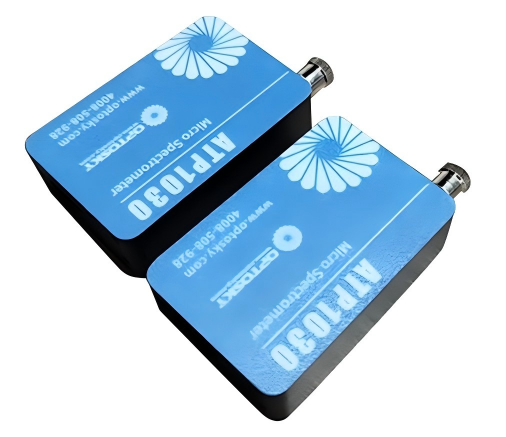
The spectral detection module uses a high-stability white light source (ATG2000) and fiber optic spectrometer (ATP2000) from Optosky. This spectrometer can collect wavelengths from 282 nm to 1124 nm. It features a compact structure, excellent signal-to-noise ratio, high measurement stability, and is easy to integrate into OEM systems.
- Testing Process
Figure 5. Absorbance (Cobalt Ion Concentration) Measurement Process
The principle of cobalt ion concentration measurement is primarily based on spectrophotometry. Spectrophotometry is based on the Beer-Lambert law, which states that at low concentrations, the absorbance of a solution is proportional to both the concentration of the solution and the path length through the solution. Therefore, when the path length is fixed, the absorbance of the solution can be calculated to analyze the concentration of cobalt ions in the solution.
The basic measurement process of absorbance is shown in Figure 5.
First, we measure the transmission spectral intensity (I1) of the empty cuvette without the solution, which serves as the reference spectrum.
Then, we add the solution and use light of the same intensity to measure the transmission light intensity (I2) and absorbance (A).
The absorbance (A) of the solution can be calculated using the formula: A = log(I1/I2).
Based on the experimental results, the wavelength range of 500 nm to 800 nm is determined to be the absorbance monitoring range. For solutions with different concentrations, different absorbance curves can be obtained within this range.
Figure 6. Spectra of 20 Different Concentrations of Cobalt-Zinc Solutions.
(a) Original Spectrum
(b) Original Spectrum Minus the Spectrum of Cobalt-Free Zinc Solution.
To highlight the spectral differences, we subtracted the spectrum of the cobalt-free zinc solution from the original spectrum, as shown in Figure 6(b). It is noteworthy that as the cobalt ion concentration increases, the absorbance of the solution changes significantly in the wavelength range of 525 ~ 630 nm, while remaining relatively stable in the 630 ~ 800 nm range. It should be noted that when the absorbance exceeds 2, noise appears in the spectrum due to insufficient transmitted light intensity through the solution.
Figure 7. Pearson Correlation Coefficients of Absorbance and Concentration Before and After Preprocessing.
To study the spectral changes of cobalt-zinc solutions with concentration, the Pearson correlation coefficient (R) between absorbance and concentration was calculated. This experiment was conducted for low (0.1 to 1 mg/L) and high (1 to 20 mg/L) concentration cobalt-zinc solutions at different wavelengths. It can be observed that the linear intervals for low and high concentration solutions are different. There is a strong positive correlation (R > 0.9) between 526 nm and 585 nm, and between 535 nm and 633 nm. Additionally, as the wavelength increases, the relationship between absorbance and concentration changes from positive to negative correlation for both low and high concentration cobalt-zinc solutions.
To reduce interference from the spectrometer's performance and noise factors, a series of spectral data preprocessing steps, such as spectral calibration, noise reduction, parameter optimization, and modeling, were applied in the actual study. This improved spectral quality and regression accuracy. The processed Pearson correlation coefficients are shown in Figure 7.
Table 2. Spectral Parameter Optimization Results for Low and High Concentration Cobalt-Zinc Solutions
Figure 8. RMSE of Cobalt-Zinc Solutions Before and After Preprocessing.
The system's detection repeatability directly impacts accuracy and is crucial for evaluating performance. To assess it, the average standard deviation of absorbance at 500 nm to 800 nm for 20 different zinc-cobalt solutions was calculated (Figure 9). Results show that the average standard deviation ranges from 0.0041 to 0.009, with low and high concentrations averaging 0.0048 and 0.0059, respectively. These are 3.45 and 4.22 times the spectrometer's noise level (0.0014), indicating good repeatability for both low and high concentration solutions.
Table 3. Comparison of Performance with Other Methods for Measuring Cobalt Ions in Multimetal Environments.
Compared to traditional methods using a single wavelength for cobalt ion detection, the fiber optic spectrometer-based spectrophotometry in this study offers high accuracy, efficiency, and quick spectrum acquisition. It is ideal for online detection of cobalt ion concentration in the zinc extraction process, enabling real-time control of zinc content and quality, thus improving production efficiency.
References
[1] Qilong Wan, Hongqiu Zhu, Fei Cheng, Jianqiang Yuan, Chunhua Yang, Can Zhou,
Automatic detection system with efficient and accurate sample preparation
for cobalt ion concentration in zinc hydrometallurgy,Microchemical Journal 199 (2024) 109991,https://doi.org/10.1016/j.microc.2024.109991
Application: Spectrometer Sensor in LIBS Solutions
ATP1030 Mini spectrometer
Related Article