

OPTOSKY /NEWS /Spectrometer Blog /Different Particle Sizes of Soil Organic Matter on The Spectral Predictionr /
Different Particle Sizes of Soil Organic Matter on The Spectral Predictionr
2021-11-19
As an important component of soil, soil organic matter (SOM) plays a decisive role in soil structure formation and soil quality improvement. Understanding SOM dynamic changes is the basic condition for monitoring soil fertility, realizing precision agriculture and ensuring sustainable agricultural development. Traditional field sampling and laboratory chemical analysis methods are time-consuming and inefficient, which are difficult to meet the real-time data requirements of current agricultural development. The spectroscopic method is low-cost, fast and pollution-free, and can be easily implemented in laboratory and field conditions. However, the spectral reflectance of soil surface with different particle size has great spatial heterogeneity. Moreover, the spectral reflectance of soil measured by the spectrometer is a comprehensive result of the soil surface in a specific area. Therefore, the uncertainty of the composition of different particles on the soil surface makes the spectral determination fluctuate, thus affecting the spectrum of soil samples.
In order to determine the best standard for sample preparation, the authors conducted field investigations with field spectrometer to clarify the surface composition characteristics of uniform and mixed samples of different sample sizes and their influence on SOM prediction, and compared and analyzed the prediction accuracy of different particle size estimation models.
From the average spectral reflectance of soil samples with different particle sizes, it can be seen that the spectral reflectance increases gradually with the decrease of particle size. When the mixed sample and uniformsample have the same total reflectance, the composition characteristics of soil surface particles are different. The smaller the particle size is, the smaller the heterogeneity of soil surface is. Increasing the interval of soil surface spectral reflectance is helpful to distinguish the subtle differences between soil samples with different SOM contents. The decrease of soil particle size increased the correlation between the whole band and SOM. Mixed samples can improve the surface reflectance of soil samples, and increase the correlation with SOM due to the complementation of large and small particles.
In order to determine the best standard for sample preparation, the authors conducted field investigations with field spectrometer to clarify the surface composition characteristics of uniform and mixed samples of different sample sizes and their influence on SOM prediction, and compared and analyzed the prediction accuracy of different particle size estimation models.
From the average spectral reflectance of soil samples with different particle sizes, it can be seen that the spectral reflectance increases gradually with the decrease of particle size. When the mixed sample and uniformsample have the same total reflectance, the composition characteristics of soil surface particles are different. The smaller the particle size is, the smaller the heterogeneity of soil surface is. Increasing the interval of soil surface spectral reflectance is helpful to distinguish the subtle differences between soil samples with different SOM contents. The decrease of soil particle size increased the correlation between the whole band and SOM. Mixed samples can improve the surface reflectance of soil samples, and increase the correlation with SOM due to the complementation of large and small particles.
How to Detect COD by UV Spectroscopy
How to Monitor Health of Mobile Biomarkers with Spectroscopy
Related Article

The ATP7810 is a wide-band, high-resolution infrared grating spectrometer covering up to 0.9–5 μm. Featuring a motorized rotating grating, multiple detector options (InGaAs/MCT), and flexible interfaces (SMA905 or free space, USB/UART control), it delivers high SNR and stability for absorption/reflection/transmission spectroscopy, laser wavelength testing, and fiber optic sensing.
New Product Recommendation | ATP7810 Ultra-Wide Range Infrared Spectrometer Series

This study uses the ATP5200P UV-Vis spectrometer to investigate xanthate adsorption on chalcopyrite surfaces. By analyzing absorbance at 300 nm under controlled pH and temperature, the method optimizes flotation conditions for copper recovery, enabling real-time, sensitive detection of adsorption mechanisms in non-ferrous mineral processing.
Using the ATP5200P Spectrometer to Unravel Xanthate Adsorption and Separation Mechanisms
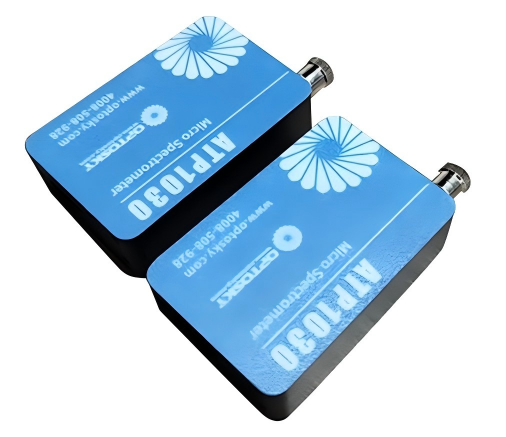
ATP1030 is an ultra‑compact, high‑resolution spectrometer covering 190–1100 nm. With a 1024‑pixel CMOS detector, adjustable integration time down to 1 ms, and USB‑powered design, it delivers reliable performance for applications like online water analysis, color measurement, handheld instruments, and Raman spectroscopy.
Product Recommendation | ATP1030 mini spectrometer Spectrometer

Vis-NIR transmission spectroscopy enables non-destructive identification of infertile duck eggs before incubation, achieving >95% accuracy. By detecting spectral fingerprints (e.g., 836 nm peak for fertile eggs), this method reduces energy waste and improves hatch rates, offering a low-cost, high-throughput solution for modern poultry farming.
Application case | How Spectral Technology is Transforming Duck Egg Farming