
Enhancing the Solar Industry with Spectroscopy
2024-10-18

Spectroscopy in Solar Energy
In the evolving landscape of solar energy, innovative technologies play a crucial role in enhancing efficiency and sustainability. Our article, “Beyond the Rays: Optimizing the Solar Industry with Spectroscopy,” delves into how spectroscopy is revolutionizing solar panel production and driving the industry toward a greener future.
Enhancing Production Quality with Spectroscopy
Spectroscopy significantly improves the precision and quality control of thin film solar panels. By employing real-time spectroscopic data acquisition, manufacturers can identify and rectify production errors on-the-fly. This not only maximizes efficiency but also results in higher-quality solar panels that perform better and last longer, thus contributing to a more reliable energy source.
Characterizing Solar Simulators
Another critical application of spectroscopy lies in characterizing solar simulators. These simulators play a pivotal role in testing solar panels under controlled conditions, and spectroscopy ensures their accuracy and reliability. By utilizing advanced spectroscopic techniques, manufacturers can validate that their simulators meet industry standards, ultimately leading to more dependable performance assessments of solar technologies.
Measuring Direct Solar Radiation
Moreover, spectroscopy is essential for measuring direct solar radiation, providing invaluable insights for both climate research and industrial applications. Understanding solar radiation levels helps optimize energy production strategies and informs climate models. These insights are crucial for developing effective renewable energy solutions that align with environmental goals.
Conclusion
As we explore the intersection of spectroscopy and solar energy, it becomes clear that these innovative techniques are not just enhancing production processes but are also instrumental in shaping a sustainable future. Join us in discovering how spectroscopy is paving the way for a more efficient and eco-friendly solar industry.
Product Introduction | ATP2000 Series Cost-effective Spectrometer
Revolutionizing Point-of-Care Diagnostics and Treatment with Spectroscopy
Related Article

The ATP7810 is a wide-band, high-resolution infrared grating spectrometer covering up to 0.9–5 μm. Featuring a motorized rotating grating, multiple detector options (InGaAs/MCT), and flexible interfaces (SMA905 or free space, USB/UART control), it delivers high SNR and stability for absorption/reflection/transmission spectroscopy, laser wavelength testing, and fiber optic sensing.
New Product Recommendation | ATP7810 Ultra-Wide Range Infrared Spectrometer Series

This study uses the ATP5200P UV-Vis spectrometer to investigate xanthate adsorption on chalcopyrite surfaces. By analyzing absorbance at 300 nm under controlled pH and temperature, the method optimizes flotation conditions for copper recovery, enabling real-time, sensitive detection of adsorption mechanisms in non-ferrous mineral processing.
Using the ATP5200P Spectrometer to Unravel Xanthate Adsorption and Separation Mechanisms
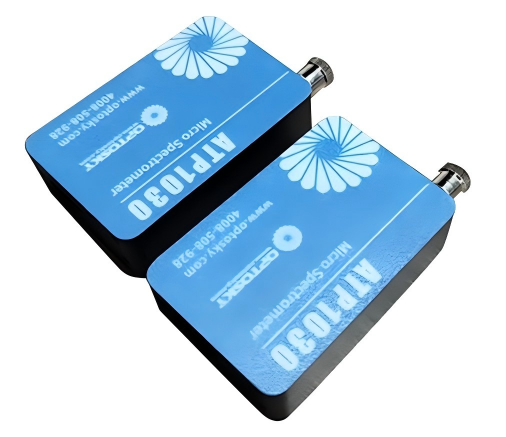
ATP1030 is an ultra‑compact, high‑resolution spectrometer covering 190–1100 nm. With a 1024‑pixel CMOS detector, adjustable integration time down to 1 ms, and USB‑powered design, it delivers reliable performance for applications like online water analysis, color measurement, handheld instruments, and Raman spectroscopy.
Product Recommendation | ATP1030 mini spectrometer Spectrometer

Vis-NIR transmission spectroscopy enables non-destructive identification of infertile duck eggs before incubation, achieving >95% accuracy. By detecting spectral fingerprints (e.g., 836 nm peak for fertile eggs), this method reduces energy waste and improves hatch rates, offering a low-cost, high-throughput solution for modern poultry farming.
Application case | How Spectral Technology is Transforming Duck Egg Farming