Product Introduction | ATP6000 Series Scientific spectrometer sensor
Overview
The ATP6000 series features a 1024x64 pixel back-illuminated linear CCD with high quantum efficiency, cooled by semiconductor technology. This design provides an exceptionally high dynamic range, with peak quantum efficiency reaching up to 92%. The cooling technology significantly reduces dark current and noise, resulting in an excellent signal-to-noise ratio.The ATP6000 series is an ideal choice for scientific research requiring high-performance spectrometers.
Features
- Detector: Back-illuminated CCD (cooled to -15°C)
- Detector Pixels: 1024 x 64
- Ultra-low noise CCD signal processing circuitry
- Quantum Efficiency: >90%
- Ultra-low Etalon effect
- Ultra-high dynamic range
- Ultra-high SNR
Specifications
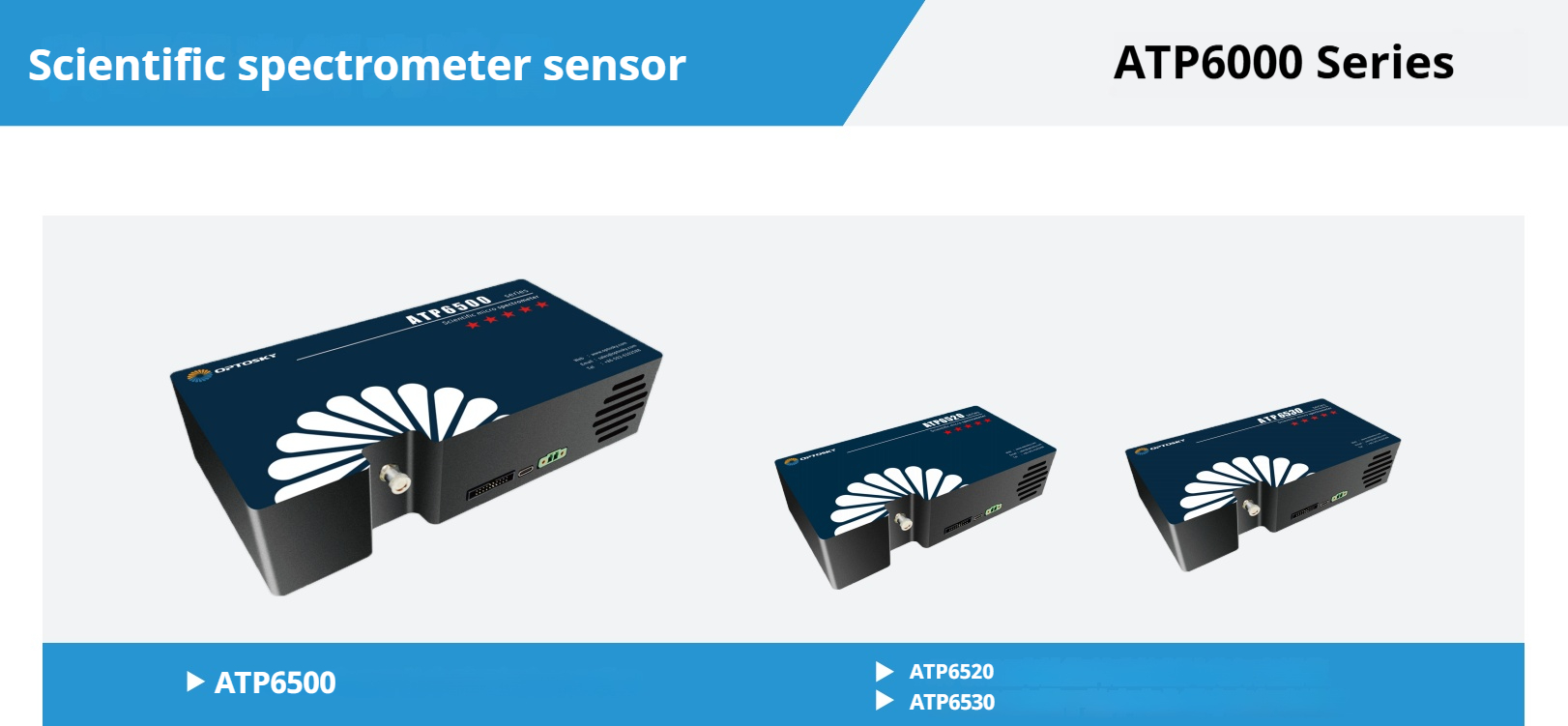
ATP6500
The ATP6500 spectrometer features a 1024x64 pixel thermoelectrically cooled back-illuminated linear CCD, with a peak quantum efficiency of up to 92%.
ATP6520
The ATP6520, built on the high quantum efficiency thermoelectric cooled CCD detector, features an optical path structure optimization similar to the ATP5200, enhancing the spectrometer's signal-to-noise ratio and stability.
ATP6530
The ATP6530 adopts an M-type optical path design, reducing stray light and further improving the spectrometer's resolution.
Applications:
- Biological fluorescence detection
- Raman spectroscopy
- Micro, fast spectrophotometry
- Transmittance detection, absorbance detection, and more.
Measured spectral line
ATP6500 Test - Dark Noise
ATP6500 Test - Mercury Lamp Spectrum
The ATP6000 series spectrometer sensor is a high-performance research-grade miniature spectrometer product developed by Optosky, based on years of experience and technological expertise in spectrometer instrumentation. It ensures low noise and a high signal-to-noise ratio, while also providing exceptional sensitivity and resolution, making it ideal for laboratory research applications.
Introduction to Common Types of Spectrometers
New Product Intensified CCD (ICCD) Cameras
Related Article