
Spectral Diagnostics of Diesel Flame Radiation in Gasifiers
2025-06-24

Flame Spontaneous Radiation Characteristics
Spontaneous radiation spectra provide critical insights into flame structure, combustion state, and temperature distribution without disturbing the flame. In hydrocarbon flames, discrete spectral radiation originates from excited radicals:
- OH & CH**: Located at fuel burned/unburned interface
- C₂: Marks flame boundaries
- CO₂: Continuous background radiation
Flame height is defined by CH peak position along the axis, avoiding soot interference.*
Technical Challenges in Gasifier Monitoring
Complex Diesel Flame Properties
Under high-temperature/pressure conditions, diesel flame radiation combines:
- Radical emission spectra (CH, OH) indicating reaction activity
- Soot continuum radiation from incomplete combustion
Traditional methods struggle to decouple these overlapping signals for real-time analysis.
Industry Demands
Efficiency and emission regulations drive need for:
- Combustion optimization to increase energy conversion
- Pollution control through emission pathway analysis
Optosky Spectrometer Solutions
ATP5020 High sensitivity & resolution Cooling Spectrometer
ATL30007 Muti-channel Spectrometer for LIBS
Core Advantages
|
Instrument
|
ATP5020
|
ATL30007
|
|
Measurement
|
Non-contact
|
Multi-channel
|
|
Resolution
|
Standard
|
Ultra-high
|
|
Range
|
UV-Vis
|
190-1100nm
|
Key Capabilities:
- Non-contact operation: Collects radiation through gasifier viewports
- Radical detection: Resolves OH* (306.47 nm), CH* (431.42 nm), Na*/K* peaks despite soot interference
- Multi-spectrometer stitching: Covers 200-950 nm with <0.1 nm resolution
Critical Parameters & Applications
Equivalence Ratio (Φ) Effects
- Decreasing CH* intensity at Φ→1.0 indicates complete combustion
- Higher Φ reduces soot radiation, enhancing radical detection
Flame Stability Metrics
Flame lift-off length (nozzle detachment distance) correlates with CH* intensity, providing:
- Early instability detection
- Operational parameter optimization benchmarks
Experimental Validation
Gasifier Setup
Schematic of Multi-Nozzle Opposed Entrained-Flow Gasifier
- Fiber probe: 3mm diameter, 25° FOV positioned at refractory brick
- Spectrometers: Quad-system covering 200-950 nm
Spectral Findings
Flame Spectral Radiation Lines in the 420-450 nm Band Spectral Radiation Lines of Diesel Flame
|
Condition
|
Key Observations
|
|
Φ=0.6
|
Strong soot continuum obscures CH* peak
|
|
Φ=0.3
|
Distinct OH*/CH*/Na*/K*/Ar* peaks
|
|
420-450 nm band
|
CH* peak clarity increases with Φ
|
The figure shows the radiation spectra of diesel flames measured by a fiber optic spectrometer in the central region of the combustion chamber under single-nozzle conditions at [O/C]e = 0.6 and [O/C]e = 1.3. Key observations include:
- OH* radiative peaks at 306.47 nm and 309.12 nm,
- A distinct CH* radiative peak at 431.42 nm,
- Emission lines from alkali metals: Na* at 589.45 nm and K* at 766.91 nm and 770.06 nm. Argon was used as the purge gas during experiments, resulting in an Ar* peak at 670.74 nm. At [O/C]e = 0.6, incomplete combustion produced significant soot, leading to intense continuous blackbody radiation in the visible spectrum.
Excited radicals in flames form via thermal excitation (e.g., Na*, K*, Ar*) and chemical excitation (e.g., OH*, CH*). The CH* peak at 431.42 nm was isolated within the 420–450 nm range for detailed analysis. As the equivalence ratio ([O/C]e) increases:
- Total radiative intensity decreases due to reduced soot (weaker blackbody radiation),
- Background radiation shifts toward CO₂* contributions,
- The CH* peak becomes less prominent and nearly vanishes in fuel-rich flames.Lower equivalence ratios strengthen background radiation, significantly interfering with radical peak detection.
This demonstrates that background radiation (e.g., from CO₂* or soot) critically impacts the visibility of CH* and other radical-specific emissions, particularly in fuel-lean conditions.
Industrial Applications
Gas Turbine Combustion Chambers
- Detects incomplete combustion via OH*/CH* ratios
- Reduces NOx emissions through real-time adjustment
Biomass Gasification Optimization
- Monitors flame uniformity for feedstock distribution tuning
- Increases syngas calorific value by 12-18%
Industrial Boiler Efficiency
- Identifies incomplete combustion zones
- Achieves 8-15% fuel savings in retrofit projects
Future Outlook
- Optosky spectrometers enable:
- Custom solutions for extreme environments
- AI-driven combustion control
- Emission compliance automation
Spectrometer Detector Selection Guide
Mineral Exploration: Spectroscopic Analysis Facilitates Malachite Content Detection
Related Article

The ATP7810 is a wide-band, high-resolution infrared grating spectrometer covering up to 0.9–5 μm. Featuring a motorized rotating grating, multiple detector options (InGaAs/MCT), and flexible interfaces (SMA905 or free space, USB/UART control), it delivers high SNR and stability for absorption/reflection/transmission spectroscopy, laser wavelength testing, and fiber optic sensing.
New Product Recommendation | ATP7810 Ultra-Wide Range Infrared Spectrometer Series

This study uses the ATP5200P UV-Vis spectrometer to investigate xanthate adsorption on chalcopyrite surfaces. By analyzing absorbance at 300 nm under controlled pH and temperature, the method optimizes flotation conditions for copper recovery, enabling real-time, sensitive detection of adsorption mechanisms in non-ferrous mineral processing.
Using the ATP5200P Spectrometer to Unravel Xanthate Adsorption and Separation Mechanisms
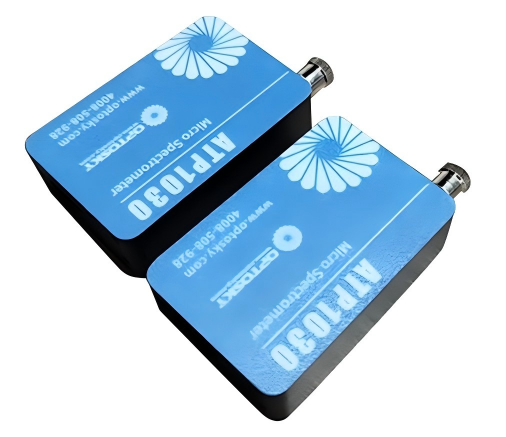
ATP1030 is an ultra‑compact, high‑resolution spectrometer covering 190–1100 nm. With a 1024‑pixel CMOS detector, adjustable integration time down to 1 ms, and USB‑powered design, it delivers reliable performance for applications like online water analysis, color measurement, handheld instruments, and Raman spectroscopy.
Product Recommendation | ATP1030 mini spectrometer Spectrometer

Vis-NIR transmission spectroscopy enables non-destructive identification of infertile duck eggs before incubation, achieving >95% accuracy. By detecting spectral fingerprints (e.g., 836 nm peak for fertile eggs), this method reduces energy waste and improves hatch rates, offering a low-cost, high-throughput solution for modern poultry farming.
Application case | How Spectral Technology is Transforming Duck Egg Farming