Application | The Use of Spectral Solutions in Gemstone Measurement
01 Gemstone Measurement Methods
Conventional Identification:
- Visual Inspection: Observing the gemstone's color, shape, transparency, and luster under natural or artificial light.
- Magnified Examination: Using a magnifying glass or microscope to inspect the internal and external features of the gemstone, such as fractures, inclusions, and stress lines.
- Refractive Index Measurement: Determining the gemstone's refractive index by measuring the ratio of light's speed in air or vacuum to its speed in the gemstone material.
- Pleochroism Detection: The phenomenon in heterogeneous colored gemstones where different colors appear due to selective absorption of light waves.
Special Identification:
- Thermal Reaction Method: Suitable for low-melting-point gemstones like amber and plastic, this method assesses the ease of melting and the emitted odor of the sample.
- Chemical Reaction Method: Utilizing reagents such as dilute hydrochloric acid and ether to test the gemstone's reaction to specific substances.
- Mohs Hardness Test: Determining the hardness level of gemstones based on their relative hardness.
- Infrared Spectroscopy Analysis: Qualitative or quantitative analysis of the composition or structure of gemstones based on their absorption characteristics in the infrared spectrum.
Additionally, non-destructive testing methods such as ultraviolet fluorescence testing, Raman spectroscopy analysis, ion beam analysis (IBA), proton-induced gamma emission (PIGE), and ultraviolet-visible spectroscopy can be employed to efficiently and accurately analyze the chemical composition and structure of gemstones, providing strong support for gemstone identification.
02 Spectral Analysis Methods
In gemstone research, spectral analysis techniques are characterized by their fast measurement speed and accurate, reliable information. As part of non-destructive testing methods, spectral analysis has been applied for a long time. It primarily utilizes the principles of transmission and reflection measurements to conduct full-wavelength analysis of the gemstone under investigation. This data is then compared with standard spectra of genuine gemstones, serving as one of the bases for determining the properties of the gemstones.
Based on the characteristic light absorption of various minerals or gemstones, one can distinguish between genuine and fake gemstones by comparing the sample's spectrum with the standard reflection or transmission spectra of genuine stones. For example, natural diamonds and synthetic diamonds can be detected using light in the wavelength range of 400–750 nm. Infrared transmission spectra can identify whether jadeite contains any fillers. Other gemstones, such as rubies, emeralds, and sapphires, can also be analyzed using spectral methods.
Additionally, in gemstone color measurement, the scattered light spectrum of the gemstone can be analyzed using color analysis devices to derive color characterization parameters, allowing for an accurate evaluation of the gemstone's color.
03 Basic Testing Devices
A typical basic gemstone measurement system includes a spectrometer, a reflective white panel, a reflective probe fiber optic, a halogen light source, and a reflective integrating sphere.
Natural Diamond Fluorescence Spectrum
Synthetic Diamond Fluorescence Spectrum
Experimental Test Results
The absorption spectrum of natural Type Ia diamonds exhibits characteristic wavelengths at 415 nm and 478 nm, while synthetic diamonds show detectable wavelengths at 592 nm and 741 nm, with the absorption peak amplitude differing by nearly ten times between natural and synthetic diamonds.
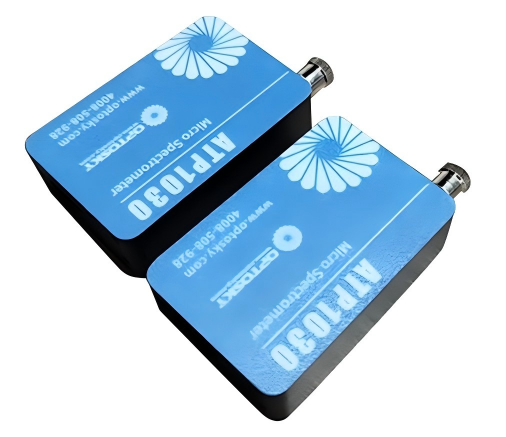
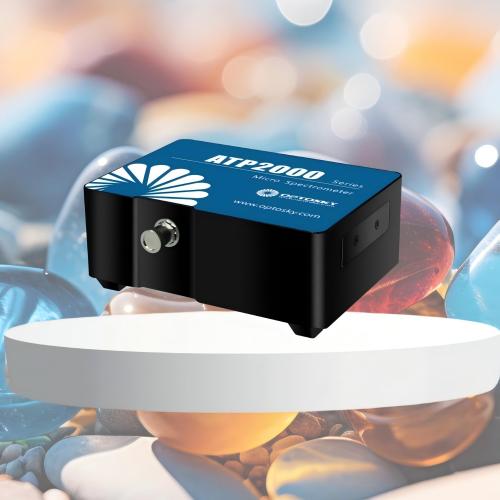
Optosky offers the ATP1000 to ATP8000 series spectrometers, covering the UV-Vis-IR range. By configuring different gratings, slits, and detectors, these instruments can meet various requirements for spectral range, resolution, sensitivity, and SNR (signal-to-noise ratio). Selecting the appropriate spectrometer model and configuration for different gemstone types enables users to quickly and accurately distinguish between genuine and synthetic gemstones. The non-destructive nature of Optosky spectrometers makes them an ideal choice in the gemstone testing field.
Different Principles: Implementing MIR Spectrometers
Product Introduction | ATP1000 Series Spectrometer
Related Article