qr Code Url

Scan qrcode to view mobile website

    OPTOSKY /NEWS /Fieldspec Blog /Why the FieldSpec Spectroradiometer covering ranges of 300-1100nm & 300-2500nm in the market? /

    Why the FieldSpec Spectroradiometer covering ranges of 300-1100nm & 300-2500nm in the market?
    2020-08-07
    Why the FieldSpec Spectroradiometer covering ranges of 300-1100nm & 300-2500nm in the market?

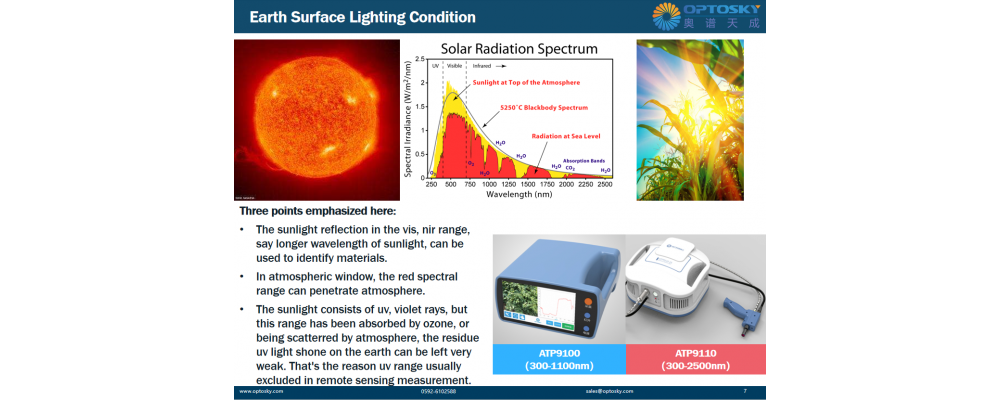
    The sun is a hot ball, it can radiate sublight. When the sun shines around the Atmosphere, Before sun lights been absorbed by the atmosphere, The range remarked in yellow shows a complete spectrum covering 200-2500nm, After being absorbed by the atmosphere, only red remarked sunlight can shine on the earth. You see from 250 to 300, this range is absorbed by the ozone, however, it's reported.that ozone layers being damaged above the sky of south pole, so that dangerous uv light shines directly on the earth, which could be a potential risk of skin cancer.

    And when the sun shines on the earth with energy left remarked in red. Besides ozone absorbs uv rays and uv range, some other sunlight being absorbed, here oxygen, water, etc

    So we say it's the earth surface sunlight decides a spectroradiometers range, If shorter than 300nm, longer 2500nm, there is very few sunlights shine on the earth. So a full range of fieldspec spectroRadiometer covers 300-2500nm. Considering the silicon dictators is cheaper. also because from 300 to 1100nm focus most sunlight shines on the earth. That's explain why Optosky design handheld FieldSpec spectroradiometer ATP9100 30-1100nm and Portable FieldSpec spectroradiometer ATP9110 300-2500nm.

    Share:

    Which field can the Field Spectrometer be used in?

    What is Atmospheric Windows?

    Related Article

    image
    This study distinguishes natural emeralds from synthetic ones by analyzing their UV-visible-NIR spectral features. Key findings reveal distinct Fe-related and water absorption peaks in natural emeralds, enabling accurate identification.
    Using Field Spectroradiometer for Synthetic Emerald Identification
    2024-11-25
    image
    This article investigates using a Field Spectroradiometer to identify chlorophyll concentration in rice leaves. The study highlights the effectiveness of hyperspectral technology for assessing chlorophyll levels in rice leaves using field-based spectral data.
    Using Field Spectroradiometer to Identify Rice Chlorophyll Concentration
    2024-10-24
    image
    This post introduces the application of field spectrometry technology in predicting and monitoring water pollution. By examining the relationship between water body reflectance spectra and water quality indicators, it demonstrates how spectral technology can be used for large-scale water quality monitoring and dynamic tracking of water pollution development.
    Water Quality Monitoring
    2024-09-20
    image
    This post explores the importance of real-time measurement of moisture content in forest litter using infrared spectroscopy. It discusses how different moisture levels influence the infrared absorption spectrum of vegetation and explains how spectral data can be used to build predictive models for forest fire prevention.
    Forest Fire Prevent
    2024-09-20


    Whatsapp :15345924185

    EMAIL: sales@optosky.net

    ADDRESS: No. 7, Tianjing International Intelligent Industrial Park, Tianxin District, Changsha City, Hunan Province, China

    Home
    Products

    About

    Contact

    Download

    SiteMap

    Powered by Optosky

    Optosky©2024

    (135891)
    0
    Service

    WhatsApp
    15345924185
    Wechat
    15345924185
    Phone
    +86-15345924185
    Email
    sales@optosky.net
    Inquiry
    Inquiry
    Top