
Hyperspectral AI for Non‑Destructive Peach Brix Prediction
Are fresh peaches sweet? You no longer need to cut them open to know. This article, based on the study “Research on Hyperspectral‑Based Brix Prediction Method for Fresh Peaches”, introduces how hyperspectral imaging combined with deep learning enables non‑destructive sugar content detection in peaches, and discusses its application prospects in fruit grading, quality inspection, and smart agriculture.
01 Why Is Brix Detection for Fresh Peaches Increasingly Important?
When consumers buy fruit, one of their top concerns is sweetness. Sugar content (Brix) not only determines the taste of fresh peaches, but also serves as a key indicator for ripeness, quality grade, and commercial value. Traditional Brix detection relies mainly on refractometers or chemical analysis, which require cutting the fruit – a destructive method that cannot be used for 100% online inspection, let alone meet the demands of modern fruit grading, storage, and logistics.
In recent years, hyperspectral imaging technology, with its advantage of simultaneous “image + spectrum” acquisition, has provided a new solution for fruit quality assessment. It captures both external morphological information and internal tissue structure and chemical composition, achieving truly non‑destructive testing. The paper indicates that hyperspectral combined with machine learning can rapidly predict the Brix of fresh peaches, laying a technical foundation for future intelligent sorting on production lines.
With the development of smart agriculture, hyperspectral detection has become an important direction for intelligent fruit quality inspection, applicable not only to peaches but also to apples, citrus, grapes, blueberries, and many other fruits.
02 How Does Hyperspectral + Deep Learning Predict Peach Brix?
This study used 270 samples from three varieties – yellow peach, nectarine, and flat peach (pan tao). First, hyperspectral images of each fresh peach were acquired, and the true Brix values were measured using a refractometer to establish a standard dataset.
The overall modeling workflow includes the following main steps:
1. Spectral data preprocessing
To reduce noise and improve model stability, the study compared five classical preprocessing methods:
- Auto‑scaling (Auto)
- Normalization (Normalize)
- Savitzky‑Golay (SG) smoothing
- Multiplicative Scatter Correction (MSC)
- Standard Normal Variate (SNV)
The experimental results showed that Normalization gave the best overall performance, effectively improving subsequent modeling accuracy.
2. Feature wavelength selection
Hyperspectral data typically contain hundreds of bands, not all of which are relevant to Brix. The Successive Projections Algorithm (SPA) was used to extract characteristic wavelengths, reducing data redundancy, improving computational efficiency, and lowering the risk of overfitting.
3. Building Brix prediction models
- Three types of models were established:
- Support Vector Regression (SVR)
- Least Squares Support Vector Regression (LSSVR)
- Convolutional Neural Network (CNN‑2)
Among them, CNN‑2 directly learns non‑linear features from hyperspectral data, offering stronger feature representation than traditional machine learning.
- Experimental results showed:
- Nectarine model: R² = 0.8975
- Yellow peach model: R² = 0.8708
- Flat peach model: R² = 0.8616
The CNN‑2 model outperformed SVR and LSSVR overall, and was insensitive to preprocessing methods and feature band selection, demonstrating good stability and robustness.
03 How Does Hyperspectral Empower Fruit Quality Detection?
In recent years, hyperspectral technology has been widely applied to internal quality inspection of fruits, including:
- Fruit Brix detection
- Soluble solids content (SSC) prediction
- Ripeness identification
- Firmness testing
- Chilling injury detection
- Internal bruise detection
- Pest and disease identification
Compared with traditional methods, hyperspectral offers the following advantages:
- Non‑destructive – does not affect fruit sale
- Enables 100% online rapid inspection
- Simultaneous detection of multiple quality indicators
- Suitable for intelligent grading and automated production lines
- Continuously improves prediction accuracy with AI algorithms
With the development of hyperspectral cameras, miniaturized spectrometers, and artificial intelligence, hyperspectral fruit inspection is gradually moving from the laboratory to industrial applications.
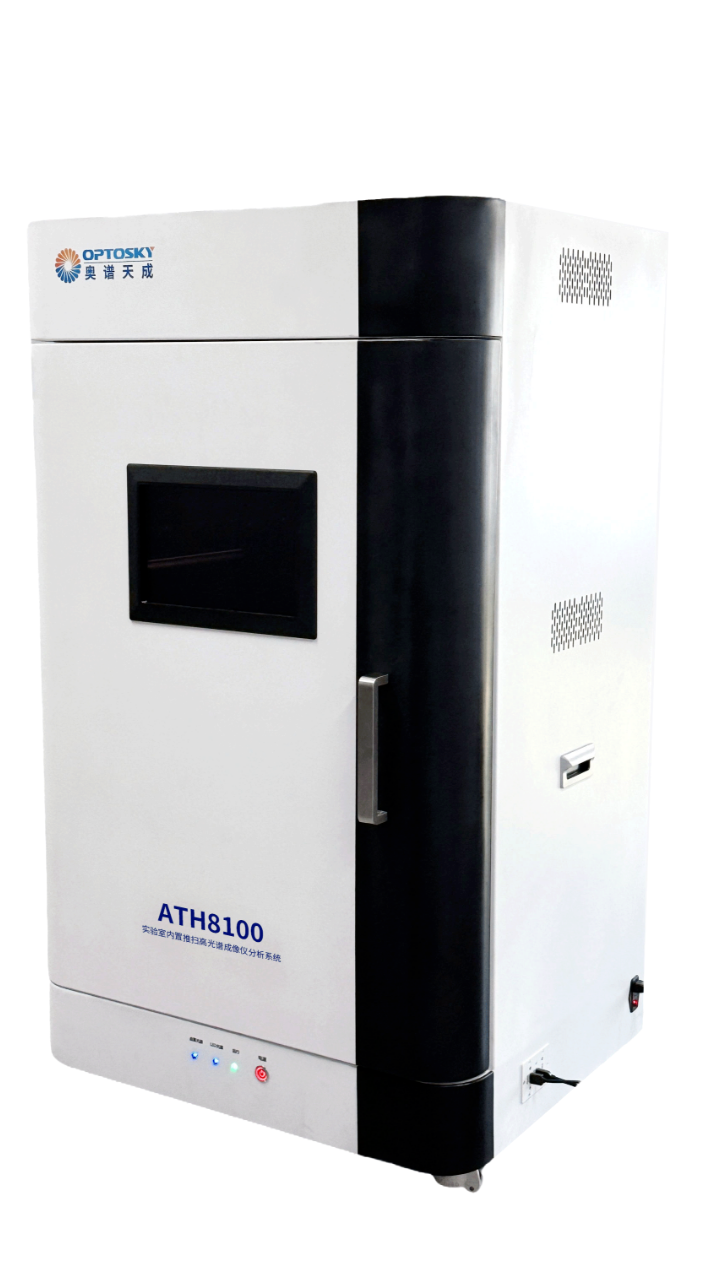
Optosky’s visible–near‑infrared hyperspectral imaging systems cover multiple spectral ranges, including 400–1000 nm, 900–1700 nm, and 1000–2500 nm, meeting the needs of fruit quality inspection, agricultural product grading, plant phenotyping, and food safety testing. Combined with its self‑developed software platform, the system enables spectral data acquisition, preprocessing, feature extraction, machine learning modeling, deep learning analysis, and result visualization, forming a complete data analysis workflow.
In the future, hyperspectral technology will be deeply integrated with artificial intelligence, automated sorting equipment, and smart agriculture, enabling digital quality management throughout the entire process from field harvesting to storage and logistics, providing more efficient and precise non‑destructive testing solutions for modern agriculture.
From “cutting to measure sugar” to “seeing sweetness through the skin”, hyperspectral imaging is driving fruit quality inspection toward intelligence and digitalization. Combined with deep learning algorithms, it not only achieves high‑precision Brix prediction for fresh peaches but also enables quality grading, ripeness evaluation, and internal quality visualization. As hyperspectral hardware and AI algorithms continue to improve, non‑destructive testing technology will play an increasingly important role in smart agriculture and food quality assurance.
For more information, please contact:
Email: [email protected]
Web: www.optosky.net
Keep Your Device Working at Peak Performance | Daily Maintenance Guide for ATP9110 Users
UAV Hyperspectral Remote Sensing for Rice Yield Prediction
Related Article