

Analysis of total organic carbon in domestic drinking water
author: Otis,cily
2023-01-03
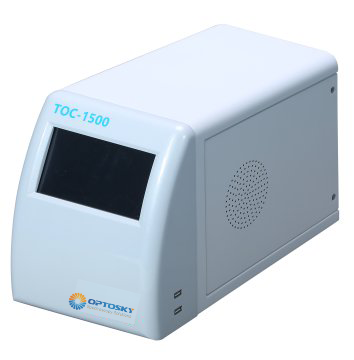
The comprehensive index of organic matter pollution in the domestic and drinking water monitoring project provides a scientific basis for protecting water sources, controlling pollution and improving water quality, and ensuring the health of people's drinking water. At present, it is no longer a technical problem to realize the detection of TOC content in drinking water through TOC analysis technology, but it is the goal that many departments pursue to transform the test in offline scenarios to online monitoring. After the release of the GB 5749-2006 version, China has revised the latest version of the Drinking Water Sanitation Standard again for 16 years. Water quality indicators were adjusted from 106 in version 06 to 97, and water quality reference standards were adjusted from 28 to 55. Total organic carbon is used as the reference index of drinking water quality, and the reference limit is 5mg / L in GB 5749-2022 Sanitary Standard for Drinking Water. In this experiment, the Optosky TOC-3000 total organic carbon analyzer was used as an analytical instrument to conduct the TOC analysis in domestic drinking water. TOC-3000 is an off-line detection equipment based on the digestion principle of ultraviolet persulfate oxidation method. It is mainly used in the detection of total organic carbon in surface water, groundwater, tap water, industrial sewage and other water bodies.
- Experimental part
- Instruments and reagents
- Instrument: Optosky TOC-3000 total organic carbon analyzer
Potassium hydrogen phthalate (reference reagent)
Sodium persulfate (grade pure)
Phosphoric acid (grade pure)
Decarbon 2 distilled water (blank)
- empirical method
2.1.1 Standard solution configuration of organic carbon
2.1.1.1 Organic carbon (TOC) standard storage solution: (ρ TOC = 1000 mg/L) Accurately weigh potassium hydrogen phthalate (predried at 110℃ ~120℃ to constant weight) 2.1255 g, place in a beaker, dissolve in pure water, transfer the solution to a 1000 mL volumetric flask, dilute to the line with pure water, and mix well.
2.1.1.2 Inorganic carbon (TIC) standard storage solution: (ρ TIC = 1000 mg/L) accurately weigh the anhydrous sodium carbonate (dried at 105℃ to constant weight) 4.4085 g and sodium bicarbonate (dried in dryer) 3.5000 g, place in a beaker, dissolve in pure water, transfer the solution to 1000 mL volumetric flask, dilute with pure water to the line, mix well.
2.1.1.3 Total carbon standard use solution: (ρ TC = 100 mg/L, ρ T IC = 50 mg/L) to absorb 10.00 mL of inorganic carbon standard storage solution (2.1.1.2) and organic carbon standard storage solution (2.1.1.1) in 200 mL volumetric bottles, dilute to the marking line with pure water, and mix well.
2.1.1.4 Inorganic carbon standard use solution: (ρ TIC = 50 mg/L), respectively absorb 10.00 mL of inorganic carbon standard storage solution (2.1.1.2) into a 200 mL volumetric bottle, dilute to the marking line with pure water, and mix well..1.
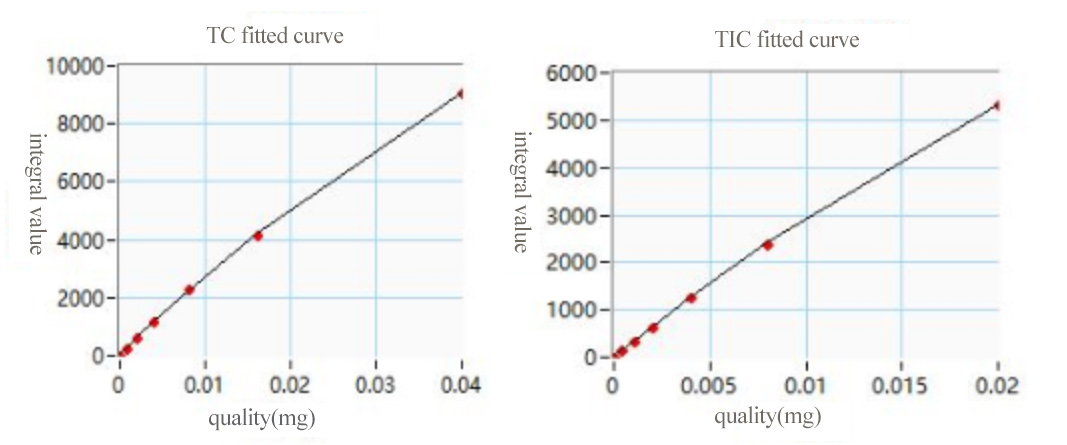
2.2 Drawing of the standard curve
2.2.1 The organic carbon concentration is 0.0, 1.0, 2.0, 5.0, 10.0, 20.0, 50.0mg/L standard solution series, using the sample with different concentrations of the same volume, drawing the sample with the carbon mass as the abscissa and the integrated area signal as the ordinate to draw the calibration curve;
2.2.2 Prepare the inorganic carbon concentration as 0.0, 0.5, 1.0, 2.5, 5.0, 10.0, 25.0mg/L standard solution series, adopt the sample with different concentrations of the same volume, take the mass of carbon as the abscissa, and take the integrated area signal as the ordinate to draw the calibration curve;
3. Sample test
Select the difference subtraction test mode and test the blank page, standard point and sample successively.
Table 1 Results of TOC determination of 3 samples
| Sample name | order number | TC mg/L |
mean mg/L |
TIC mg/L |
mean mg/L |
TOC mg/L |
| Sample No. 1 | 1 | 3.38 | 3.28 | 2.37 | 2.41 | 0.87 |
| 2 | 3.27 | 2.43 | ||||
| 3 | 3.19 | 2.44 | ||||
| Sample No. 2 | 1 | 1.59 | 1.56 | 1.32 | 1.31 | 0.25 |
| 2 | 1.56 | 1.33 | ||||
| 3 | 1.53 | 1.27 | ||||
| Sample No. 3 | 1 | 1.88 | 1.88 | 1.15 | 1.17 | 0.71 |
| 2 | 1.88 | 1.17 | ||||
| 3 | 1.87 | 1.19 |
How to detect the TOC in acidic wastewater?
The role of TOC validation technology in the pharmaceutical industry
Related Article
LC/MS enhances pesticide detection with high sensitivity, selectivity, specificity, and efficiency, enabling precise and rapid analysis to meet food safety standards.
Top Four Benefits of LC/MS in Pesticide Detection
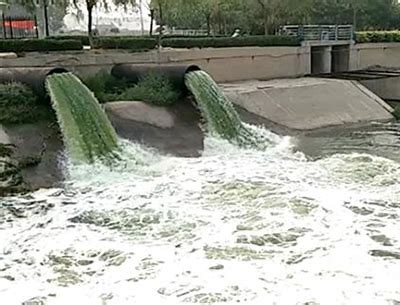
We chose the TOC-2000 TOC analyzer and configured an organic carbon standard solution in accordance with the standard "HJ 501-2009 Determination of Water Quality TOC Combustion Oxidation-Non-Dispersive Infrared Absorption Method" to measure the total organic carbon in the sample using the combustion oxidation method.
TOC content detection in industrial wastewater
Using the Optosky TOC-2000 total organic carbon meter to measure water samples with high chlorine compounds can achieve comprehensive, simple and accurate determination under certain conditions. High chloride content has basically no effect on the TOC measurement results of water samples.
Determination of TOC content of high chlorine samples by dry oxidation method
TOC total organic carbon analyzers have been increasingly used in the environment, drinking water, pharmaceuticals, electronics, power plants and other industries. In 2003, the four national ministries and commissions officially included TOC in the water pollutant pollution equivalent value table as an important indicator for environmental monitoring in the newly promulgated "Standard Management Measures for the Collection of Pollution Fees".
Water quality standards related to TOC analysis