TOC content detection in industrial wastewater
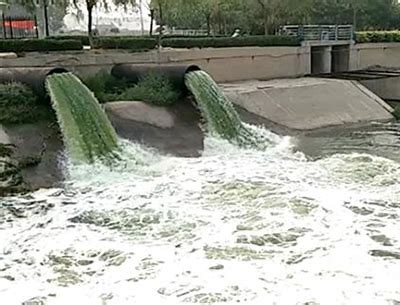
Industrial wastewater refers to wastewater, sewage and waste liquid generated during industrial production, which contains industrial production materials, intermediates and products lost with water, as well as pollutants generated during the production process. With the rapid development of industry, the type and quantity of wastewater have increased rapidly, and the pollution of water bodies has become increasingly widespread and serious, threatening human health and safety. Therefore, for protecting the environment, the treatment of industrial wastewater is more important than the treatment of urban sewage.
In order to implement the "Environmental Protection Law of the People's Republic of China", the "Water Pollution Prevention and Control Law of the People's Republic of China" and the "Marine Environmental Protection Law of the People's Republic of China" and control water pollution, in the past ten years, The country has formulated water pollutant discharge standards for many industries including the steel industry, electroplating, petroleum refining industry, etc. Most of these standards have set clear emission limits for TOC.
An electroplating factory in Nantong, Jiangsu now provides data support for the treated wastewater to meet the discharge standard requirements, and tests the TOC in the electroplating wastewater generated from its production. We chose the TOC-2000 TOC analyzer and configured an organic carbon standard solution in accordance with the standard "HJ 501-2009 Determination of Water Quality TOC Combustion Oxidation-Non-Dispersive Infrared Absorption Method" to measure the total organic carbon in the sample using the combustion oxidation method.
1. Experimental part
1. Instruments and reagents
1.1 Instrument: TOC-2000 TOC analyzer
1.2 Reagent: Potassium hydrogen phthalate (baseline reagent)
Sodium carbonate (baseline reagent)
Sodium bicarbonate (excellent grade pure)
Phosphoric acid (excellent grade pure)
Decarbonated distilled water
2. Experimental methods
2.1 Configuration of standard solution
Weigh 2.1254g of potassium hydrogen phthalate (previously dried at 110-120°C to constant weight), place it in a beaker, add pure water to dissolve, transfer this solution to a 1000 mL volumetric flask, and dilute to the mark with pure water, mix well, and prepare a standard solution with a TOC value of 1000 mg/L.
Weigh 4.4085 g of anhydrous sodium carbonate (dried in advance at 105°C to constant weight) and 3.5000 g of sodium bicarbonate (dried in a desiccator in advance), place them in a beaker, add pure water to dissolve, transfer this solution to 1000 mL volumetric flask, dilute to the mark with pure water, mix well, and prepare a standard solution with an IC value of 1000 mg/L.
2.2 Drawing of standard curve
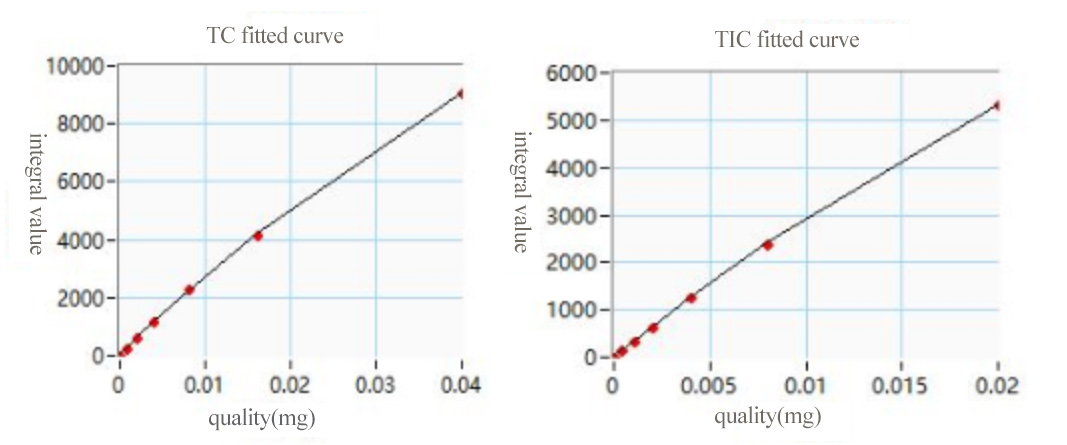
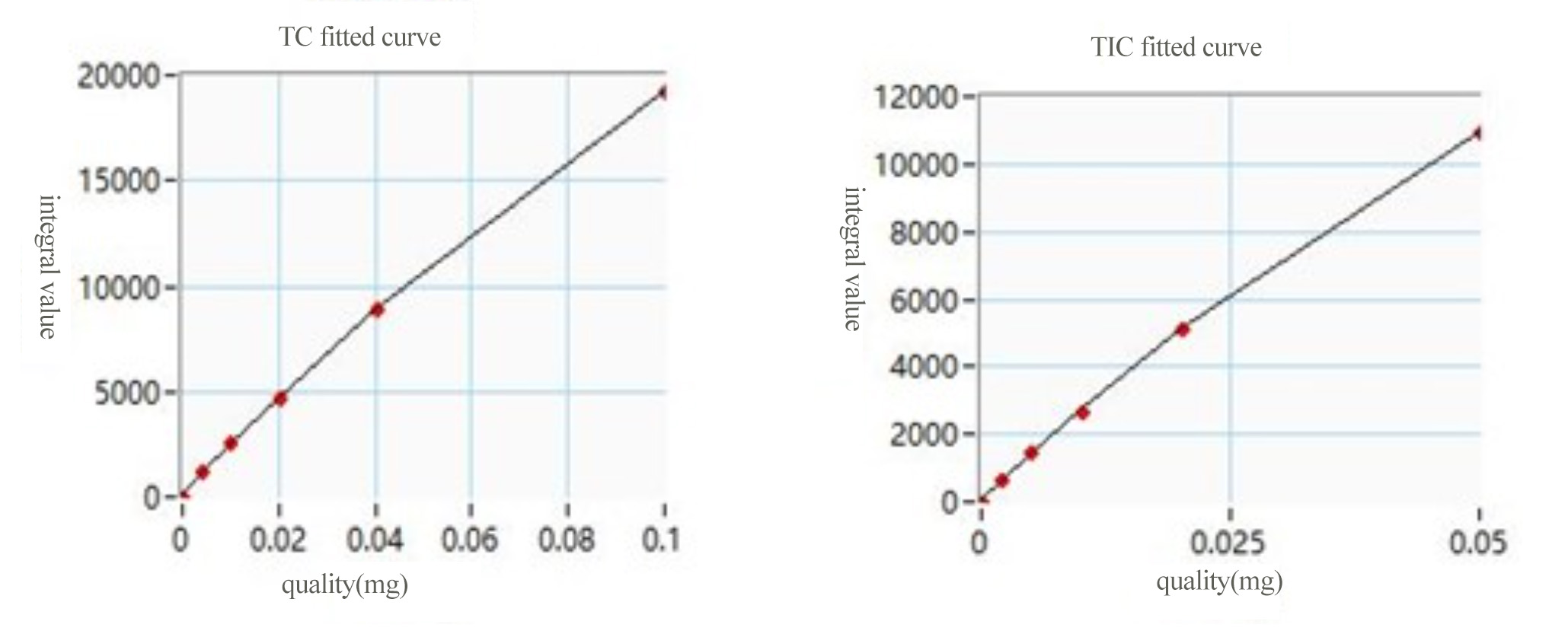
According to the standard, a mixed standard series solution with a total carbon concentration of 0.0, 4.0, 10.0, 20.0, 40.0, 80.0, 200.0mg/L and an inorganic carbon concentration of 0.0, 2.0, 5.0, 10.0, 20.0, 40.0, 100.0mg/L is prepared, the standard line is drawn by injecting samples of the same volume with different concentrations, with the mass of carbon as the abscissa and the integrated area signal as the ordinate, and the calibration curve is drawn as follows:
TC curve equation: Y= -1643374X2+312868X+42, correlation coefficient R= 0.9999
TIC curve equation: Y=-3094839X2+338829X+20, correlation coefficient R= 0.9997
3. Sample testing
The customer provided information that the sulfuric acid content in the two samples was about 10%. In order to minimize the interference of sulfate ions on the test and to reduce the loss of instrument consumables, the samples were first manually injected and tested, and the samples were drawn with a microsyringe. Inject 20 μL of sample into the TC reaction tube. According to the test response value, the TOC content in the sample is between 400-600 mg/L.
To ensure good test accuracy, dilute the TOC concentration of the sample near the middle point of the standard curve, dilute the two samples 20 times with ultrapure water, and then transfer the diluted sample to a sample bottle.
4. Test parameters
Cracking furnace temperature: 800℃
Carrier gas flow: 180mL/min
Injection volume: 200μL
Injection method: automatic sampler
5.Test results
|
Sample |
TC average value (mg/L) |
TIC average value (mg/L) |
TOC average value (mg/L) |
RSD (%) |
|
1# Dilute 20 times |
32.9 |
0.2 |
32.7 |
1.34 |
|
2# Dilute 20 times |
23.2 |
0.1 |
23.1 |
0.76 |
Multiply the test results of the two samples by the dilution factor of 20, and the TOC concentration of the 1# sample is 654 mg/L, and the TOC concentration of the 2# sample is 462 mg/L.
2. Results and discussion
The common coexisting ions S042-, Cl-, NO3-, P043-, and S2- in the sample will cause certain interference in the TOC test. The usual practice is to dilute the water sample with carbon dioxide-free water until the concentration of the above coexisting ions is lower than its interference allowable concentration before analysis. When the TOC concentration in the sample is relatively low and the dilution factor is too large, it will have a great impact on the accuracy of the test results. At this time, you can use the manual injection measurement mode to pre-measure the TOC concentration range of the sample and then determine the appropriate dilution factor.
Top Four Benefits of LC/MS in Pesticide Detection
Determination of TOC content of high chlorine samples by dry oxidation method
Related Article