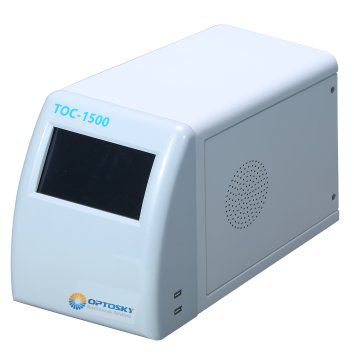
Determination of TOC content of high chlorine samples by dry oxidation method

Determination of TOC content of high chlorine samples by dry oxidation method
For samples containing high chloride, there is currently no effective way to remove salt components. However, in order to prevent salts from accumulating in the combustion tube and reduce the flow rate of the carrier gas, it also affects the catalytic effect of the catalyst and reduce the service life of the catalyst. It is best to dilute the high chloride sample and then measure it. Dilution protects the catalyst, extends catalyst life, and reduces salt buildup inside the instrument to effectively protect instruments.
Currently, two samples from a user in Xiamen are clear and transparent water samples, and the sample numbers are "1#" and "2#" respectively. The pH value of the "1#" sample is around 10, and the pH value of the "2#" sample is around 7. The chloride ion content of two samples is approximately 8000~22400 mg/L.
Experimental part
1. Instruments and reagents
1.1 Instrument: TOC-2000 total organic carbon analyzer
1.2 Reagents:
Potassium hydrogen phthalate (baseline reagent)
Phosphoric acid (excellent grade pure)
Distilled water without carbon dioxide (blank sample)
2. Experimental methods
2.1 Preparation of standard solution
2.1.1 Organic carbon standard solution configuration
2.1.1.1 Organic carbon (TOC) standard stock solution: (ρTOC= 1000 mg/L) Accurately weigh 2.1253 g of potassium hydrogen phthalate (dried to constant weight at 110 ℃ ~ 120 ℃ in advance), and place it in a beaker, add pure water to dissolve, transfer this solution to a 1000 mL volumetric flask, dilute to the mark with pure water, and mix well.
2.1.1.2 Inorganic carbon (TIC) standard stock solution: (ρTIC=1000 mg/L) Accurately weigh 4.4085 g of anhydrous sodium carbonate (preliminarily dried at 105°C to constant weight) and sodium bicarbonate (preliminarily dried in a desiccator) 3.5000 g, place it in a beaker, add pure water to dissolve, transfer this solution to a 1000 mL volumetric flask, dilute it with pure water to the mark, and mix well.
2.1.1.3 Total carbon standard solution: (ρTC= 200 mg/L, ρTIC= 100 mg/L) Use a single-marked pipette to add 40.00 mL of inorganic carbon standard stock solution and organic carbon standard stock solution to a 200 mL volumetric flask respectively. Dilute to the mark with pure water and mix well.
2.1.1.4 Inorganic carbon standard solution: (ρTIC= 100 mg/L) Use a single-marked pipette to suck 20.00 mL of the inorganic carbon standard stock solution into a 200 mL volumetric flask, dilute to the mark with pure water, and mix.
2.2 Drawing of standard curve
2.2.1 Prepare a series of standard solutions with the total carbon concentration to be 0.0, 4.0, 10.0, 20.0, 40.0, 80.0, and 200.0 mg/L. Use the mass of carbon as the abscissa and the integrated area signal as the ordinate to draw a calibration curve.
2.2.2 Prepare a series of standard solutions with inorganic carbon concentrations of 0.0, 2.0, 5.0, 10.0, 20.0, 40.0, and 100.0 mg/L. Use the same volume to inject samples with different concentrations. Take the mass of carbon as the abscissa and the integrated area signal as the ordinate to draw a calibration curve.
3. Sample testing
Take two 100 mL volumetric flasks and wash them three times with fresh pure water. Use a 5 mL pipette to transfer 2 mL of sample into the cleaned volumetric flasks. Dilute to 100 mL with pure water and mix well. Adjust pH to 2-3 and purge for 10 minutes as the sample to be tested (diluted 50 times). Use the TOC-2000 total organic carbon analyzer to perform a subtraction test.
4. Results and discussion
TC curve equation: Y=-1531555.9X2+286528.1X+32.7 R2=0.9999
TIC curve equation: Y=-2726731.6X2+320039.9X+19.1 R2=0.9999
|
Sample name |
Serial number |
Test value(mg/L) |
Average value(mg/L) |
RSD(%) |
Original solution(mg/L) |
|
1# |
1 |
21.02 |
21.17 |
0.71 |
1050.5 |
|
2 |
21.32 |
||||
|
3 |
21.16 |
||||
|
2# |
1 |
3.21 |
3.26 |
1.45 |
155.0 |
|
2 |
3.26 |
||||
|
3 |
3.30 |
||||
|
Remark |
Blank 0.16 mg/L, sample diluted 50 times |
||||
It can be seen from the results that using the Optosky TOC-2000 total organic carbon meter to measure water samples with high chlorine compounds can achieve comprehensive, simple and accurate determination under certain conditions. High chloride content has basically no effect on the TOC measurement results of water samples.
TOC content detection in industrial wastewater
Water quality standards related to TOC analysis
Related Article