Analysis of total organic carbon in drinking water
Analysis of total organic carbon in drinking water
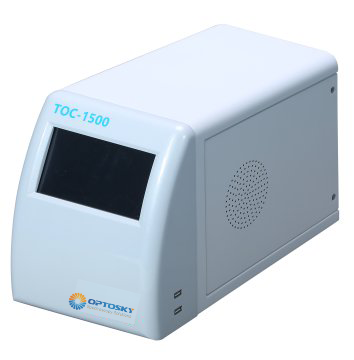
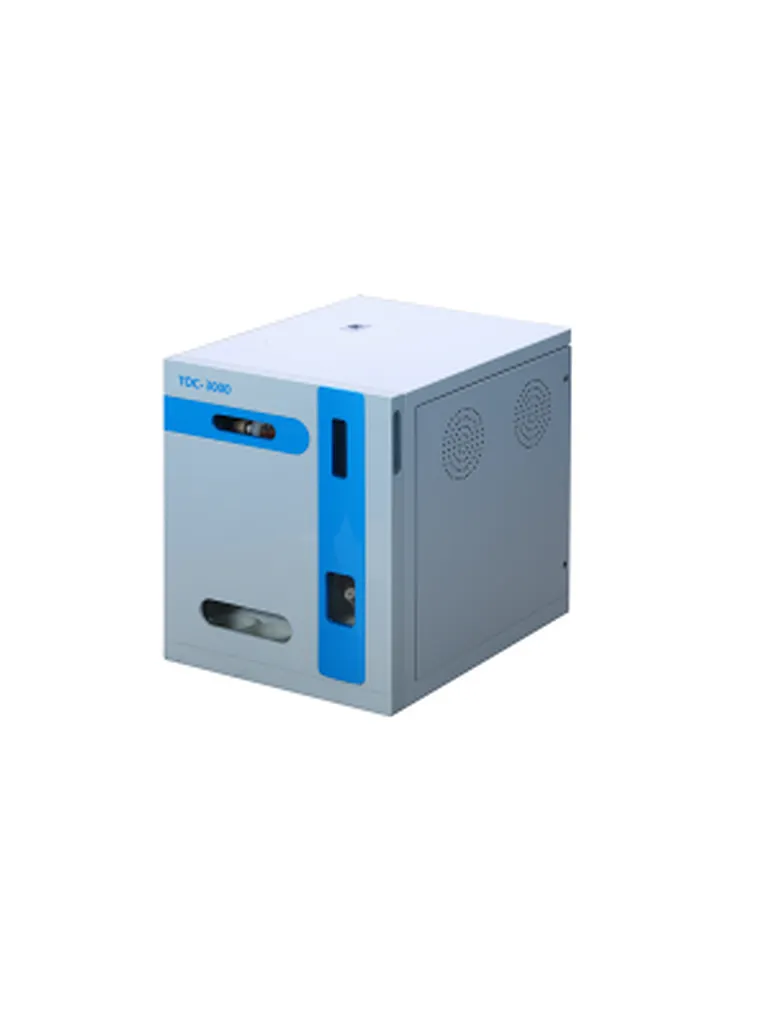
The comprehensive indicators of organic pollution in drinking water monitoring projects provide scientific basis for protecting water sources, controlling pollution and improving water quality, and ensuring the health of people's drinking water. It is no longer a technical problem to detect the TOC content of drinking water through TOC analysis technology. Converting testing in offline scenarios to online monitoring is the goal pursued by many departments. Following the release of the GB 5749-2006 version, 16 years later, my country has revised the latest version of the "Hygienic Standards for Drinking Water" again. The water quality indicators were adjusted from 106 items in the 2006 edition to 97 items, and the water quality reference standards were adjusted from 28 items to 55 items. Total organic carbon is used as a reference indicator for drinking water quality. The reference limit in GB 5749-2022 "Hygienic Standard for Drinking Water" is 5mg/L. In this experiment, TOC-3000 total organic carbon analyzer was used as the analytical instrument to analyze TOC in drinking water. TOC-3000 is an offline detection equipment based on the UV persulfate oxidation method as the digestion principle. It is mainly used for total organic carbon detection in surface water, groundwater, tap water, industrial sewage and other water bodies.
Experimental part
1. Instruments and reagents
1.1 Instrument: TOC-3000 total organic carbon analyzer
1.2 Reagents:
Potassium hydrogen phthalate (baseline reagent)
Sodium persulfate (excellent grade pure)
Phosphoric acid (excellent grade pure)
Distilled water without carbon dioxide (blank sample)
2. Experimental methods
2.1 Preparation of standard solution
2.1.1 Organic carbon standard solution configuration
2.1.1.1 Organic carbon (TOC) standard stock solution: (ρTOC= 1000 mg/L) Accurately weigh 2.1253 g of potassium hydrogen phthalate (dried to constant weight at 110 ℃ ~ 120 ℃ in advance), and place it in a beaker, add pure water to dissolve, transfer this solution to a 1000 mL volumetric flask, dilute to the mark with pure water, and mix well.
2.1.1.2 Inorganic carbon (TIC) standard stock solution: (ρTIC=1000 mg/L) Accurately weigh 4.4085 g of anhydrous sodium carbonate (preliminarily dried at 105°C to constant weight) and sodium bicarbonate (preliminarily dried in a desiccator) 3.5000 g, place it in a beaker, add pure water to dissolve, transfer this solution to a 1000 mL volumetric flask, dilute it with pure water to the mark, and mix well.
2.1.1.3 Total carbon standard solution: (ρTC= 100 mg/L, ρTIC= 50 mg/L) Use a single-marked pipette to add 40.00 mL of inorganic carbon standard stock solution and organic carbon standard stock solution to a 200 mL volumetric flask respectively. Dilute to the mark with pure water and mix well.
2.1.1.4 Inorganic carbon standard solution: (ρTIC= 50 mg/L) Use a single-marked pipette to suck 20.00 mL of the inorganic carbon standard stock solution into a 200 mL volumetric flask, dilute to the mark with pure water, and mix.
2.2 Drawing of standard curve
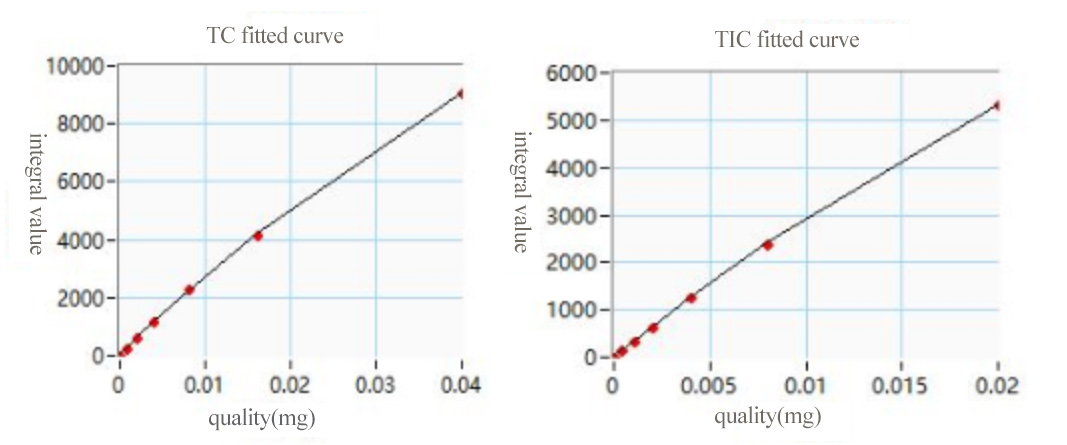
2.2.1 Prepare a series of standard solutions with organic carbon concentrations of 0.0, 1.0, 2.0, 5.0, 10.0, 20.0, and 50.0 mg/L, and use the same volume to inject samples with different concentrations. Take the mass of carbon as the abscissa and the integrated area signal as the ordinate is used to draw a calibration curve.
2.2.2 Prepare a series of standard solutions with inorganic carbon concentrations of 0.0, 0.5, 1.0, 2.5, 5.0, 10.0, and 25.0 mg/L. Use the same volume of samples with different concentrations. Take the mass of carbon as the abscissa and the integrated area signal as the ordinate is used to draw a calibration curve.
3. Sample testing
Select the difference subtraction test mode to test the blank page, standard point and sample in sequence.
|
Sample name |
Serial number |
TC (mg/L) |
Average value(mg/L) |
TIC (mg/L) |
Average value(mg/L) |
TOC (mg/L) |
|
Sample No. 1 |
1 |
3.38 |
3.28 |
2.37 |
2.41 |
0.87 |
|
2 |
3.27 |
2.43 |
||||
|
3 |
3.19 |
2.44 |
||||
|
Sample No. 2 |
1 |
1.59 |
1.56 |
1.32 |
1.31 |
0.25 |
|
2 |
1.56 |
1.33 |
||||
|
3 |
1.53 |
1.27 |
||||
|
Sample No. 3 |
1 |
1.88 |
1.88 |
1.15 |
1.17 |
0.71 |
It can be seen from the results in Table 1 that each of the three drinking water samples collected was tested three times in parallel. The TOC contents of samples 1-3 were 0.87mg/L, 0.25mg/L, and 0.71mg/L respectively. , are all lower than the TOC limit requirements in GB 5749-2022. Whether it reaches the drinkable standard needs to comprehensively consider other indicators. The TOC-3000 total organic carbon analyzer requires no consumables during the detection process. It has fast detection speed and sensitive response. When paired with an automatic sampler, it can achieve efficient analysis of total organic carbon in drinking water.
Total organic carbon analyzer unique dehydration technology dehydration efficiency
TOC elemental analysis
Related Article