
Application of NIR Spectroscopy in Dairy Production
author: Susan
2021-10-25
Infrared spectroscopy analysis technology is a testing technology that developed rapidly in the late 1980s. In Europe and the United States, it has become an important method for the analysis of dairy products and has been recognized by authoritative dairy analysis institutions.
The current traditional milk powder detection methods are time-consuming and cumbersome for the detection of these physical and chemical indicators, and the milk powder production process is a continuous process, and long-term analysis and detection cannot meet the effective control of the milk powder production process.
The current domestic milk powder production process generally includes raw milk acceptance → pretreatment and standardization → concentration → spray drying → cooling storage → packaging → finished product. There are multiple key control points in the whole process that need to be tested for multiple indicators, and these points are very suitable Use near-infrared spectroscopy analysis technology for rapid analysis.
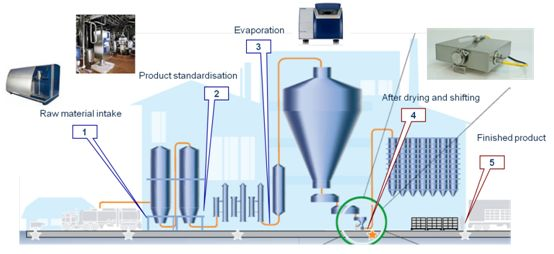
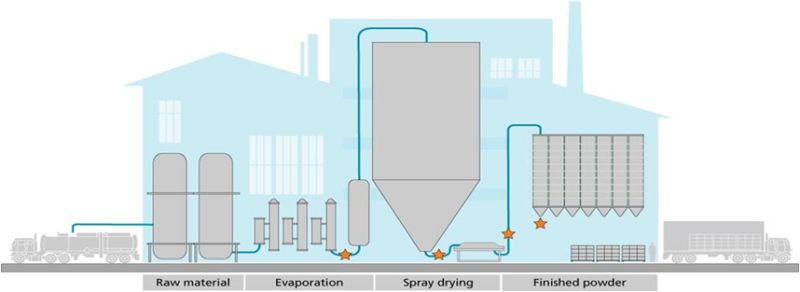
In the entire production process of milk powder, almost all the key control points (marked by the red star in the above figure) can be analyzed and tested by infrared spectroscopy technology. The use of near-infrared analysis technology to monitor the milk powder production process can effectively improve the qualification rate of the product. The cost control of enterprises and the provision of safe and qualified dairy products for consumers have a very high practical effect.
Optosky could provide low-cost NIR modular spectrometer with free software for the monitoring dairy system, from 900-2500nm wavelength range.
The current traditional milk powder detection methods are time-consuming and cumbersome for the detection of these physical and chemical indicators, and the milk powder production process is a continuous process, and long-term analysis and detection cannot meet the effective control of the milk powder production process.
The current domestic milk powder production process generally includes raw milk acceptance → pretreatment and standardization → concentration → spray drying → cooling storage → packaging → finished product. There are multiple key control points in the whole process that need to be tested for multiple indicators, and these points are very suitable Use near-infrared spectroscopy analysis technology for rapid analysis.
In the entire production process of milk powder, almost all the key control points (marked by the red star in the above figure) can be analyzed and tested by infrared spectroscopy technology. The use of near-infrared analysis technology to monitor the milk powder production process can effectively improve the qualification rate of the product. The cost control of enterprises and the provision of safe and qualified dairy products for consumers have a very high practical effect.
Absorbance Spectrum Analysis Measure Solution
Using UV Imaging Spectrometer to Research Natural World
Related Article

The ATP7810 is a wide-band, high-resolution infrared grating spectrometer covering up to 0.9–5 μm. Featuring a motorized rotating grating, multiple detector options (InGaAs/MCT), and flexible interfaces (SMA905 or free space, USB/UART control), it delivers high SNR and stability for absorption/reflection/transmission spectroscopy, laser wavelength testing, and fiber optic sensing.
New Product Recommendation | ATP7810 Ultra-Wide Range Infrared Spectrometer Series

This study uses the ATP5200P UV-Vis spectrometer to investigate xanthate adsorption on chalcopyrite surfaces. By analyzing absorbance at 300 nm under controlled pH and temperature, the method optimizes flotation conditions for copper recovery, enabling real-time, sensitive detection of adsorption mechanisms in non-ferrous mineral processing.
Using the ATP5200P Spectrometer to Unravel Xanthate Adsorption and Separation Mechanisms
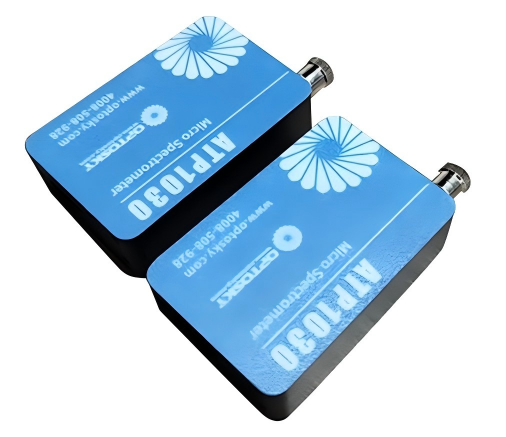
ATP1030 is an ultra‑compact, high‑resolution spectrometer covering 190–1100 nm. With a 1024‑pixel CMOS detector, adjustable integration time down to 1 ms, and USB‑powered design, it delivers reliable performance for applications like online water analysis, color measurement, handheld instruments, and Raman spectroscopy.
Product Recommendation | ATP1030 mini spectrometer Spectrometer

Vis-NIR transmission spectroscopy enables non-destructive identification of infertile duck eggs before incubation, achieving >95% accuracy. By detecting spectral fingerprints (e.g., 836 nm peak for fertile eggs), this method reduces energy waste and improves hatch rates, offering a low-cost, high-throughput solution for modern poultry farming.
Application case | How Spectral Technology is Transforming Duck Egg Farming