Application of NanoBio200 ultra-trace UV spectrophotometer in the food Safety
UV spectrum
Ultraviolet spectrum is an electron absorption spectrum. The wavelength range of the usually called ultraviolet spectrum is 200~400nm. The testing range of the usual ultraviolet spectrometer can be extended to the visible light area, including the wavelength area of 400~800nm. When the sample molecules or atoms absorb photons, , the outer electrons transition from the ground state to the excited state. The electron transition modes of sample molecules with different structures are different, and the wavelength range of absorbed light is different, and the absorption ratio is also different. Therefore, different types of molecules can be identified based on the wavelength range and absorbance. Differences in the structure of matter. Therefore, each substance has its own unique and fixed absorption spectrum curve, and the presence of a certain substance can be judged based on the maximum absorption peak (peak) and waveform at certain characteristic wavelengths on the absorption spectrum.
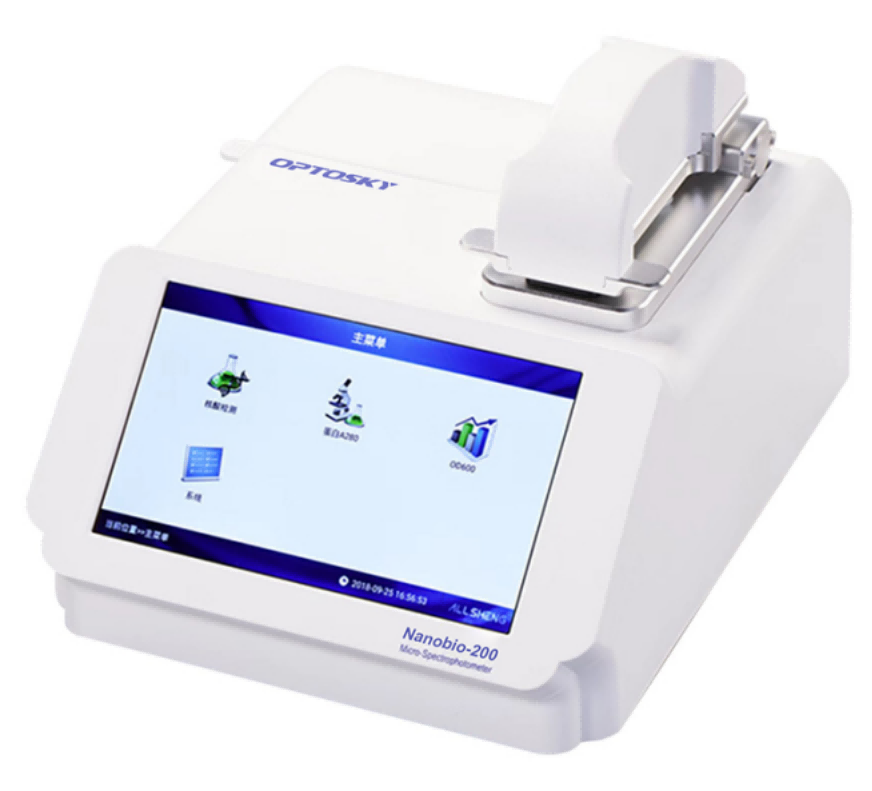
NanoBio200 UV spectrophotometer
NanoBio200 is a full-wavelength (190-850 nm) ultra-trace ultraviolet spectrophotometer developed by Optosky. It uses self-produced high-performance fiber spectrometer and high-stability pulse xenon lamp, which can quickly and accurately detect nucleic acids, proteins and cell solutions. wait. The time is short, the efficiency is high, and the detection effect is accurate. Regarding the amount of sample used, the ultra-trace UV spectrophotometer will not waste the sample, has a wide detection range, and does not need to worry about errors caused by sample dilution, and can meet the needs of the majority of small and medium-sized food companies for food testing and analysis.
Uv-vis mode interface
Application in food field
In food production, in order to ensure that the color of colored beverages (such as cola, juice, tea) is consistent, an ultra-trace ultraviolet spectrophotometer can be used to measure the absorbance value in the visible wavelength region, so that the color difference meets the product requirements. For some products with relatively single ingredients, the absorbance value can also be measured to determine whether the product is qualified or not. For example, to determine the quality of the nutritional enhancer vitamin Bl, the absorbance value can be measured at 400nm. When the value does not exceed 0.020, it can be determined to be a qualified product.
Some food additives are used in food production. In order to determine the quality of food additives, ultra-trace UV spectrophotometer can also be used to perform spectral scanning. For example, some compound sweeteners, compound preservatives and compound flavoring agents involved in food can be comprehensively scanned with an ultra-trace UV spectrophotometer to exclude the use of prohibited additives.
Proteins are biological macromolecules, and the ultraviolet light absorption produced is often caused by small groups within the molecules, such as purine bases, pyrimidine bases, and peptide bonds. Purine bases, pyrimidine bases and the nucleosides, nucleotides and nucleic acids composed of them have strong absorption of ultraviolet light, with a maximum absorption value at the absorption wavelength of 260nm. In protein molecules, the benzene rings of tyrosine, phenylalanine, and tryptophan residues contain conjugated double bonds, which absorb ultraviolet light (the maximum absorption of tyrosine is at the absorption wavelength of 274 nm; Alanine absorbs at a wavelength of 257nm; tryptophan absorbs at a wavelength of 280nm), causing the protein to absorb ultraviolet light. The maximum absorption of ultraviolet light by peptide bonds is at the absorption wavelength of 238nm. This feature can be used to accurately and reliably determine the protein content in dairy products.
In short, with the development of science and technology, ultra-trace UV spectrophotometers can also be connected with other analytical instruments to make their application range wider and play a role in more fields.
Solution | Example of Visible-Near Infrared (Vis-NIR) Fiber Optic Spectrometer in Transmittance Applications
Academic dry stuff|Understanding UV, visible and near infrared spectrophotometer in one article
Related Article