
New product|recommendation-GF900 UAV-borne laser methane telemetry system
2023-08-30
City gas safety issues frequently arise. By the end of 2022, after more than 40 years of high-speed and large-scale construction, the urbanization rate has reached 65.22%, and various problems in urban operation have also been highlighted. Accidents such as gas leaks have occurred across the country. According to relevant statistics, there are an average of more than 900 gas accidents in the country every year, and urban gas safety accidents have become the third largest killer in my country after traffic accidents and industrial accidents. The "6.21" gas explosion in Yinchuan killed 31 people! The terrible accident has warned us many times.
|
|
|
|
|
|
The picture comes from the Internet*
In China, gas pipelines are characterized by wide distribution and long distances, and inspection has always been a difficult point in pipeline management. Among them, the safety of gas consumption by residential gas users is the focus of urban gas safety management. Once leaked, it is easy to cause gas fire and explosion accidents, causing heavy casualties and property losses, and has a huge social impact. The security check situation of residential users is complicated. Statistics show that the rate of security check-in is about 85%, and the proportion of people who cannot enter the house is 15%. In addition, the empty rooms with natural gas in the standpipe are not included in the scope of daily security checks, and cannot be checked. ratio is actually higher.
The party and the state attach great importance to gas safety issues and have deployed a number of related policies and measures. In 2022, the General Office of the State Council issued the "Implementation Plan for the Aging and Renovation of Urban Gas Pipelines and Others (2022~2025)", which requires speeding up the renovation of urban gas pipelines and other aging facilities.
GF900 Product Introduction
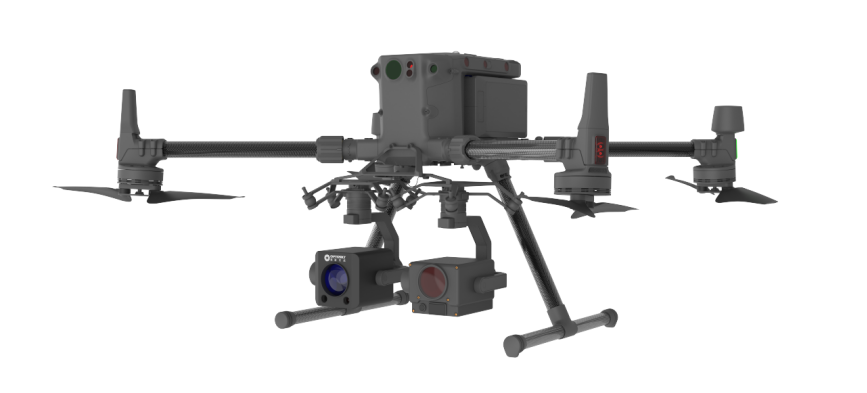
GF900 UAV-borne laser methane telemetry system is a new generation of intelligent inspection equipment for methane leaks launched by Opu Tiancheng. The GF900 solution can provide intelligent, accurate and reliable inspection solutions for complex and dangerous environments such as factories, pipelines, residential buildings, urban complexes, and mountains.
Working principle of GF900
When the instrument is working, it emits a detection laser with a specific wavelength range (the measured gas is different, the central wavelength is also different), and the detection laser encounters reflective objects (such as the ground, valves, pipes, walls, etc.) The laser light returns to the detection unit of the instrument. In the beam path, if there is an air mass formed by the leakage of the gas to be measured, the air mass will absorb the detection laser light, and the ratio of the amount of unabsorbed light to the amount of absorbed light is proportional to the concentration of the air mass. By calculating the ratio, it can be deduced The concentration of the air mass.
When the instrument is working, it emits a detection laser with a specific wavelength range (the measured gas is different, the central wavelength is also different), and the detection laser encounters reflective objects (such as the ground, valves, pipes, walls, etc.) The laser light returns to the detection unit of the instrument. In the beam path, if there is an air mass formed by the leakage of the gas to be measured, the air mass will absorb the detection laser light, and the ratio of the amount of unabsorbed light to the amount of absorbed light is proportional to the concentration of the air mass. By calculating the ratio, it can be deduced The concentration of the air mass.
The measurement results are expressed in gas column concentration (ppm.m): gas concentration (ppm) × air mass thickness (m). As shown in the figure below, the gas concentration value reaches 300ppm, and the thickness of the clump is 1m, then the gas column concentration=300ppm×1m=300ppm.m.
Notice:
-
Unit concentration (ppm.m): The detection value of this product is the overall concentration of the measured gas in the beam path, and the unit is ppm m, which is the product of gas concentration (ppm) and air mass size (m);
-
Choose a suitable reflective surface: The reflective ability of the target to the laser will directly affect the distance and effect of the measurement. If the target is dark, inclined at a large angle, porous, mirror or highly reflective surface, please adjust the angle and position to achieve the best detection effect.
For example, black foam, facing glass, large-angle exposure to the ground, stainless steel metal grids, etc. are bad reflection targets; plaster walls, cement planes, continuous foliage vegetation, land or sand are excellent reflection backgrounds;
-
Highly reflective surface: The device is facing a surface with high reflectivity (glass, smooth tiles, water surface, smooth stainless steel railing), and the direct reflection of specular light into the detector will overload the detector instantly, resulting in false alarms. In addition, highly reflective surfaces may also cause a directional reflection of the detection beam, no return light, and an error of too low light intensity.
-
The situation of penetrating transparent objects: laser can detect methane through transparent objects, but during the penetrating process, the measurement value will be lower due to the reflection of transparent objects, and the more transparent objects penetrated, the greater the loss.
Long-distance monitoring: The beam emitted by the laser collimator is not a strict straight line, but will continue to diverge and become weaker as the distance increases; forming a conical divergent beam. The spot size of the detection beam at a distance of 100 meters is about a circle with a diameter of 1 meter, so when the distance increases, the area of the gas detection is too small, which may cause a part of the laser light to not pass through the gas and reflect back to the instrument, resulting in a measured value that is higher than the actual value Issues that are too small to detect effectively.
When detecting high-rise residential buildings, when the measurement elevation angle is too large, the oval spot will cover multiple layers, and the detection target cannot be filled with the spot, resulting in a small detection value. In the case of long-distance detection, the laser itself will scatter, and the situation will be even worse in windy, sandy, rainy and foggy weather, resulting in too low light intensity reflected back to the device, resulting in small detection values or too weak light intensity errors.
GF900 Features
GF900 uses 3AXIS three-axis stabilized gimbal, the gyroscope detects the inclination angle of the drone, and the attitude processor controls the three motion axes of the gimbal to balance the flight attitude, so that the telemetry sensor always points in the same direction no matter how the aircraft shakes. It is the basis for effective detection of machine detection system. The intelligent application software on the ground side receives real-time feedback images and detection data, and immediately reports to the police when leaks are found. At the same time, it records inspection tracks and alarm events, and automatically generates inspection reports. The system supports planned flight and manual flight control.
The main features are:
-
Using advanced laser telemetry technology, with 0.01S response time and extremely low static monitoring limit, it can effectively monitor methane leakage air mass in low-altitude areas below 100m;
-
Ppm-level high precision, accurate measurement can be achieved with air masses exceeding 5ppm.m concentration;
-
Single target gas, only sensitive to methane;
-
Highly integrated flight control and methane leak inspection functions, you can view data and control equipment through the remote control or cloud;
-
Highly automated, it supports two automatic inspection modes of area scan and path cruise, and can also be selected on site to scan for leaks in factories or stations;
-
Highly open, it supports APP to export inspection reports and event records, and the SD card on the machine is used to store videos and logs;
-
Ultra-long flight time, the longest single working time is 55 minutes;
-
Real-time data display, supporting software real-time display of methane concentration, latitude and longitude, time, light intensity, etc;
-
Data wireless transmission function, the longest image transmission distance is 15km.
GF900 application fields
1.Natural Gas Pipeline Inspection
Use the ground station software for route planning, and easily realize the inspection operation of medium and long distance pipelines. During the inspection process, you can check the current status (drone status, telemeter status, measurement results) in real time. In case of leakage, the system will automatically alarm and record data ( Time, coordinates, leakage concentration, on-site photos) to produce inspection reports.
2.Building inspection
Carry out simple settings (floor height, number of floors, inspection row width, number of inspection rows) according to the conditions of residential buildings, and determine the appropriate take-off point to complete the autonomous inspection. For areas with irregular routes, manual patrol can be performed (control the gimbal to detect when the flying platform is hovering).
3.Station Inspection
Carry out frame selection on the station area, and select the production inspection route. It can be used for methane leakage monitoring in landfills and methane leakage detection for LNG carriers before entering port. After the inspection is completed, the leak point is automatically marked, and the user can click the icon to view the detailed information.
4.Accident emergency,etc.
GF900 specifications
|
NO.
|
Parts
|
Quantity
|
Optional/Standard
|
|
1
|
Laser Methane Telemeter
|
1
|
Standard
|
|
2
|
DJI Matrice M300RTK UAV
|
1
|
Standard
|
|
3
|
DJI X-Port Standard Duty Gimbal
|
1
|
Standard
|
|
4
|
Zenmuse H20 Camera
|
1
|
Standard
|
Hyperspectral and Chlorophyll Fluorescence Imaging for Early Detection of Plant Diseases
Unmanned airborne pine nematodes Early warning plan
Related Article

Discover Optosky’s air–ground collaborative hyperspectral solution for mine ecological restoration monitoring. Combining UAV hyperspectral imaging, fixed-point rotating-scan systems, and field spectroradiometers, it supports vegetation, soil, mineral alteration, and water environment monitoring for green mine evaluation and restoration acceptance.
Applications | Hyperspectral Mine Restoration Monitoring
Compare single InGaAs and CMOS+InGaAs detector architectures in hyperspectral imaging. Learn why both can cover 400–1700 nm, how visible-light-extended InGaAs works, and the trade-offs in calibration, spectral registration, and system integration for applications in agriculture, food safety, and industrial inspection.
Technology | Single InGaAs vs. CMOS+InGaAs in Hyperspectral Imaging
Discover how hyperspectral imaging combined with multi-feature fusion (PCA + 2DCOS + CARS) enables non-destructive three-level grading of chili pepper sunburn with 97.2% accuracy. Learn about the ATH3000 system and Optosky's customized solutions for horticultural crop quality inspection and damage classification.
Can Sunburned Chili Peppers Be Non-Destructively Graded? Hyperspectral Imaging ATH3000 Offers a New Answer
Discover the Optosky ATH9600 multi-lens UAV-borne multispectral imaging system—featuring 67° ultra-wide FOV, synchronous snapshot, 3.75 μm large pixel, and native DJI X-Port integration. Ideal for large-area farmland monitoring, orchard management, pest early warning, water quality inversion, and complex crop classification. Born for efficient, all-weather low-altitude remote sensing.
Born for Large-Area Remote Sensing! Optosky Releases the ATH9600 Multi-Lens UAV-Borne Multispectral Imaging System