Solution recommendation | Application of UV-visible spectrophotometer in food testing

Introduction
UV-visible spectrophotometer is one of the most useful analytical tools for analysts. Almost every analytical laboratory is inseparable from UV-visible spectrophotometer. The same is true in food testing. It can be used to analyze and detect various components of food and has a wide range of applications.
1. Characteristics of UV-visible spectrophotometer
(1) Widely used
Among the relevant analytical papers published internationally, photometric methods account for about 28%. Since various inorganic and organic substances absorb in the ultraviolet-visible region, they can all be measured by this method. In the food industry, UV-visible spectrophotometers are also widely used in food testing.
(2) Less capital investment required
UV-visible spectrophotometers are relatively cheap and have low analysis costs. There is almost no wear and tear on the instrument during use. In food companies, it is particularly important to reduce food testing costs. Using UV-visible spectrophotometers as the main testing instrument can greatly reduce the cost of corporate testing.
(3) High detection efficiency
The UV-visible spectrophotometer is easy to operate and fast, which is very important for food testing, especially for food with a short shelf life. Fast and effective testing can ensure its normal production and sales. Moreover, the use of UV-visible spectrophotometers for measurement can achieve mechanization and intelligence very well. It improves accuracy while also improving efficiency, further improving the level of intelligence and mechanization in food production.
(4) High accuracy
For general spectrophotometry, the relative error of concentration measurement is in the range of 1% to 3%, which cannot meet the requirements of food testing. Using visible spectrophotometry for detection can reduce the error to a few thousandths, greatly improving the quality of detection and ensuring food quality and safety.
2. Application of UV-visible spectrophotometer in food testing
(1) Photometric measurement
In food production, in order to ensure that the color of colored beverages (such as cola, fruit and tea drinks) is consistent, a UV-visible spectrophotometer can be used to measure the absorbance value in the visible light region, so that the color difference meets the product requirements. In the fermentation industry, the degree of completion of the product can also be determined by measuring the absorbance value. For some products with relatively single ingredients, the absorbance value can also be measured to determine whether the product is qualified or not. For example, to determine the quality of nutritional enhancer vitamin B1, the absorbance value can be measured at 400 nm. When the value does not exceed 0.020, it can be determined to be a qualified product.
(2) Qualitative analysis of ingredients
The absorption spectrum of a substance is essentially the result of the molecules and atoms in the substance absorbing light energy of certain specific wavelengths in the incident light, and corresponding molecular vibration energy level transitions and electronic energy level transitions occur. Since various substances have different molecules, atoms and different molecular spatial structures, their absorption of light energy will not be the same. Therefore, each substance has its own unique and fixed absorption spectrum curve, which can be used to determine whether a certain substance exists according to the maximum absorption peak and waveform at certain characteristic wavelengths on the absorption spectrum.
Some food additives are used in food production. In order to determine the quality of food additives, they can be spectrally scanned with a UV-visible spectrophotometer. For example, a UV-visible spectrophotometer can be used to conduct a comprehensive scan of some compound sweeteners, compound preservatives and compound flavoring agents involved in food to exclude the use of prohibited additives.
(3) Quantitative analysis of ingredients
For some ingredients that need to be strictly controlled in food hygiene and safety testing, UV-visible spectrophotometers can be used to accurately detect them.
Table 1 Items in food that can be detected by UV-visible spectrophotometer
|
Determination of components |
Method |
Absorption wavelength (nm) |
|
PB |
Dithizone |
510 |
|
As |
Sodium diethylamidodithiocarbamate |
510 |
|
Fe |
o-Phenanthroline |
510 |
|
Cu |
Sodium diethylamidodithiocarbamate |
440 |
|
Cd |
Dithizone |
518 |
|
Hg |
Dithizone |
485 |
|
Free chlorine/total chlorine |
N, N-Diethyl-1, 4-phenylenediamine |
510 |
|
Fluoride |
Fluoride Reagent |
540 |
|
Cyanide |
Isonicotinic acid-Pyrazolone |
620 |
|
Formaldehyde |
Acetylacetone |
638 |
|
Sulfur dioxide |
Formaldehyde-pararosaniline hydrochloride |
548 |
|
Pectin |
Carbazole condensation reaction |
530 |
|
Hexose |
Phenol condensation reaction |
490 |
|
Pentose |
Phenol condensation reaction |
480 |
|
Methylpentose |
Phenol condensation reaction |
480 |
|
Fructose |
Anthrone method |
620 |
|
Glucose |
o-Toluidine |
625 |
|
Fat |
Copper reagent chelation |
700 |
In short, the basic principle used by UV-visible spectrophotometer is to distinguish substances by using different spectral wavelengths absorbed by different substances, so as to accurately and quickly measure the type and quantity of substances contained in food, and to achieve the purpose of testing food quality and ingredients. With the rapid development of technology, a mechanized detection system can be effectively formed based on UV-visible spectrophotometer and combined with other analytical instruments. It not only provides technical and equipment support for food testing, but also makes food testing more comprehensive and reasonable, ensure food safety and promote the rapid development and progress of the food industry.
3. Product recommendation
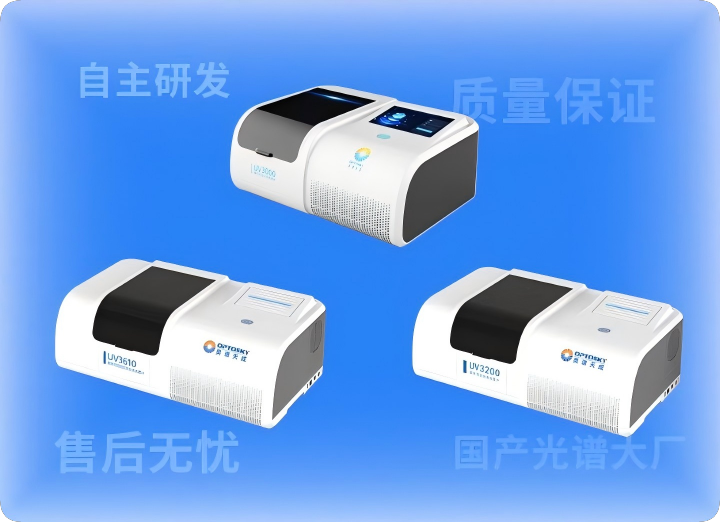
UV3000 is a brand new product carefully crafted by Optosky. It uses a UV-enhanced detector and superior optical path design to ensure the accuracy of detection results. The simultaneous proportional detection dual-beam system enables the instrument to achieve high precision and high reliability at the same time. It is equipped with a USB data output interface, which can be connected to a computer, making it easier to process data. Not only that, UV3000TP is equipped with a 10-inch high-definition large screen, which can display data and graphics without being connected, making it easier for users to view test results more quickly.
In order to solve the problem of instrument light source performance declining with the increase of service life, the flash pulse xenon lamp used in UV3000 not only does not need to be preheated, saving a lot of time, but also has excellent performance and can be maintained for a long time without replacing the light source. Reduces post-maintenance consumption. Built-in 0.5nm, 1.0nm, 2.0nm, 4.0nm and other resolution test modes can be freely selected through the software.
The novel UV spectrophotometer UV3000 is equipped with an indicator light design, which is more intelligent. Different colors of the lights represent different operating states, allowing users to intuitively grasp the operating status of the instrument and proceed to the next step.
Table 2 UV3000 product parameters
|
Model |
UV3000 |
UV3000TP |
|
Wavelength range |
180~1100nm |
|
|
Optical system |
Double beam |
|
|
Number of channels in the sample cell |
6 channels, automatic switching |
|
|
Spectral bandwidth |
Configuration 1: 0.5nm, 1.0nm, 2.0nm, 4.0nm, software can be set Configuration 2: 0. 1nm-4.0nm continuously adjustable |
|
|
Wavelength Accuracy |
±0.3nm |
|
|
Wavelength repeatability |
<0. 1nm |
|
|
Transmittance Accuracy |
±0.3% (0-100%) ±0.002% (0~0.5A) ±0.003% (0.5A~1A) |
|
|
Transmittance repeatability |
±0. 15% (0-100%) ±0.001% (0~0.5A) ±0.0015% (0.5A~1A) |
|
|
Stray light |
≤0.03% (220nm NaCl, 340nm NaNO3) |
|
|
Stability |
0.0005A/h (after preheating, 500nm) |
|
|
Metering method |
Transmittance, absorbance, concentration, energy |
|
|
Wavelength adjustment |
Auto scan |
|
|
Photometric range |
-4~4A |
|
|
Detector |
Imported low noise UV enhanced silicon photodiode |
|
|
Light source |
Imported pulse xenon lamp |
|
|
Monitor |
None |
10. 1 inch capacitive touch screen |
|
Built-in storage |
None |
32GB storage, can store 1 million spectra |
|
External Interface |
USB2.0 |
USB2.0, LAN, WIFI |
|
Power supply and power consumption |
AC110~240V, 100W |
|
|
Volume |
45.5×28.6×22.5 |
|
|
Weight |
22 kg |
22.5Kg |
Examples of UV-Visible Spectrometers in Absorbance Applications
Application of fluorescence spectrophotometry in the field of medicinal materials research
Related Article