
Application of ATH9010 in Monitoring Rice Diseases
author: Callum
2024-09-18
Rice is one of major food crops and plays a crucial role in the survival and development of people. The growth status of rice directly affects the yield and quality of rice, making the health of rice a major concern for millions of farmers. Among the various factors impacting rice growth, diseases are the most significant disturbance. The invasion of various diseases can reduce rice yield or cause widespread lodging overnight, making early monitoring and scientific control of rice diseases essential.
This study utilizes a UAV to acquire hyperspectral data for monitoring rice diseases through machine learning and deep convolutional neural networks.
Rice Field
First, hyperspectral images are preprocessed. Then, deep neural networks are used to accurately extract rice fields. Following this, spectral information and disease characteristics of the rice are analyzed. Finally, PNN (Probabilistic Neural Network) is employed to precisely monitor disease levels, providing valuable references for rice management.
Flowchart
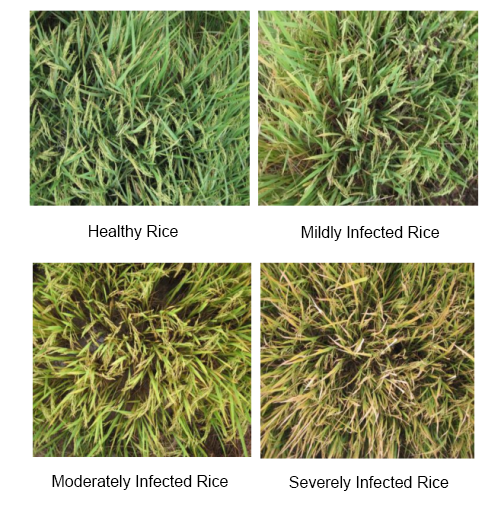
Rice disease monitoring is categorized into four levels: healthy, minor disease, moderate disease, and severe disease, based on the severity of the disease affecting the rice.
Physical Diagram of Rice Disease Levels
The process includes steps from the raw image to leaf segmentation and then to disease spot segmentation.
Lesion Segmentation
Accurate estimation of white leaf spot proportions is fundamental for assessing disease severity. Using disease severity to characterize rice bacterial leaf blight not only reduces prediction errors of spot proportions in models but also helps in developing an intelligent breeding decision mechanism by integrating disease onset times. Disease severity levels for the validation and test sets were determined based on PNN model predictions of spot proportions. The accuracy of disease severity prediction for the validation set remains higher than that for the test set, at 90.90%, with a micro F1 score of 0.90 further demonstrating the stable predictive capability of the PNN. The confusion matrix indicates that the image segmentation model tends to output results with a higher spot proportion than the actual. The accuracy for determining disease severity in the test set is 85.00%, with most misclassifications occurring in lower disease severity levels.
Predicted Lesion Ratio Results
Using Hyperspectral Imager to Identifying Frozen Meals
Hyperspectral Wavelength Extraction and Origin Identification Model for Spearmint
Related Article

Discover Optosky’s air–ground collaborative hyperspectral solution for mine ecological restoration monitoring. Combining UAV hyperspectral imaging, fixed-point rotating-scan systems, and field spectroradiometers, it supports vegetation, soil, mineral alteration, and water environment monitoring for green mine evaluation and restoration acceptance.
Applications | Hyperspectral Mine Restoration Monitoring
Compare single InGaAs and CMOS+InGaAs detector architectures in hyperspectral imaging. Learn why both can cover 400–1700 nm, how visible-light-extended InGaAs works, and the trade-offs in calibration, spectral registration, and system integration for applications in agriculture, food safety, and industrial inspection.
Technology | Single InGaAs vs. CMOS+InGaAs in Hyperspectral Imaging
Discover how hyperspectral imaging combined with multi-feature fusion (PCA + 2DCOS + CARS) enables non-destructive three-level grading of chili pepper sunburn with 97.2% accuracy. Learn about the ATH3000 system and Optosky's customized solutions for horticultural crop quality inspection and damage classification.
Can Sunburned Chili Peppers Be Non-Destructively Graded? Hyperspectral Imaging ATH3000 Offers a New Answer
Discover the Optosky ATH9600 multi-lens UAV-borne multispectral imaging system—featuring 67° ultra-wide FOV, synchronous snapshot, 3.75 μm large pixel, and native DJI X-Port integration. Ideal for large-area farmland monitoring, orchard management, pest early warning, water quality inversion, and complex crop classification. Born for efficient, all-weather low-altitude remote sensing.
Born for Large-Area Remote Sensing! Optosky Releases the ATH9600 Multi-Lens UAV-Borne Multispectral Imaging System