
How Much Does a Hyperspectral Imaging System Cost? A Practical Guide
author: Peggy
2026-09-16
Understanding the Cost Structure of Hyperspectral Imaging Systems
One of the first questions potential buyers ask is deceptively simple: “How much does a hyperspectral imaging system cost?” The answer is rarely a single number. Unlike a conventional camera, a hyperspectral imaging system is a complete measurement platform that includes the spectral sensor, imaging optics, data acquisition hardware, calibration components, and often specialized software.
For someone evaluating hyperspectral technology for the first time, it helps to think of the cost in terms of three layers: the core sensor module, the integrated system, and the application-specific solution. Each layer adds capability—and cost.
What Determines the Price of a Hyperspectral Camera?
The price of a hyperspectral camera varies widely depending on several technical factors. The spectral range is one of the most significant drivers. Visible-to-near-infrared (VNIR) systems, typically covering 400–1000 nm, use silicon-based detectors that benefit from mature supply chains and relatively lower component costs. Shortwave infrared (SWIR) systems, covering 900–1700 nm or beyond, require indium gallium arsenide detectors, which are more expensive and often require cooling for stable performance.
Spectral resolution is another key variable. A system with a spectral resolution better than 2 nm provides much finer discrimination between materials, but achieving this requires more precise optical design and higher-performance detectors. The imaging method—push-broom, snapshot, or rotating scanning—also affects cost and suitability. Push-broom imagers are widely used for drone and field applications, while snapshot systems can capture full spectral cubes in a single exposure, offering advantages for dynamic scenes.
Market Positioning: From Entry-Level to High-Performance
Based on current market offerings, hyperspectral imaging systems can be roughly categorized into three tiers. Entry-level systems, often designed for teaching, basic research, or simple agricultural trials, typically cover the VNIR range with moderate spectral resolution.
Mid-range industrial and research-grade systems offer better signal-to-noise ratio, faster acquisition, and broader spectral options. These are suitable for continuous industrial inspection, larger-scale scientific projects, and more demanding field applications.
High-performance airborne and SWIR systems, designed for drone deployment or advanced material analysis across extended spectral ranges, sit at the top of the range. At this level, users are paying for lightweight integration, real-time data processing, and the ability to operate in challenging environments.
How Optosky Addresses Cost and Performance
Optosky’s product line reflects a deliberate approach to balancing performance with practical cost. The ATH1500-04-17 VIS-NIR hyperspectral camera covers 400–1700 nm with a spectral resolution better than 2 nm, using a high-performance thermoelectrically cooled CCD detector. It is designed for lab, field, and industrial applications including food safety, agricultural analysis, and mineral prospecting.
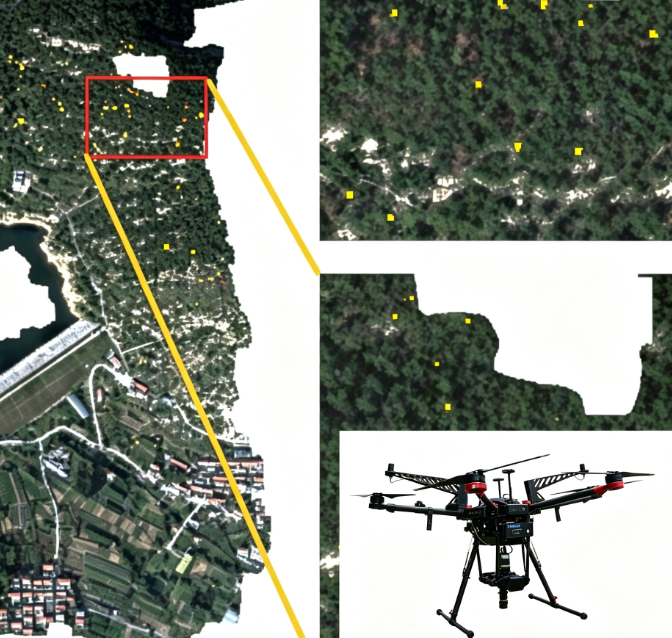
For drone-based remote sensing, the ATH9030 UAV hyperspectral imaging system offers a lightweight integrated design with real-time spectral image viewing and inversion preview on the remote controller. It includes a downwelling light sensor for illumination correction and supports optional thermal and LiDAR expansion.
For applications requiring broad spectral coverage in a compact form, the ATH3100 rotating scanning hyperspectral imager provides models spanning 370–1000 nm, 900–1700 nm, and 1200–2500 nm, with spectral resolution as fine as 1.3 nm in the visible range.
Beyond the Hardware: The Hidden Costs of Ownership
When budgeting for a hyperspectral system, it is important to account for factors beyond the sensor itself. Calibration and validation are essential for reliable data, and while some systems include built-in calibration features, others require additional reference panels or procedures. Data processing software can be a significant cost component; Optosky provides application-focused software and SDK options, but the level of analysis capability needed varies by use case.
Integration costs should also be considered. A system destined for a drone requires lightweight mounting hardware and power management. A system for industrial sorting needs robust interfacing with production line control systems. These application-specific requirements can add substantially to the total cost of ownership.
Making a Cost-Effective Choice
The most cost-effective hyperspectral system is not necessarily the cheapest one—it is the one that matches your application requirements without unnecessary over-specification. For agricultural monitoring of crop health and nutrient status, a VNIR system with moderate spectral resolution may be entirely sufficient. For mineral identification or plastic sorting, the additional spectral information available in the SWIR range may be essential.
Optosky’s range of systems allows users to select a configuration that fits their spectral range, resolution, and deployment needs. By understanding what drives cost and what capabilities matter for your specific application, you can make an informed investment that delivers reliable data without exceeding your budget.
Example of HSI Applications and Optosky Solutions
Test Case | Hyperspectral ATH1010/ATH8100 Series Ore Testing
Related Article

Explore practical examples of hyperspectral imaging in agriculture, environmental monitoring, and industrial inspection. See how Optosky’s hyperspectral cameras deliver actionable results across industries.
Example of HSI Applications and Optosky Solutions

Explore how hyperspectral imaging with Optosky’s ATH1010/ATH8100 series enables rapid, non‑destructive ore identification, grade classification, and impurity removal. Using continuous spectral data and machine learning, the system distinguishes minerals even with similar colours – driving intelligent, automated sorting for iron, copper, lithium, and other mineral resources.
Test Case | Hyperspectral ATH1010/ATH8100 Series Ore Testing
Discover how UAV‑based hyperspectral imaging and deep learning can monitor SDI, TOC, and TEP – key membrane fouling indicators for seawater desalination during harmful algal blooms. Based on a recent Water Research study, this article explores how Optosky's ATH9010 enables spatial risk mapping and proactive intake management.
Applications | ATH9010 Enables Water Quality and Membrane Fouling Monitoring for Desalination During Algal Blooms
Choosing between 785 nm and 1064 nm for Raman? This guide explains the physics of fluorescence, compares signal strength and fluorescence suppression, and provides a step‑by‑step decision tree. Real‑world drug detection and pesticide examples show why wavelength matters – and how dual‑wavelength coverage offers the ultimate solution.
785 nm or 1064 nm? Fluorescence Is the Dividing Line