
Overview of hyperspectral imaging technology
author: Gavin
2021-11-23
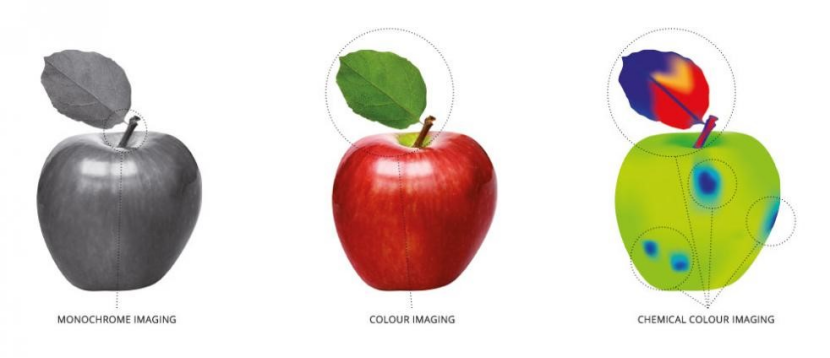
Spectral imaging is a rapidly growing inspection method for industries benefiting from machine vision solutions. It provides valuable information by identifying materials based on their chemical properties, not available with other camera technologies. Objects with similar looks but different chemical compositions can be reliably identified and sorted with a hyperspectral camera. This makes spectral imaging the most powerful inspection method in many applications with high commercial value.
Hyperspectral imaging expands traditional optical spectroscopy from instruments measuring a single spot at a time to a rapid analysis of non-homogeneous samples and targets. Single-camera operating in a specific wavelength range can be used for various applications like in food research to measure fat, moisture, or protein distribution, or in geology to map the distribution of different minerals on a geological site. The same camera can also be applied in various environments: in laboratories, field, industrial pilot lines, and airborne. With the newest mobile, handheld cameras, the researcher can easily take it to the samples without the need to bring the samples to a lab system.
Hyperspectral imaging is used increasingly in many research areas, such as life sciences, vegetation research, precision agriculture, forensics, food and feed analysis, mineral exploration, and for developing new recycling research methods. In each application area, a spectral camera is used to identify, measure, and map the biological, chemical, and physical properties of the objects.
Analysis of Hyperspectral Imagery for Oil Spill Detection
UV imaging spectrometer is a potential research tool in plant science, entomology and ornithology
Related Article

Discover Optosky’s air–ground collaborative hyperspectral solution for mine ecological restoration monitoring. Combining UAV hyperspectral imaging, fixed-point rotating-scan systems, and field spectroradiometers, it supports vegetation, soil, mineral alteration, and water environment monitoring for green mine evaluation and restoration acceptance.
Applications | Hyperspectral Mine Restoration Monitoring
Compare single InGaAs and CMOS+InGaAs detector architectures in hyperspectral imaging. Learn why both can cover 400–1700 nm, how visible-light-extended InGaAs works, and the trade-offs in calibration, spectral registration, and system integration for applications in agriculture, food safety, and industrial inspection.
Technology | Single InGaAs vs. CMOS+InGaAs in Hyperspectral Imaging
Discover how hyperspectral imaging combined with multi-feature fusion (PCA + 2DCOS + CARS) enables non-destructive three-level grading of chili pepper sunburn with 97.2% accuracy. Learn about the ATH3000 system and Optosky's customized solutions for horticultural crop quality inspection and damage classification.
Can Sunburned Chili Peppers Be Non-Destructively Graded? Hyperspectral Imaging ATH3000 Offers a New Answer
Discover the Optosky ATH9600 multi-lens UAV-borne multispectral imaging system—featuring 67° ultra-wide FOV, synchronous snapshot, 3.75 μm large pixel, and native DJI X-Port integration. Ideal for large-area farmland monitoring, orchard management, pest early warning, water quality inversion, and complex crop classification. Born for efficient, all-weather low-altitude remote sensing.
Born for Large-Area Remote Sensing! Optosky Releases the ATH9600 Multi-Lens UAV-Borne Multispectral Imaging System